

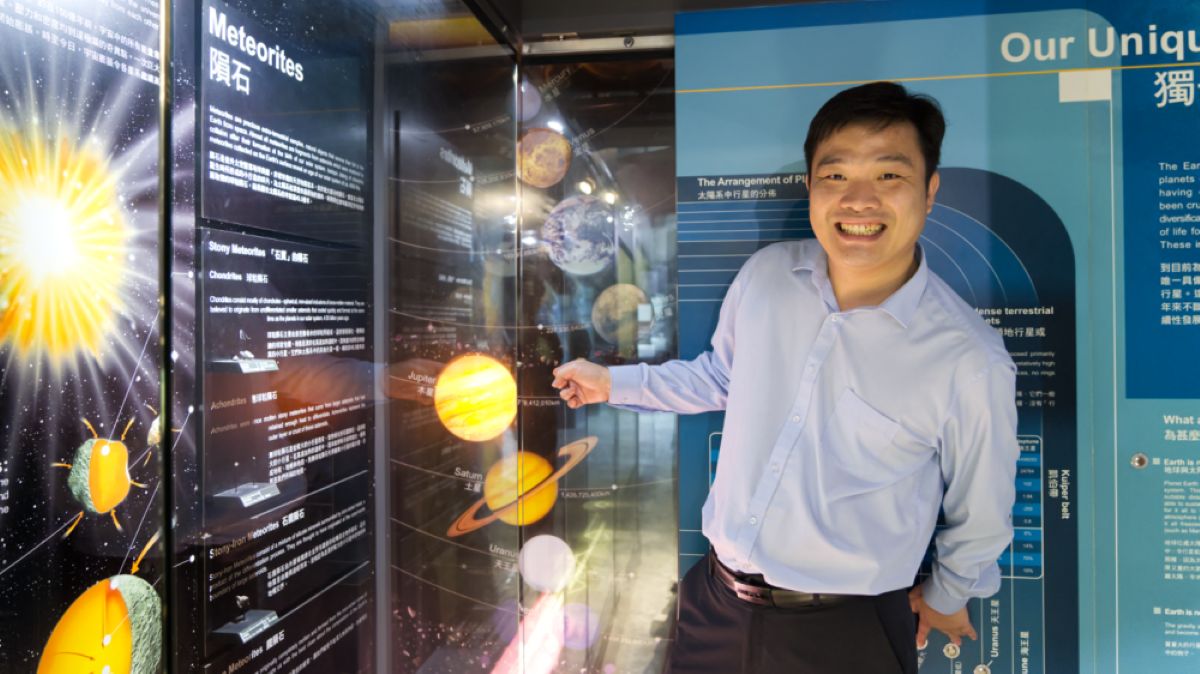
Zhonghua Yao, director of the University of Hong Kong’s Laboratory for Space Research (LSR), has been elected to the 11th Council of the Chinese Society of Space Research (CSSR), a role he hopes will help bring HKU’s planetary-science expertise into closer conversation with future national missions.
For Yao, the appointment arrives at a crucial moment for HKU and its home city, offering a great opportunity in what he calls “the second space boom”.
“The coming second space boom will be fundamentally different from the first: it will be initiated by humanity as a whole, with countries exploring together within a framework of cooperation,” he said, following his election to the CSSR, a national academic society, on Sunday.
Yao said he would use the position to promote HKU’s participation in future national space missions and to strengthen the LSR’s research and development capability.
The LSR director’s work offers a glimpse of the science HKU hopes to contribute. He studies the space environments of Earth and the giant planets, including magnetic reconnection, planetary aurorae and the systems of charged particles that surround them.
RELATED ARTICLES
- Tiangong class inspires Hong Kong, Macao students
- 'Sky is the limit' takes on new meaning for Hong Kong, Macao youth
- HKU geologists become HK's first to analyze lunar samples
- 15th Five-Year Plan a heavenly opportunity for HK’s space ventures
Earlier this year, an HKU-led team using NASA’s Cassini spacecraft data reported that Saturn’s magnetic “cusp” regions are commonly shifted towards the afternoon side, unlike Earth’s more symmetrical pattern. The study linked the difference to Saturn’s rapid rotation and electrically charged material released by its moons.
Such comparative research has been a thread throughout Yao’s career. The European Geosciences Union awarded him its 2018 Arne Richter Award for Outstanding Early Career Scientists, citing his work on how energy is transferred and dissipated in planets across the solar system and his contribution to comparative planetary science.
Earlier this year, he received the Young Scientists Fund (Type A) — formerly the National Science Fund for Distinguished Young Scholars — becoming the first space scientist in Hong Kong to receive this honor.
While the 2025 Policy Address announced that an aerospace-technology special call had allocated more than HK$100 million ($12.75 million) to six university research-and-development projects, this year’s Policy Address has decreed a new round, focused on research connected to national space missions, including satellite technologies, exploration instruments, aerospace materials and remote sensing.
The opportunity is also visible in HKU’s alumni community. Lai Ka-ying, who holds BSc, MPhil and PhD degrees from HKU, is the first payload specialist from the SAR and a member of the three-person Shenzhou XXIII crew.
On Sept 9, the crew’s “Tiangong Class” from China’s space station was streamed to a campus gathering at Sun Yat-sen Place (Happy Park), where students and staff followed in-orbit demonstrations, expert analysis and a question-and-answer session with the crew. The mission is carrying out more than 100 science and applications projects in life sciences, materials science, fluid physics and medicine.
Yao also attended the event as one of three local space experts, delivering an on-site lecture to share insights on the country’s Jupiter space program and the opportunities for the Hong Kong Special Administrative Region.
Hong Kong’s institutional position can add something distinctive to that national effort, Yao said. In the same opinion statement, he wrote that the SAR’s advantage under the ‘one country, two systems’ framework enables it to serve as a superconnector for aerospace cooperation and academic exchange between China and other countries.
