

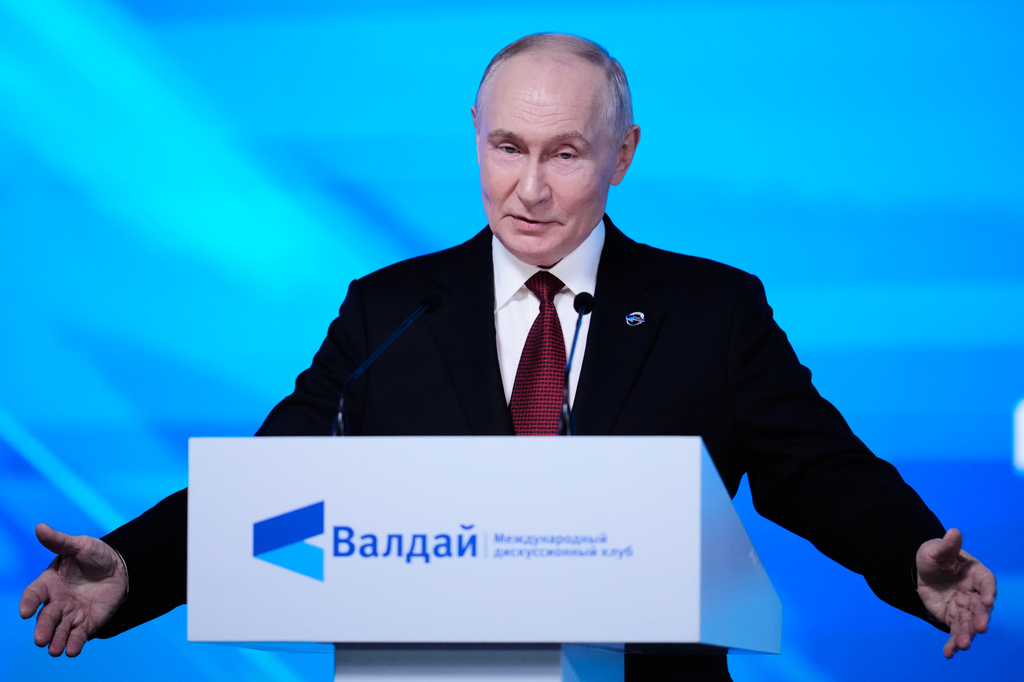
MOSCOW - Russian President Vladimir Putin said Thursday that bloc confrontation and the West's pursuit of unilateral security advantages lie at the heart of the current global security crisis.
Speaking at the plenary session of the 23rd annual meeting of the Valdai Discussion Club, he warned that rhetoric seeking a "strategic defeat" of Russia carries severe risks of pushing the conflict into its most brutal phase.
Putin said the West had for years nurtured aggressive nationalism and Russophobia in Ukraine, seeking to turn the country into a geopolitical instrument against Russia. Moscow's actions were a response to tangible threats to its own security, he said.
The path out of conflict lies not in defeating one side, but in mutual compromise and a restored stable balance of forces, he said, adding that Europe must abandon bloc thinking and return to the principle of equal and indivisible security.
On world order, Putin stated the old unipolar system is collapsing and the world is becoming multipolar. Western nations must adapt to this reality and cooperate while respecting the core interests of most countries, he said.
He added that international relations require adherence not merely to written law, but also the spirit of law, established customs and moral restraints. Systematic breach of obligations and the transformation of diplomatic dialogue into propaganda erode the foundations of coexistence between states, he said.
New 'iron curtain'
He also accused Western nations of erecting a new "iron curtain" in global relations, stressing that such isolationist policies are doomed to failure.
Contrary to Western accusations, Russia has no intention of creating divides in the international community, said Putin.
He pointed out that Western countries have imposed thousands of sanctions on Russia, barred diplomatic engagements with Russian representatives, and sought to isolate Russia from international organizations.
Noting the historical lessons of the Cold War, Putin stated that the Soviet Union's attempt to build an iron curtain ended in total failure. He added that any modern attempt to impose such ideological and geopolitical barriers is unrealistic and will inevitably collapse amid current global dynamics.
Founded in 2004, the Valdai Discussion Club held annual forum this year in Moscow under the theme: "Responsibility for the Future: Limits of the Possible, or Limitless Possibilities?" It gathered around 120 delegates from 40 countries and regions.
Kaliningrad's security
Separately, Kremlin spokesman Dmitry Peskov said on Thursday that Russia will undoubtedly ensure the security of the Kaliningrad region.
"Kaliningrad is an integral part of Russia. It is our highly important westernmost region. Essentially, the point is that Russia will undoubtedly ensure the security of this region under its national legislation," Peskov told reporters.
ALSO READ: Lavrov: Russia ready for Ukraine talks, but firm on NATO
On Monday, the Russian Embassy in Belgium said Russia had warned the North Atlantic Treaty Organization (NATO) and the Belgian Foreign Ministry that the alliance's hostile actions near the Kaliningrad region were increasing the risk of a direct armed clash, entitling Russia to deploy any weapons at its disposal for defensive purposes.
Russia expels Hungarian diplomats
The Russian Foreign Ministry summoned Hungary's Charge d'Affaires to Russia Gabor Gergics on Thursday to inform him of retaliatory measures in connection with Hungary expelling a group of Russian diplomats on Sept. 8.
"A group of staff members of the Hungarian Embassy in Moscow and the Hungarian Consulates General in St. Petersburg and Kazan must leave the territory of the Russian Federation within two weeks," said the ministry.
On Sept. 8, Hungarian Foreign Minister Anita Orban announced that the country was expelling 10 staff members of the Russian Embassy in Budapest due to their activities, which were incompatible with their diplomatic status.
