

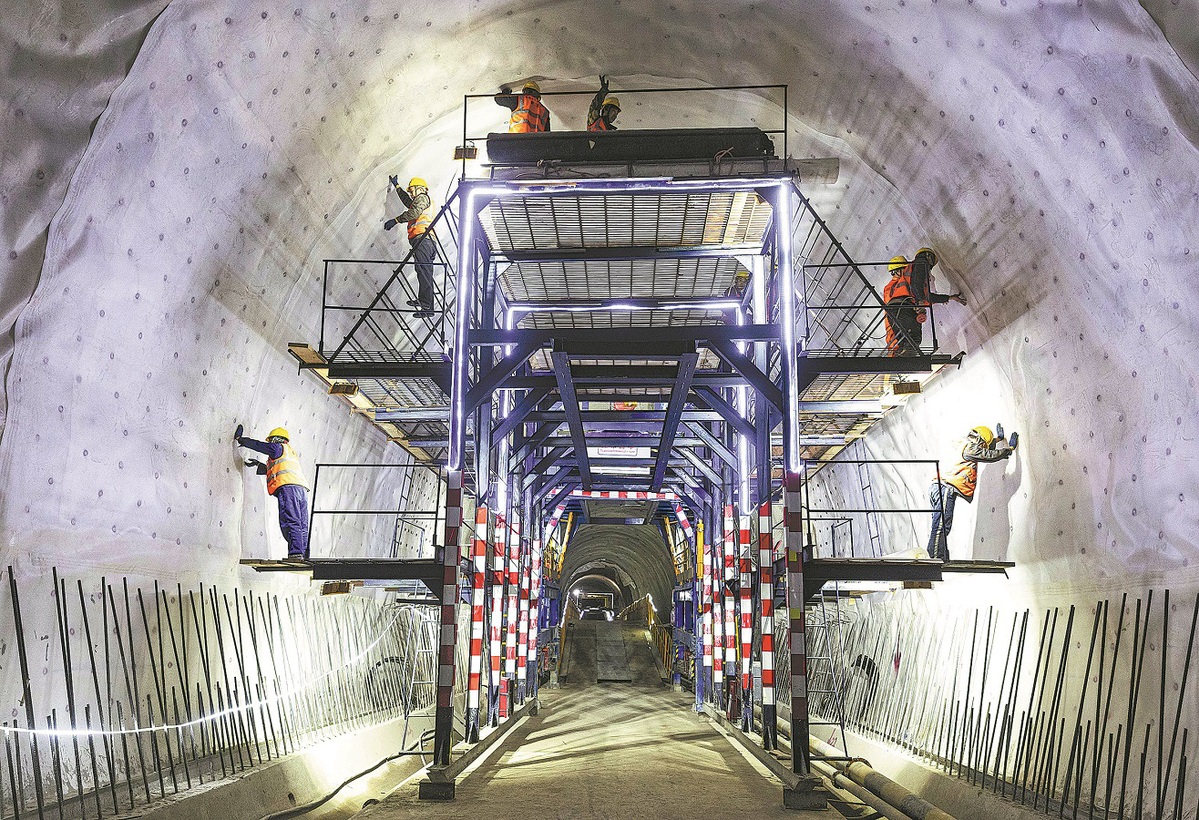
Summer marked a massive acceleration in cross-border connectivity between China and Kyrgyzstan, as new flight routes, land port expansions and high-altitude rail tunnels began converging into a seamless trade corridor.
What began as routine transit upgrades has rapidly evolved into a multimodal overhaul of how goods and people move between China and Central Asia.
In the air, direct flights have greatly increased in capacity. Air China launched direct flights between Beijing and the Kyrgyz capital Bishkek on July 17, operating three round trips a week. Less than three weeks later, Kyrgyz carrier Aero Nomad began flying between Bishkek and Urumqi, capital of Northwest China's Xinjiang Uygur autonomous region, adding another carrier to the air link between the two countries.
Xinjiang has three air routes connecting Urumqi and Kashgar with Bishkek and Osh, offering eight round trips a week, according to Xinjiang airport authorities.
Zhalyn Brimkulov, director of operations and production at Airports of Kyrgyzstan, said the latest Beijing-Bishkek service would give passengers "more flexible and convenient travel options", Xinhua News Agency reported.
On the ground, construction is underway on the China-Kyrgyzstan-Uzbekistan Railway, a project discussed for nearly three decades that will give Kyrgyzstan a direct rail connection with China and provide another transport route between China and Central Asia.
China, Kyrgyzstan and Uzbekistan signed an intergovernmental agreement on the railway in Beijing in June 2024, which was followed by a launch ceremony in Kyrgyzstan in December that year.
The railway starts in Kashgar, crosses Kyrgyzstan and enters Uzbekistan. The Kyrgyz section is designed as a single-track railway with a speed of 120 kilometers per hour, with provisions for future electrification, according to information released by Chinese authorities.
Construction entered a substantive phase in April 2025 when work began on three major tunnels on the Kyrgyz section — the Fergana Mountain, Naryn No 1 and Koshtobe tunnels. Each is more than 10 km long and crosses terrain marked by high altitude, low temperatures and complex geological conditions, according to information published by China's State Council Information Office.
Ulan Kulov, a Kyrgyz railway professional involved in the preparations for the project, said he hoped the railway would "bring development to communities along the route and make travel easier for local residents", according to People's Daily.
ALSO READ: China major strategic partner for Kyrgyzstan, says Kyrgyz foreign minister
Biedieli Port began temporary operations in September 2024, becoming the third land port between China and Kyrgyzstan after Irkeshtam and Torugart. Supporting road and port facilities are being developed as the two sides work to improve cross-border transport capacity.
At Irkeshtam, one of the main road gateways linking southern Xinjiang with Kyrgyzstan, trial round-the-clock cargo clearance began in June 2025, allowing freight vehicles to cross throughout the day and night.
The transit expansion reflects intensifying trade connectivity. Commerce Ministry data show bilateral trade between China and Central Asia hit a record $106.3 billion last year, a 12 percent jump year-over-year. Road transport accounted for 51.8 percent of China's trade with the five Central Asian countries in 2024, up from 19.9 percent in 2020, according to the General Administration of Customs of China.
