

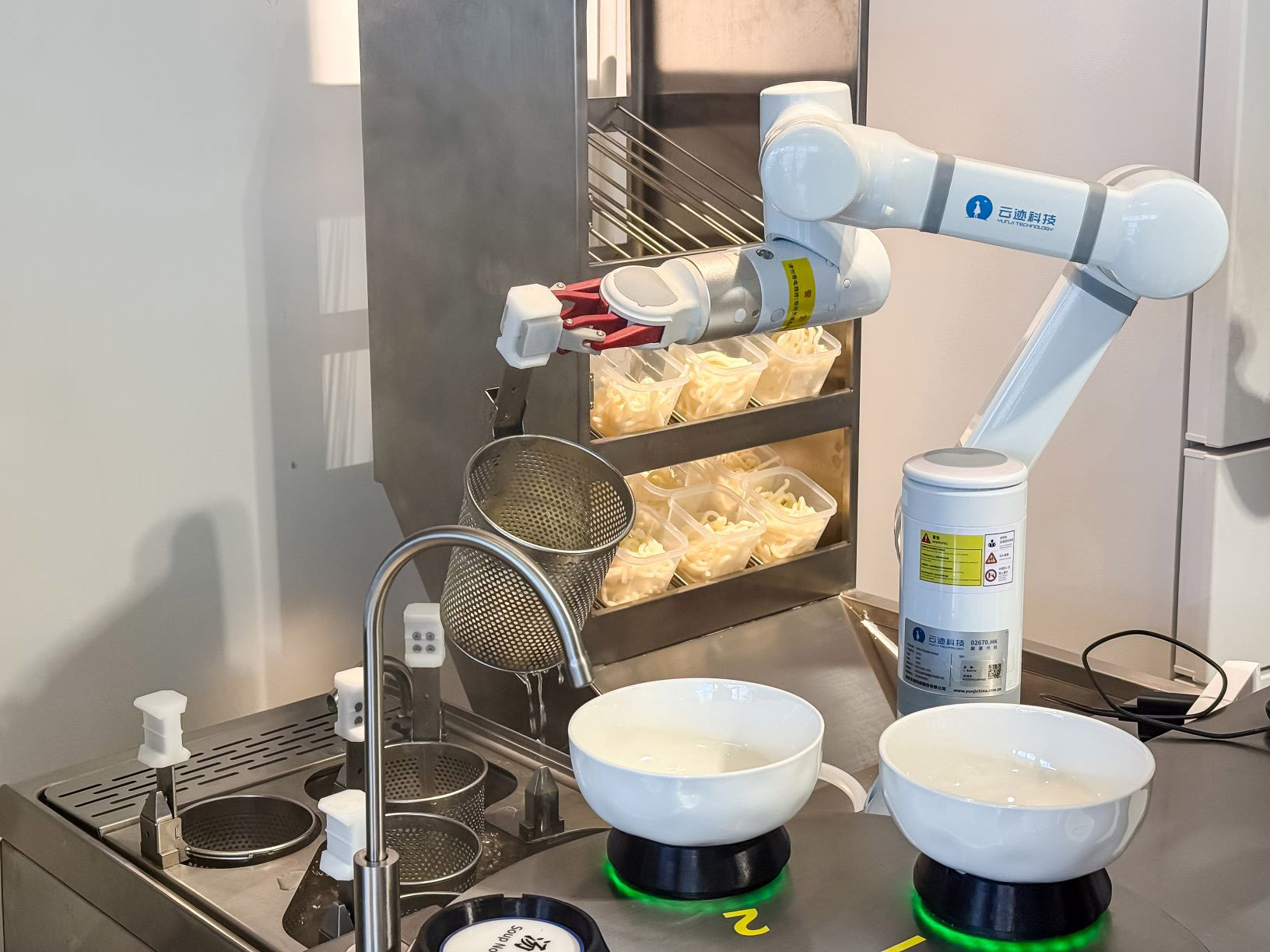
With Hong Kong's abundant internationally connected services sector enterprises, research and development capabilities, and financial advantages, the special administrative region is becoming a testing ground for robotics companies seeking to take embodied artificial intelligence into overseas markets.
"Hong Kong was chosen as our first overseas stop because reference cases tested here travel well to Southeast Asia, Japan and the Middle East, where some service patterns and consumer habits mirror those in Hong Kong," said Xie Yunpeng, chief development officer of Yunji Technology.
Founded in 2014, the Beijing-based service robot manufacturer established its international business headquarters in Hong Kong in October 2024 and was listed on the main board there a year later.
READ MORE: Tech firm releases new humanoid robot, eyeing HK’s promotion role
Now used in Hong Kong hotels, senior living facilities, hospitals and factories, the company's Hong Kong presence combines R&D, market development and support for overseas operations, including a joint innovation lab built by the company and Hong Kong Polytechnic University to push forward intelligent practices for hotel services.
"A robot making reliable deliveries along a hotel corridor may draw on a Beijing company's engineering capabilities, Hong Kong academics' strengths in hotel management research, and the city's international services-sector environment," Xie said.
The city's financial sector can also support continued research and wider deployment, Xie said, adding that the company hopes to build ties with regional conglomerates and family-run offices.
Government support is reinforcing that role. The Hong Kong SAR government's 2026-27 Budget published in February includes embodied AI for the first time, and outlines measures to guide market capital into AI, robotics and other strategic cutting-edge technological fields.
At the first Hong Kong Embodied AI Industry Summit in May, Hong Kong SAR Chief Executive John Lee Ka-chiu said Hong Kong will establish a committee on AI+ and industry development strategy to formulate policies for driving industrial transformation through AI, with an initial focus on life and health technology and embodied intelligence.
Embodied AI companies on the Chinese mainland are backing that interest with concrete plans. Shanghai-based AGIBOT said in May it would establish an international R&D headquarters in Hong Kong and, over five years, work with the HKSAR government to set up several joint industry-research laboratories, nurture dozens of start-ups and develop hundreds of industry partners. Shenzhen, Guangdong province-based Pudu Robotics is establishing R&D, operations and production centers in the city, while Beijing-based Galbot has also pledged to build a local team, co-found an international embodied-AI talent exchange center with Hong Kong universities, and test its robots in commercial, tourism and other service sector environments.
That strategy is beginning to show up in the companies' accounts. Yunji's latest interim results put first-half overseas revenue at 5.4 million yuan ($803,220), surging 638.1 percent year-on-year, although it still accounted for only 2.8 percent of group revenue.
Yunji attributed the increase to deliveries to new customers and wider channel coverage. As projects reached more customers and service environments, its business abroad has moved from early validation toward more consistent product delivery, the company said.
ALSO READ: HK agri-tech projects eye overseas market
What robots are asked to do also changes from one market to another, Xie said. Dense delivery networks on the Chinese mainland generate a large number of food orders, while higher costs and thinner logistics networks overseas shift hotel robots toward guests' needs during their stays, such as bringing slippers or toiletries, he said.
"For overseas resorts offering children's souvenirs, specialty foods, medicines and translation-device rentals, robots can handle final deliveries 24/7," Xie said, adding that Yunji has linked its robots with retail outlets, allowing them to receive an order, collect the item and deliver it without human staff intervention.
"Imagine if one wants an iced coffee in the middle of the night, the front desk may no longer be staffed, but a robot can get it ready with one click and bring it straight to the room," Xie said. "That's where hotels eye the robots for higher non-room revenue."
