

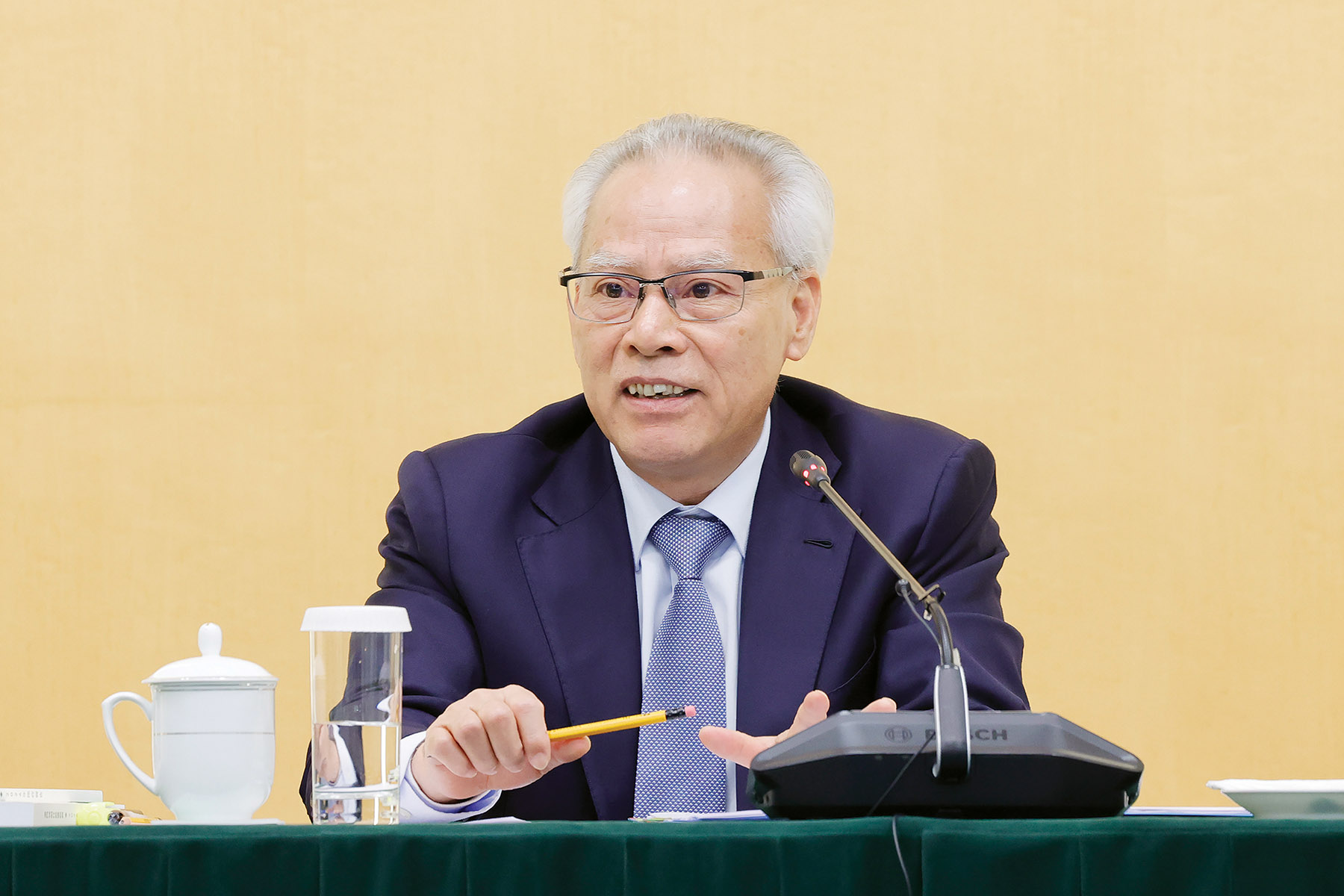
Sam Hou Fai, Chief Executive of the Macao Special Administrative Region
Editor’s note: The Macao Special Administrative Region is in the process of formulating its Third Five-Year Plan for Economic and Social Development (2026–2030), in alignment with the country’s 15th Five-Year Plan.
In a signed article, Chief Executive Sam Hou Fai outlines key priorities for this period, including economic diversification, regional integration, and building a smarter, more vibrant city. The following is an abridged version:
“A shining pearl on the coast of the South China Sea and a treasured place of the great motherland” is a heartfelt description of Macao by President Xi Jinping. Since its return to the motherland, Macao has, under the firm leadership of the central authorities, forged a development path suited to its own realities and characteristics, making it a widely recognised example for the international community of the successful practising of the “one country, two systems” principle.
From a new and historic starting point, the Macao Special Administrative Region (MSAR) is proactively aligning itself with the country’s 15th Five-Year Plan by scientifically formulating the Third Five-Year Plan for Economic and Social Development of the MSAR (2026–2030), striving to realise the cherished vision of “Law-based Macao”, “Vibrant Macao”, “Cultural Macao”, and “Blissful Macao” — important missions for the MSAR in the new era.
We hope that friends at home and abroad will visit Macao to experience its unique charm and convergence of Chinese and Western cultures, while jointly exploring the opportunities arising from the MSAR’s future development.
I. Focusing on key areas: advancing appropriate economic diversification through four major projects and a government guidance fund
Over the next five years, the MSAR Government will continue its efforts to promote appropriate economic diversification, leveraging Macao’s strengths and resource endowment to focus on key areas. The MSAR Government will strengthen policy support and financial investment, make better use of market forces and the initiative of enterprises, and enhance its own role in guiding market expectations and providing institutional and policy support. Through four major infrastructure projects and a government guidance fund, the MSAR Government aims to advance the “1+4” strategy for industrial diversification and increase the contribution of the gross value added (GVA) of non-gaming sectors to Macao’s gross domestic product (GDP) to around 60 percent by 2030.
Macao will make substantial and tangible investments in appropriate economic diversification. Preliminary estimates indicate that total budgeted investment in major economic diversification projects during the period covered by the MSAR’s Third Five-Year Plan will reach approximately 130 billion patacas ($16.1 billion).
Macao will focus on its four major infrastructure projects as strategic drivers to accelerate appropriate economic diversification:
— Accelerating the construction of the Macao-Hengqin International Education (University) Town. Leveraging the synergistic strengths of Macao and Hengqin, Macao will provide support to enable a greater number of qualified public and private higher education institutions in the MSAR to extend their operations to Hengqin, expanding the development space for Macao’s higher education. The first phase will commence operations in August 2026. The University of Macau’s campus in the Cooperation Zone in Hengqin will begin trial operations in 2028 and be fully completed and put into operation in 2029. The main construction of the Cooperation Zone facilities for Macao Polytechnic University and Macao University of Tourism will be basically completed by 2030. Through internationalised talent development, scientific research, and technological exchange, Macao aims to attract high-quality academic and research resources, and gradually form a cluster effect in higher education, providing a new pillar for Macao’s appropriate economic diversification.
— Advancing the high-standard construction of the Macao Technology Research Industrial Park. Focusing on four key sectors — digital technology, biomedicine, integrated circuits, and aerospace technology — Macao will cultivate promising sub-sectors such as artificial intelligence, innovative pharmaceuticals, RISC-V (Reduced Instruction Set Computing — fifth generation) open-source architecture, and aerospace data services. Specialised industrial support policies will be formulated, in conjunction with the government guidance fund, to attract high-quality technology enterprises and research institutions. In 2026, the overall design and planning for the Macao Technology Research Industrial Park will be completed. Meanwhile, construction of the Macao International Technology Industry Centre — a pilot platform for the Industrial Park — will also be completed and the facility will be brought into operation. By 2030, the first construction project of the Industrial Park will be completed and operational. Through the Industry Centre, it aims to attract a first batch of at least 20 technology enterprises as pioneer tenants.
— Progressing with the Macao International Integrated Tourism and Cultural Zone project. Drawing on Macao’s advantages of unique blend of Chinese and Western cultures and the MSAR’s role as “One Centre” and “One Base”, new cultural tourism landmarks combining sightseeing with immersive experiences will be developed, injecting fresh vitality into Macao’s cultural and tourism markets. Construction of the Macao National Museum of Culture will proceed in two phases. Phase one, comprising exhibition facilities, is expected to be substantially completed by 2029, while planning for phase two will proceed concurrently. In 2027, planning will commence for the International Performing Arts Centre and the International Museum of Contemporary Art, with the aim of completing the architectural designs and launching tendering procedures for both venues by 2030.
— Advancing the construction of the Macau International Airport Hengqin Upstream Cargo Terminal. In tandem with the development of an international air transport hub (port) on the west bank of the Pearl River, Macao will advance the land reclamation work for Macau International Airport, as well as the construction of the Macau International Airport Hengqin Upstream Cargo Terminal. The relocation of security-screening and cargo-loading functions to the Cooperation Zone in Hengqin and the upgrade of airport freight facilities aim to enhance the efficiency and capacity of Macao’s air cargo operations. It is expected that the Hengqin Upstream Cargo Terminal will enter trial operation in August 2026 and commence full operations in the first half of 2027, with a target annual handling capacity of 300,000 tonnes, thereby strengthening Macao’s competitiveness in air freight.
During the period of the MSAR’s Third Five-Year Plan, Macao will further strengthen its integrated tourism and leisure sector, actively attract more international visitors, and consolidate its position as a world centre of tourism and leisure. Macao will strive to build a globally competitive and distinctive biomedicine and “Big Health” industry. Macao will accelerate the development of specialised financial services such as bond markets, investment funds, and green finance, and advance the China-Portuguese-speaking countries financial services platform. Deeply integrating into the national innovation system, Macao will develop high-tech industries suited to the MSAR’s strengths. Macao will also enhance the competitiveness of its MICE (meetings, incentives, conferences and exhibitions) and commerce sectors, and promote sustained growth in culture and sports.
II. Deepening Macao-Hengqin integration and advancing high-quality development of the cooperation zone in Hengqin
The MSAR Government will leverage science, technology, and education to deepen Macao-Hengqin integration, promote high-level economic synergies, enhance alignment of rules and mechanisms, and ensure an efficient cross-boundary flow of resources. By 2030, Macao aims to reach a combined value added of tourism, cultural activities, MICE, commerce, traditional Chinese medicine (TCM) and other health services, specialised finance, technology research, and advanced manufacturing to account for 65 percent or more of the GDP in the Cooperation Zone in Hengqin, thereby making further progress in Macao’s appropriate economic diversification.
Strengthening “Macao + Hengqin” integrated development. Aligned with the new positioning of “Macao + Hengqin”, Macao will push forward efforts to refine the Guangdong-Macao mechanism of “mutual discussion, joint construction, joint administration and shared benefits”. Macao will deepen institutional connectivity in rules and systems, aligning Macao-Hengqin mechanisms with high international standards, and creating a legal environment in Hengqin similar to that of the MSAR. Macao will actively explore more open and convenient “tier-specific” management models for the Cooperation Zone in Hengqin. Macao will enhance physical connectivity through the Light Rapid Transit network and other infrastructure projects, while developing landmark projects and industrial spaces. Examples include: the Macao-Hengqin International Education (University) Town; the Macau International Airport Hengqin Upstream Cargo Terminal; the China-Portuguese (Spanish) Speaking Countries Economic and Trade Service Centre; and the Hengqin-Macao Innovation Industrial Park.
Enhancing Macao-Hengqin industrial synergy. Macao and Hengqin will jointly develop as a world-class tourism and resort destination. The “Multi-Venue Event” model will be normalised. Macao will support the establishment of a “Macao-Hengqin joint micro-drama production and export base”. A cross-boundary e-commerce hub will be jointly built to facilitate the efficient entry of Macao and Portuguese-speaking countries’ products into the Chinese mainland market.
Innovating the traditional Chinese medicine (TCM) and “Big Health” industrial chain. Macao will promote the “Macao Registration + Hengqin Production + Overseas Sales” model for TCM products, gradually extending it to synthetic chemical medicines, biologics, and medical devices, with a view actively to attract renowned domestic and international enterprises. Enterprises will be encouraged to make good use of the Macao Sub-center platform of the University Regional Traditional Chinese Medicine Technology Transfer and Translation Center (Guangdong-Hong Kong-Macao Greater Bay Area) to research, develop and incubate Macao-branded TCM products. Focusing on wellness and health-preservation, Macao will develop high-end health management and medical tourism services.
Jointly building a new landscape for Macao-Hengqin cross-boundary finance. Macao will continue promoting participation in a pilot scheme for electronic fence or multifunctional free trade accounts (EF Accounts). Macao will support asset management institutions in the Cooperation Zone in Hengqin to establish operations in Macao and make full use of the Qualified Foreign Limited Partner (QFLP) mechanism to channel Macao and overseas capital into the Chinese-mainland fund markets.
Jointly cultivating high-tech industries. Leveraging platforms such as State Key Laboratories, Macao will build integrated “research-to-investment” incubation platforms to foster a sci-tech innovation ecosystem under the model of “Macao R&D, Hengqin Transformation”. Macao will advance the Macao-Hengqin joint research funding scheme and expand the cooperation model of “Hengqin posing the challenges, Macao providing the sci-tech solutions”, supporting the transformation of research projects in the Cooperation Zone in Hengqin.
Hengqin connects Macao’s international resources with the vast Chinese mainland market, benefiting from special policies such as a tiered customs management system, “double 15-percent” tax incentives, and exemption from corporate income tax on new outbound direct investment. The Cooperation Zone in Hengqin is becoming a hub of openness and a hotbed for investment.
III. Accelerating urban renewal, building a beautiful, smart Macao
During the period of the MSAR’s Third Five-Year Plan, the MSAR Government will take urban renewal as a key lever in order to comprehensively advance the construction of a beautiful and smart Macao. Under the premise of maintaining overall social stability, Macao will adopt bold thinking and decisive action to accelerate the urban renewal process.
1. Strengthen overall coordination and planning, and define urban renewal objectives. The MSAR Government will enhance top-level design, implement systematic and phased measures — starting with simpler tasks before tackling more complex ones. Macao will explore a comprehensive urban renewal model featuring “government guidance, market-based operations, district-specific strategies, integrated utilisation, and a combination of redevelopment, revitalisation, and area-based development”. The aim is to improve significantly the appearance of older neighbourhoods and achieve substantial breakthroughs in urban renewal efforts.
2. Conduct urban diagnostics and complete the special plan on urban renewal. The MSAR Government will, in a phased manner, compile a database of old buildings, and assess the existing resources and spatial conditions of old neighbourhoods. The MSAR Government will establish fresh renewal principles, and conduct district-level, neighbourhood-level, and community-based micro-renewal projects.
3. Improve the legal framework for urban renewal. The MSAR Government will conduct amendments to the Legal System Governing Urban Renewal and related regulations to provide greater convenience and appropriate incentives.
4. Coordinate funding, resources, and policy support, and establish a sustainable urban renewal mechanism. Macao will integrate government, corporate, and social capital in urban renewal work, make rational use of governmental resources such as replacement and temporary housing, and explore the use of more diverse and equitable urban renewal support mechanisms.
5. Advance the conservation-led renewal and revitalisation of the area around the Ruins of St. Paul’s Church. In line with the need to safeguard the integrity of the UNESCO-listed Historic Centre of Macao, the MSAR Government will study the phased implementation of protective renewal and revitalisation initiatives covering the vicinity of the Ruins of St. Paul’s Church.
6. Accelerate the comprehensive urban renewal of older districts and buildings, such as the Iao Hon area. The MSAR Government will optimise infrastructure in older districts and promote integrated urban renewal, focusing on the development of the six historic districts and the revitalisation of distinctive commercial areas. Macao will enhance local economic vitality by advancing the integration of culture, commerce and tourism, driving industrial transformation and functional renewal. Ultimately, these initiatives seek to improve residents’ sense of wellbeing in older neighbourhoods.
IV. Strengthening internal connectivity and external links: better integrating into and serving the country’s overall development
Actively participating in the high-quality development of the Guangdong-Hong Kong-Macao Greater Bay Area. The MSAR Government will promote deep industrial collaboration with other Greater Bay Area cities, working with Guangzhou, Shenzhen, and Hong Kong to build a modern industrial system with international competitiveness, in order to enhance technological innovation synergies and to build a high-quality living circle.
Strengthening cooperation with Hong Kong. The MSAR Government will enhance collaboration with the Hong Kong Special Administrative Region in areas relating to economic matters, livelihoods, education, culture, sports, justice, anti-corruption practices, and civil service exchanges. This will enable the two SARs to leverage their platform roles for the country’s high-level opening-up and for supporting the country’s “dual circulation” development strategy.
Expanding the function and profile of the China-Portuguese (Spanish)-speaking countries platform. The MSAR Government will enhance Macao’s role as a “precise connector” between China and Portuguese-speaking countries, strengthen the MSAR’s positioning as a trade and economic services platform, support Macao and Chinese mainland enterprises in joining forces to “go global” and expand into overseas markets, while simultaneously bringing in more enterprises and investment projects from Portuguese-speaking countries. The MSAR Government will actively extend the platform’s reach to Spanish-speaking countries through the China-Portuguese (Spanish) Speaking Countries Economic and Trade Service Centre and the China and Portuguese (Spanish) Speaking Countries Economic and Trade Development Fund, with a view to strengthening economic and trade exchanges.
Actively participating in and supporting the Belt and Road Initiative. Guided by the principle of “serving the country’s needs, delivering Macao’s strengths”, Macao will continuously enhance its role in the country’s opening-up, creating landmark projects for Macao’s participation in high-quality Belt and Road cooperation. Macao will make full use of the bridging role of returned overseas Chinese and their families in order to expand Macao’s external cooperation network.
Building an important window for mutual learning and exchanges between Chinese and Western civilisations. Leveraging Macao’s cultural strengths as a meeting point of East and West, the MSAR will deepen international people-to-people exchanges, significantly enhance the influence of the “Cultural Macao” vision, and highlight Macao’s unique role in the country’s external cultural exchanges.
The MSAR Government warmly welcomes investors from around the world to seize the policy dividends and market opportunities offered by its Third Five-Year Plan by investing in Macao and Hengqin — and in their future development!
