

World Heritage Site includes Changshan Archipelago in Liaoning, drawing praise from China's growing community of twitchers
While navigating a mountain road near Yingjing county in Sichuan province in late July, Le Weiqiang got news that made him pull over and turn the car around: An African comb duck had been spotted that morning at Erhai Lake in Dali, Yunnan province.
"It was the first confirmed sighting of this duck since I began birdwatching more than 20 years ago," said Le, an avid twitcher — a birdwatcher who goes to great lengths to spot rare birds — from Guangzhou, Guangdong province. "It was a rare opportunity, and we definitely had to try our luck."
Le had set out from Lanzhou in Gansu province three weeks earlier with his son and two fellow twitchers, initially heading west to scout birding sites before turning south toward Yunnan. News of the sighting, however, prompted an immediate detour.
Two days later, they arrived in Dali.
READ MORE: Changshan Islands on World Heritage List
Yet the elusive duck never reappeared. Le was among those who came up empty-handed.
"But that's how it often goes," Le said. "We hear about a sighting, we go twitching, and even if we don't succeed, we have no regrets."
On July 27, a day before the duck was spotted, the 48th session of the UNESCO World Heritage Committee in Busan, South Korea, approved the boundary modification of the Migratory Bird Sanctuaries along the Coast of Yellow Sea-Bohai Gulf of China, officially adding the Changshan Archipelago to the World Heritage Site.
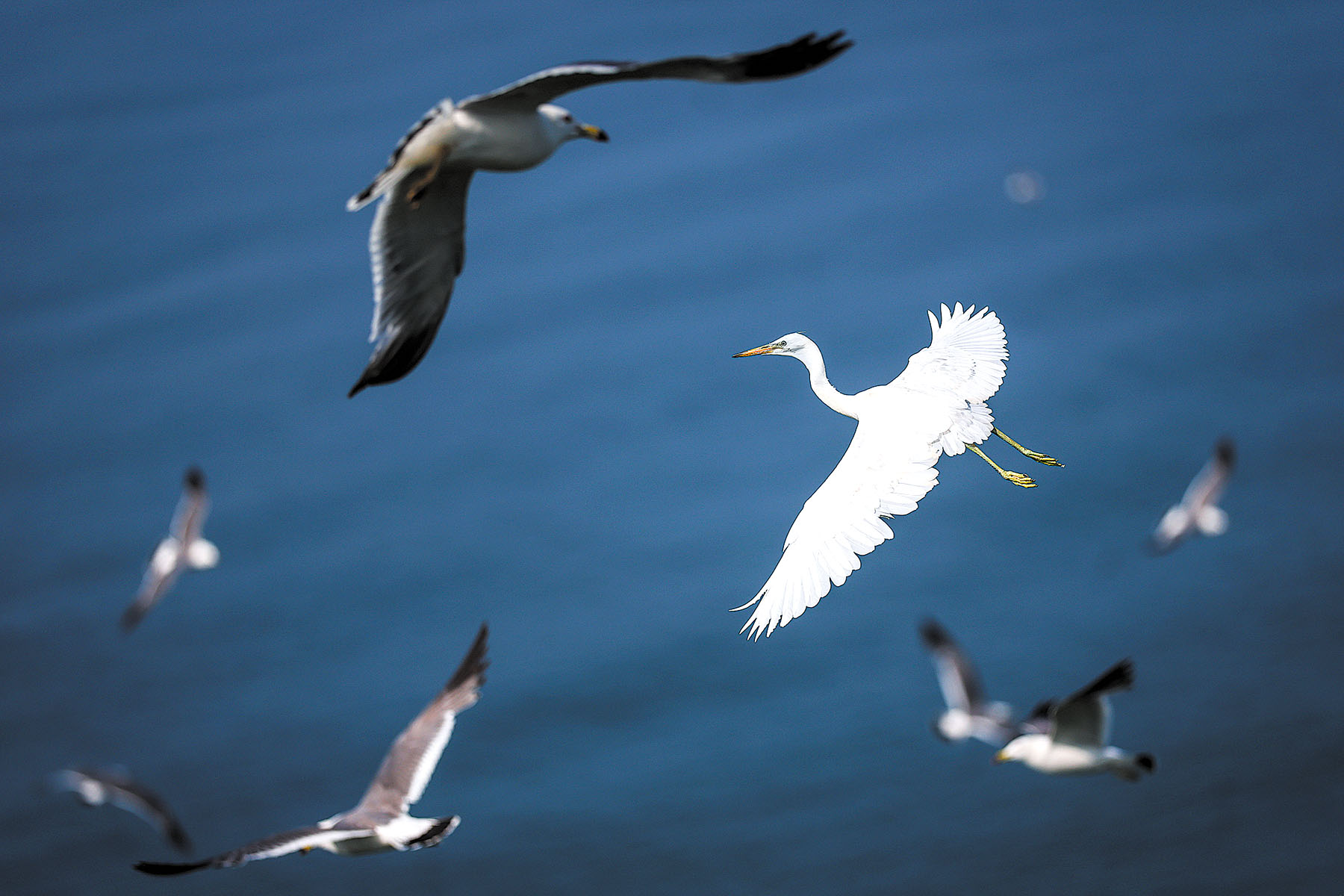
"The Shicheng Archipelago near Zhuanghe in Dalian is part of the Changshan Archipelago and has long been seen as one of the top birding sites in Liaoning," said Liu Yang, a professor at Sun Yat-sen University's School of Life Sciences, who is a co-author of The CNG Field Guide to the Birds of China. He visited the site in September 2017 and spotted several signature species, including Chinese egret, Japanese cormorant and pelagic cormorant, and was struck by the sheer variety of birds breeding on the islands.
"The Changshan Archipelago is considered the 'maritime lifeline' of the East Asian-Australasian migratory flyway. Its addition to the World Heritage Site not only fills a conservation gap in China's temperate island and reef ecosystems, but also connects islands, reefs and coastal wetlands into a complete ecological corridor," Liu said. "I'm glad that it will be put under better conservation."
Lei Jinyu, secretary-general of the Rosefinch Center, a nonprofit organization dedicated to promoting bird-watching and conservation, said the expansion reflects a growing recognition among local governments of the area's potential as a premier birding destination.
"I think many local governments are starting to see bird-watching as an alternative form of tourism," he said. "Birders can bring a significant boost to local economies, especially in grassroots communities."
ALSO READ: Restored wetlands welcome new flocks of migratory birds
Over the past three decades, the bird-watching community has become a vital force in observing, documenting, monitoring and conserving the country's natural ecosystems.
Lei said that by the end of 2025, birdreport.cn, one of the country's bird-recording websites, had attracted nearly 95,000 registered users. Throughout the year, about 22,000 users submitted 559,278 observation reports, documenting 6,927,544 bird sightings covering 1,379 species.
Back in Yunnan, Le continued his birding trip, still hoping that the comb duck might turn up at another lake in the province.
"There are so many birders at various sites across Yunnan," he said. "If the bird is still around, someone will spot it sooner or later. I might still get a chance to see it."
Contact the writers at chenliang@chinadaily.com.cn
