

Innovation drive, resilience to bolster global demand and supply chains
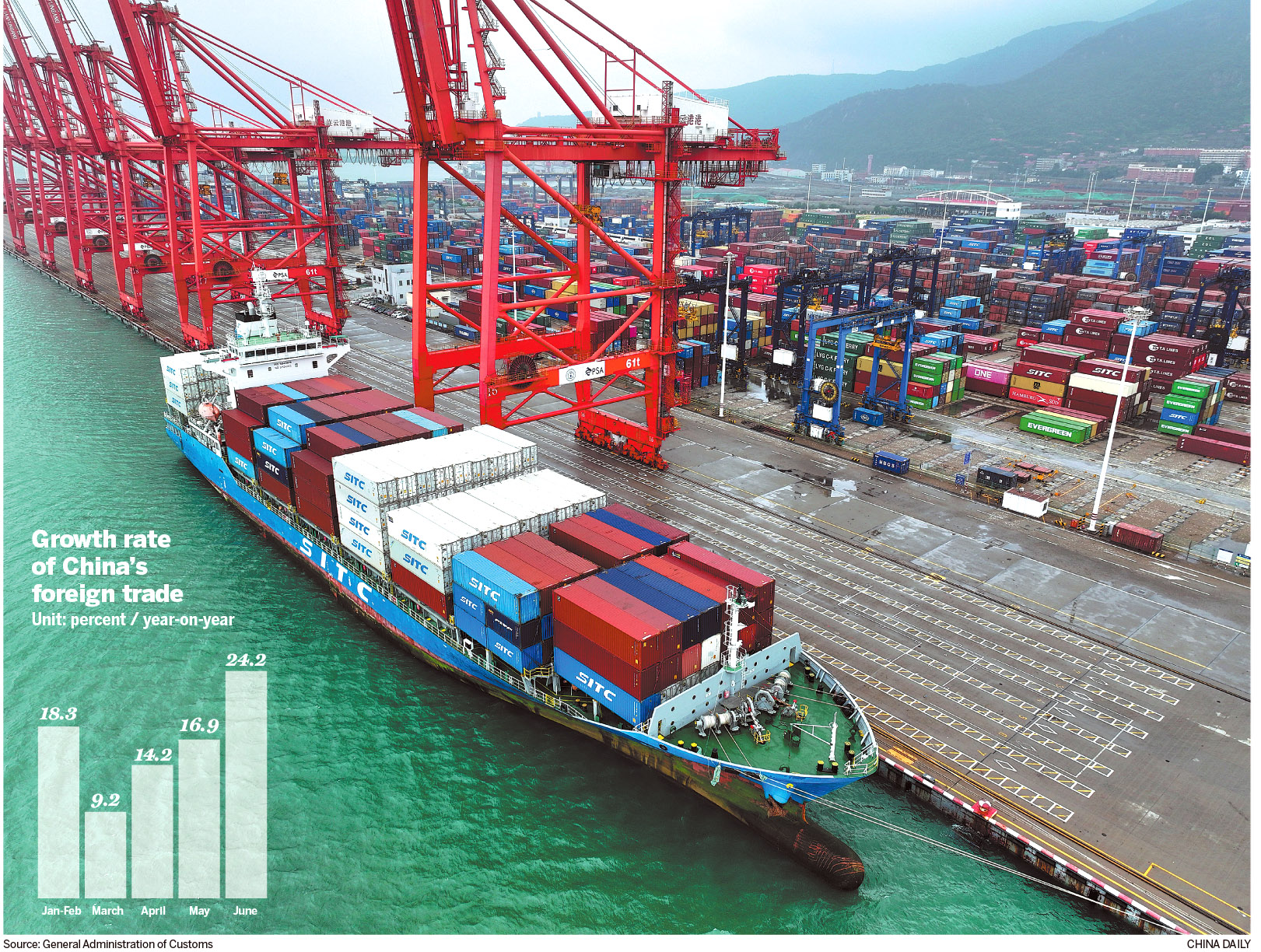
China's foreign trade is expected to maintain steady growth momentum in the second half of 2026, supported by a strong innovation drive and resilient market players, further reinforcing the country's role as a source of global demand and a stabilizer of international supply chains, government officials and economists said on Tuesday.
Data released by the General Administration of Customs showed that China's trade in goods expanded 16.9 percent year-on-year to 25.47 trillion yuan ($3.76 trillion) in the first half, with imports growing faster than exports. Exports rose 13.4 percent, while imports climbed 22.1 percent, exceeding export growth by 8.7 percentage points.
READ MORE: China's H1 foreign trade posts 16.9% growth with optimized structure
Speaking at a news conference in Beijing, Wang Jun, the administration's vice-minister, acknowledged that China's foreign trade will face certain headwinds in the second half, but said innovative products and continued opening-up will remain key pillars supporting its solid fundamentals.
"Stronger import growth, together with robust exports of higher-value manufactured goods, reflects a healthier and more balanced trade structure," he said, adding that the trend shows that China is contributing to global growth not only through its manufacturing strength, but also through its expanding domestic market, helping stabilize global industrial and supply chains.
Alongside notable export growth in tech-intensive green products such as energy storage systems and electric trucks, China's trade in hardware that supports computing power, including electronic components and computer parts, surged 56.6 percent year-on-year to 5.13 trillion yuan in the first half.
China's artificial intelligence-powered smart glasses, translation devices and robotic exoskeletons are among a growing range of intelligent products undergoing rapid innovation, Wang added.
Yan Min, a researcher at the department of economic forecasting of the State Information Center in Beijing, said that China's resilient foreign trade remains a key engine of economic growth, providing greater certainty for domestic activity while supporting global demand through imports and industrial production through competitive exports.
Rather than serving only as a manufacturing hub, China is increasingly contributing to global growth by expanding imports, fostering innovation and strengthening industrial cooperation across international supply chains, Yan said.
Wen Bin, chief economist at China Minsheng Bank, said that China's exports are likely to remain resilient in the second half, supported by the ongoing AI investment cycle, the United States' relatively moderate tariff policy, and a range of supportive measures aimed at enhancing the competitiveness of Chinese manufacturers.
However, Wen cautioned that risks remain, including potential disruptions to energy supply chains in the Gulf region and renewed trade friction between China and the European Union.
Sheana Yue, senior economist at British think tank Oxford Economics, said that China's competitive advantages can help offset external headwinds.
Although tensions surrounding the Strait of Hormuz are expected to weigh on global demand, she said that China is well positioned to fill supply gaps in affected supply chains and benefit from robust demand for products in which it has a competitive advantage, including electric vehicles, solar panels and lithium batteries.
Amid the Middle East tensions that disrupted global chemical supplies in the first half, China's integrated industrial base helped fill supply gaps. Its exports of basic organic chemicals and primary plastics rose, supporting global manufacturing activity and supply chain stability, according to the GAC.
Lyu Daliang, director of the GAC's department of statistics and analysis, said China's continued opening-up, expanding domestic market and innovation-driven growth are also creating new opportunities for foreign-invested companies, strengthening China's contribution to global demand and supply chain stability.
ALSO READ: Hainan FTP sees sharp increase in global investment
Foreign-invested businesses in China generated 7.39 trillion yuan in imports and exports in the first half, up 17.1 percent year-on-year, marking a ninth consecutive quarter of growth, customs data showed.
The trend is reflected in the investment strategies of multinational companies operating in the country. Joe Bao, president of Kone China, said China has become not only a major market for the Finnish elevator manufacturer, but also a critical part of its global manufacturing and innovation network. "China not only serves the domestic market, but also acts as a key export base, with products shipped to more than 100 countries and regions," said Bao.
Contact the writers at zhongnan@chinadaily.com.cn
