

Old structures tell lasting stories as tradition meets innovation, ensuring remarkable landmarks remain part of everyday life, Yang Xiaoyu reports.

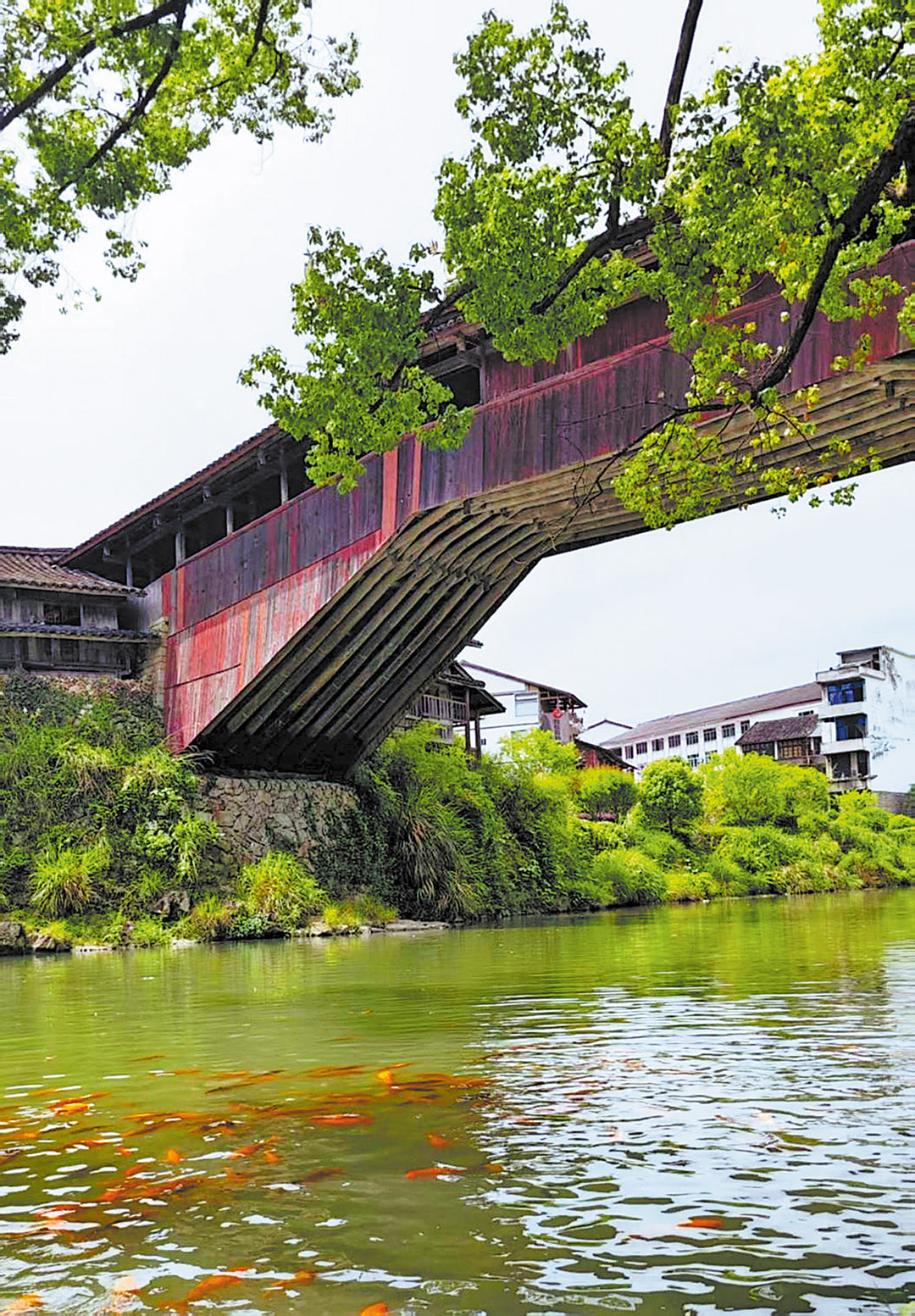
On an early summer afternoon in Taishun county, a mountainous region of Wenzhou city in Zhejiang province, tourists stroll across Beijian Bridge, a quaint wooden arch bridge spanning a river teeming with red carp. Partly veiled by ancient trees, its weathered red structure stretches 51 meters and is topped by a covered corridor with tiled roofs, flying eaves and carved dragons.
First built in 1674 and rebuilt and repaired several times over the centuries, Beijian Bridge is one of Taishun's 32 historical covered bridges, known in Chinese as langqiao. The term was coined in the 1940s by architect and historian Liu Dunzhen, who encountered such bridges "traversing rivers like rainbows with covered houses on top" during his travels in China's southwestern provinces.
The covered corridor shields the timber structure from the elements while providing shelter for travelers.
"I grew up by the Beijian Bridge," says Chen Songnian, deputy director of the Taishun Museum, pointing toward his ancestral house nearby. "Every day I crossed it on my way to school and often came here to hang out with friends."
READ MORE: Bridging past and present
Chen was speaking during a media trip organized by the National Cultural Heritage Administration to highlight achievements of the Three-Year Action Plan for the Protection of Covered Bridges (2023-25). The tour took journalists to Taishun in Zhejiang, and the counties of Shouning and Pingnan, both in Ningde city, Fujian province, an area of mountains and deep ravines.
"Covered bridges were the heart of local communities," Chen says. "They not only connected villages but also served as shelters, marketplaces, information hubs, and places of worship. Today, they remain deeply woven into the cultural identity of the Taishun people."
Jointly launched by the Publicity Department of the Communist Party of China Central Committee, the Ministry of Culture and Tourism, and the National Cultural Heritage Administration, the action plan recognized covered bridges as an independent category of cultural relics for the first time, strengthening their protection, research and public use.
Over the past three years, a nationwide survey documented 2,193 covered bridges as cultural relics, an increase of more than 61 percent, while conservation efforts have improved significantly nationwide.
Engineering masterpiece
The mountainous borderlands of Fujian and Zhejiang are home to more than 800 covered bridges, one of the world's largest concentrations. More than 100 historic examples, including Beijian Bridge, embody "the traditional design and practices of Chinese wooden arch bridge building".
The craft was inscribed on UNESCO's List of Intangible Cultural Heritage in Need of Urgent Safeguarding in 2009 after urbanization, timber shortages and a dwindling number of master builders threatened its survival. Renewed efforts by governments and local communities led to its transfer to UNESCO's Representative List of the Intangible Cultural Heritage of Humanity in 2024.
Experts trace the origins of Chinese wooden arch bridges to the Northern Song Dynasty (960-1127), as depicted in the famous 12th-century scroll Along the River During the Qingming Festival.
According to Su Xudong, a veteran scholar from Pingnan who helped prepare the UNESCO nomination, the defining feature of the craft is the beam-weaving technique. Using sunmao (mortise-and-tenon) joints, craftsmen interlock timber beams into a sturdy arch resembling an upside-down basket.
"The beam-woven arch achieves the largest span of any all-timber structure in the world to date," Su says. "Its wide span reduces the number of piers, allowing floodwaters and boats to pass more easily while also lowering construction costs."
In 2012, the Fujian-Zhejiang Wooden Arch Covered Bridges, nominated by seven counties across the two provinces, were added to China's tentative list seeking World Cultural Heritage status. They were included again in the updated 2025 list. This sustained presence signals that the bridges may be moving closer to meeting World Heritage criteria, experts note.

Rising from the ashes
Yet, these treasured bridges remain vulnerable to disasters, particularly floods and fires.
In September 2016, Typhoon Meranti triggered flash floods that swept away three nationally protected Taishun bridges — Xuezhai, Wenxing and Wenzhong — in just two hours.
"It was a devastating day for the people of Taishun. Many broke down in tears," recalls Zeng Jiakuai, a national-level inheritor of the traditional design and practices for building Chinese wooden arch bridges.
"But even before the floodwaters receded, local residents spontaneously joined the rescue effort, salvaging more than 90 percent of the wooden components and drying them in their own courtyards, making the restoration possible," he says.
Zeng led the restoration of Wenxing Bridge. Working alongside cultural relics departments and experts, his team followed the principle of "using original components, original materials and traditional craftsmanship whenever possible". With government and community support, all three bridges were rebuilt the following year, preserving their historic character and structural integrity.
In 2021, the restoration of Taishun's wooden arch bridges became the only Chinese case included in the ICOMOS-ICCROM publication, Analysis of Case Studies in Recovery and Reconstruction.
A year later, tragedy struck again. In August 2022, Wan'an Bridge in Pingnan — China's longest surviving wooden arch-covered bridge at 98.2 meters with six arches — was destroyed by fire. Originally built in the 11th century, it had survived repeated restorations following earlier fires and floods.
The disaster prompted urgent state action, leading to the launch of the Three-Year Action Plan.
Huang Minhui, a municipal-level inheritor of traditional wooden arch bridge-building techniques in Ningde, led the Wan'an restoration as his family has a long-standing history of rebuilding and repairing the bridge.
Like the Taishun project, the team adhered to the principles of minimal intervention and "restoring the old as old". Over 200 surviving wooden components were salvaged, polished, treated with preservatives, and reused. When the bridge reopened in August 2024, visitors could see fire-scarred original pieces integrated with new ones — a deliberate reminder of the bridge's history.

Modern armor
The disasters in Taishun galvanized public support for stronger protection and accelerated legislative efforts.
In 2017, local community leaders proposed specific laws. Four years later, the nation's first local regulation, the Wenzhou Taishun Covered Bridge Protection Regulations, was enacted. Detailed implementation rules followed in December 2023, adopting a "one bridge, one policy" approach for the county's 32 historic covered bridges.
Hu Rong'en, a professor at Shanghai University of Political Science and Law, commends the legislation: "Protecting covered bridges through legislation helps regulate activities that may affect them, including rural construction projects, while also supporting their bid for World Heritage status."
Taishun's efforts have inspired neighboring regions. Ningde promulgated regulations in January 2024; Nanping (in Fujian)'s will take effect on Oct 1; and Lishui, in Zhejiang, is advancing its own.
Beyond legislation, technology has become another vital layer of protection.
Many of the bridges stand deep in the mountains, accessible only by winding roads, making routine inspections especially challenging during bad weather.
At the Taishun Museum, housed in a building shaped like a covered bridge, Chen, the deputy director, demonstrates the Taishun Cultural Heritage (Covered Bridges) Supervision and Protection Platform.
"We have equipped our covered bridges with AI-powered thermal imaging cameras. If abnormal temperatures or open flames are detected, the system immediately triggers an alarm to warn people on the bridge to evacuate, while simultaneously alerting the monitoring center," Chen says.
"In addition to smart cameras, Taishun's ancient covered bridges are fitted with temperature-sensing cables and devices that monitor traffic and water flow," he adds."The platform issues an alert whenever it detects unusual activity."
The platform, launched in 2022, integrates data from the firefighting, water conservancy, meteorology, and law enforcement departments, and links over 700 intelligent monitoring terminals countywide.
ALSO READ: 'Fortune bridges' span generations
"These technologies have made the work of grassroots heritage guardians much easier," Chen says.
In Ningde, Fujian, the province's first video monitoring and early warning platform for wooden arch bridges now provides round-the-clock intelligent surveillance.
"Many covered bridges have been equipped with firefighting IoT devices including smoke alarms, thermal imaging cameras, and automatic sprinklers," Ou Donghai, director of the Ningde Cultural Heritage Protection Center, told reporters at the Baixiang Bridge in Pingnan, which was destroyed by fire three times throughout its history.
Ou says Ningde is also working with universities on high-precision 3D laser scanning and BIM (building information modeling). "These tools support daily monitoring and can simulate disasters such as fires and floods, helping improve emergency planning and response," he says.
Contact the writer at yangxiaoyu@chinadaily.com.cn
