

Craftsmen protect aging structures by working hands-on while teaching younger people the skills needed to sustain them, Bai Shuhao reports in Huaihua, Hunan.
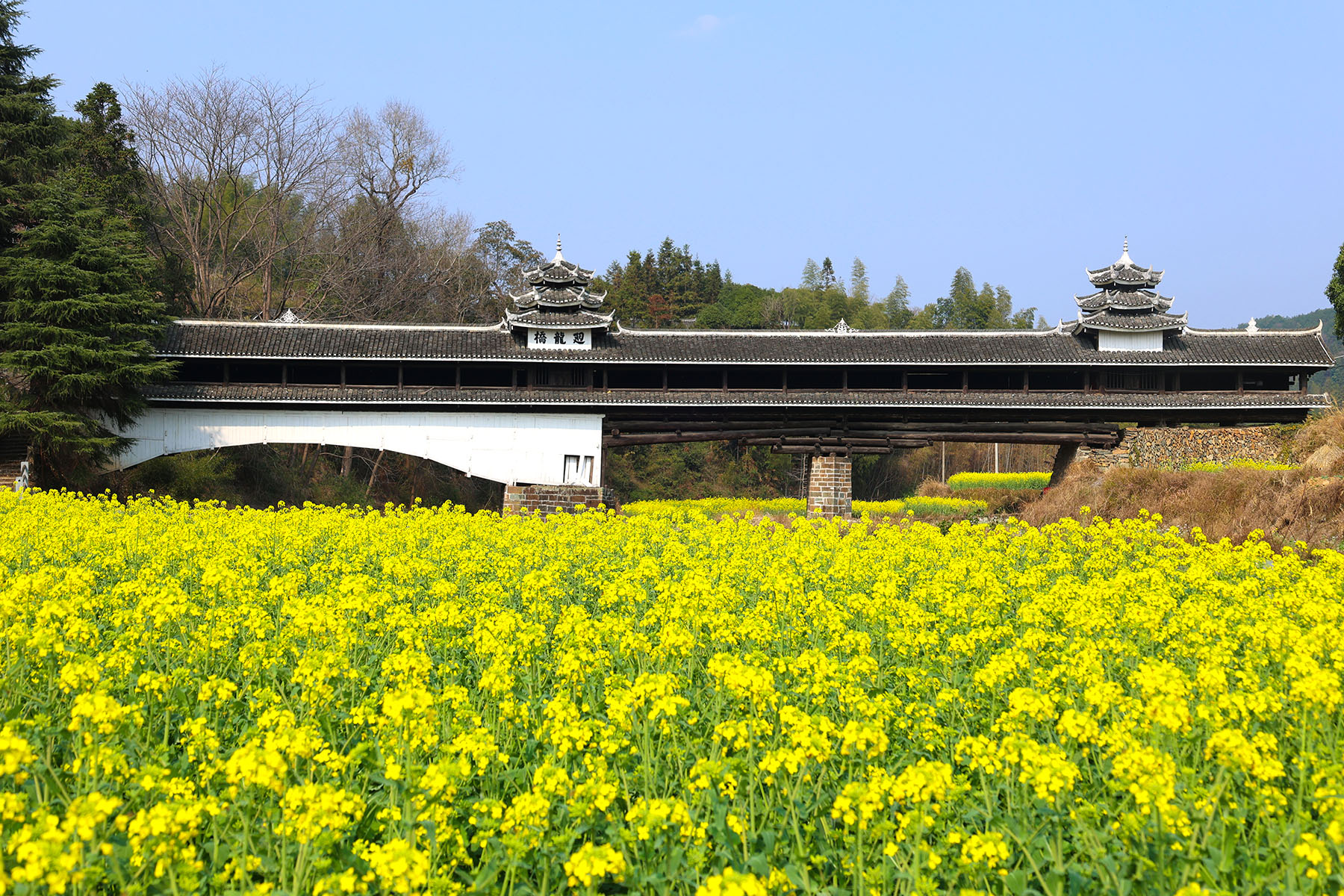
On a drizzly spring morning in Tongdao Dong autonomous county, tucked into the misty borderlands where Hunan province meets the Guangxi Zhuang autonomous region and Guizhou province, villagers move in a quiet procession. With woven baskets strapped to their backs, they cross wooden covered bridges built by their ancestors and head uphill to pick the season's first tea leaves.
These structures are more than mere crossings over water. In the villages of the Dong ethnic group, they function as shelters, gathering places, and, in a sense, spiritual anchors. Locals call them "wind-and-rain bridges", for their ability to shield travelers from the elements. Some refer to them as "fortune bridges", believed to gather and bestow blessings.
China's recorded history of such bridges dates to the Han Dynasty (206 BC–AD 220), though the term "Chinese covered bridge" was only formally defined in the mid-20th century by architectural scholars. Today, there are 2,193 documented covered bridges, according to the conclusion of a recent three-year national covered bridge preservation initiative.
READ MORE: Walk in the mists of time
Tongdao, in Huaihua, Hunan, alone accounts for 117, nine of which are nationally protected cultural relics. Each week, one man makes a circuit to check on them.
"They're like old friends," says Yang Huixiang, a member of Tongdao county government's cultural relics unit, who has spent two decades researching and safeguarding the bridges."Some are 100 to 200 years old."
Yang grew up in a Dong village where these bridges were part of daily life. He remembers elders chatting under their roofs, children playing overhead, and others swimming in the rivers below. When he began work in 2003, his first assignment was deceptively simple: to draw the bridges he knew so well.
"I didn't even know where to start," he says. Trained in law rather than architecture, he struggled to translate lived familiarity into precise technical drawings. At the time, documentation relied heavily on manual measuring and hand sketching. To record details accurately, Yang sometimes climbed onto beams with a tape measure.

Reaching the bridges could be just as arduous. In mountainous terrain with limited road access, he and his colleagues often traveled by bicycle, pushing uphill when paths became too steep. "If you didn't love it, you couldn't keep going," he adds.
His favorite remains Puji Bridge, a roughly 30-meter-long structure built in 1760 during the Qianlong era of the Qing Dynasty (1644–1911). Constructed entirely of stone and timber, it contains not a single iron nail — an example of the Dong people's mastery of mortise-and-tenon joinery.
Its gray stone slabs, white-painted body, and darkened wooden beams lend it a quiet elegance. Beneath it, a river flows gently; nearby, fields of rapeseed flowers bloom each spring. At one end stand an ancient well and a temple dedicated to the God of Earth.
"It blends perfectly with the village, doesn't it?" Yang asks. He notes that during the recent national preservation initiative, no sweeping restorations were carried out. Instead, the focus remained on routine upkeep and fire prevention.
He attributes this in part to the resilience of traditional timber construction techniques, as well as the deliberate siting of bridges over relatively calm waters.
Long before formal preservation policies were put in place, he adds, local villagers took responsibility for upkeep — pooling funds, materials and labor, and commissioning nearby carpenters for repairs when needed.
While sifting through historical records in Tongdao, Yang came across a striking account from the 1970s: another nationally treasured covered bridge, Huilong Bridge, had been torn apart by a flood.
Entire sections of the bridge were swept downstream, but villagers salvaged the scattered timbers and returned them upstream. "It must have taken the effort of the whole village," Yang says.
Yang Shengchun remembers that flood vividly. He was about 10 when his grandfather helped rebuild Huilong Bridge. "My grandfather always said it was a pity."

Three generations of his family have been, in Yang Huixiang's words, "nearby carpenters". Today, Yang Shengchun himself is recognized as a provincial inheritor of the Dong people's traditional wooden construction techniques.
Tongdao's abundance of covered bridges, Yang Shengchun believes, is tied to geography. Located on the border between provinces, the area historically relied on rivers for trade. Some transactions even took place on the bridges themselves, where villagers would hang handmade straw sandals for travelers to borrow.
"The Dong communities are generous. They believe in doing good," he says. If the wood rotted or the roof leaked, villagers called for repairs. At times, carpenters worked without pay.
At the heart of the Dong covered bridges is the wooden mortise-and-tenon method. To guide the assembly of each component, craftsmen employ a secretive set of coded symbols known as moshiwen, often marked on bamboo sticks. These signs ensure that the wooden pieces interlock tightly and securely. Yang Shengchun notes that mastering the craft takes at least three years, a prerequisite for any bridge repair.
Beyond bridges, Yang Shengchun also builds traditional wooden homes for local families. He currently teaches more than 20 apprentices, most over the age of 50.
His young grandnephew, not yet 30, has become his main protege. As Yang Shengchun says, "I'm happy to teach anything I know to young people who are willing to learn."
Efforts to preserve China's covered bridges increasingly combine physical conservation with the protection of intangible heritage. After a devastating fire in 2022 destroyed Wan'an Bridge in Fujian province, reconstruction followed strict conservation principles, reusing original materials where possible and involving traditional craftsmen in the rebuilding.
In 2024, traditional designs and practices for building Chinese wooden arch bridges were transferred from UNESCO's List of Intangible Cultural Heritage in Need of Urgent Safeguarding to its Representative List of the Intangible Cultural Heritage of Humanity, underscoring the global concern for their survival.
International scholars have long taken an interest. Since the 1960s, American geographer Ronald G. Knapp has studied Chinese rural architecture. In his book, China's Covered Bridges: Architecture over Water, he argues that preservation in China need not follow Western models.
"All too often," he said in an interview, "the average person knows what is worth preserving, whereas architects, planners, and designers may not reflect the integrity of the original landscape."
Back in Tongdao, modern tools — from digital modeling to 3D scanning — are beginning to supplement traditional methods. But Yang Huixiang insists they cannot replace the intangible heritage of traditional bridge craftsmanship. "It still has to be passed down."
For Yang Huixiang, the principle of protecting covered bridges is simple: diligence.
"Cultural relic protection is not talk, but work — go to the site, see it for yourself, and build understanding on solid ground."
For Yang Shengchun, the lesson is equally clear, though rooted in a different mindset: humility.
"Skill is no mystery," he says. "Stay humble, practice more — there's nothing magical."
Contact the writer at baishuhao@chinadaily.com.cn
