

Prices plummet seen in commercial, industrial sectors as production surges
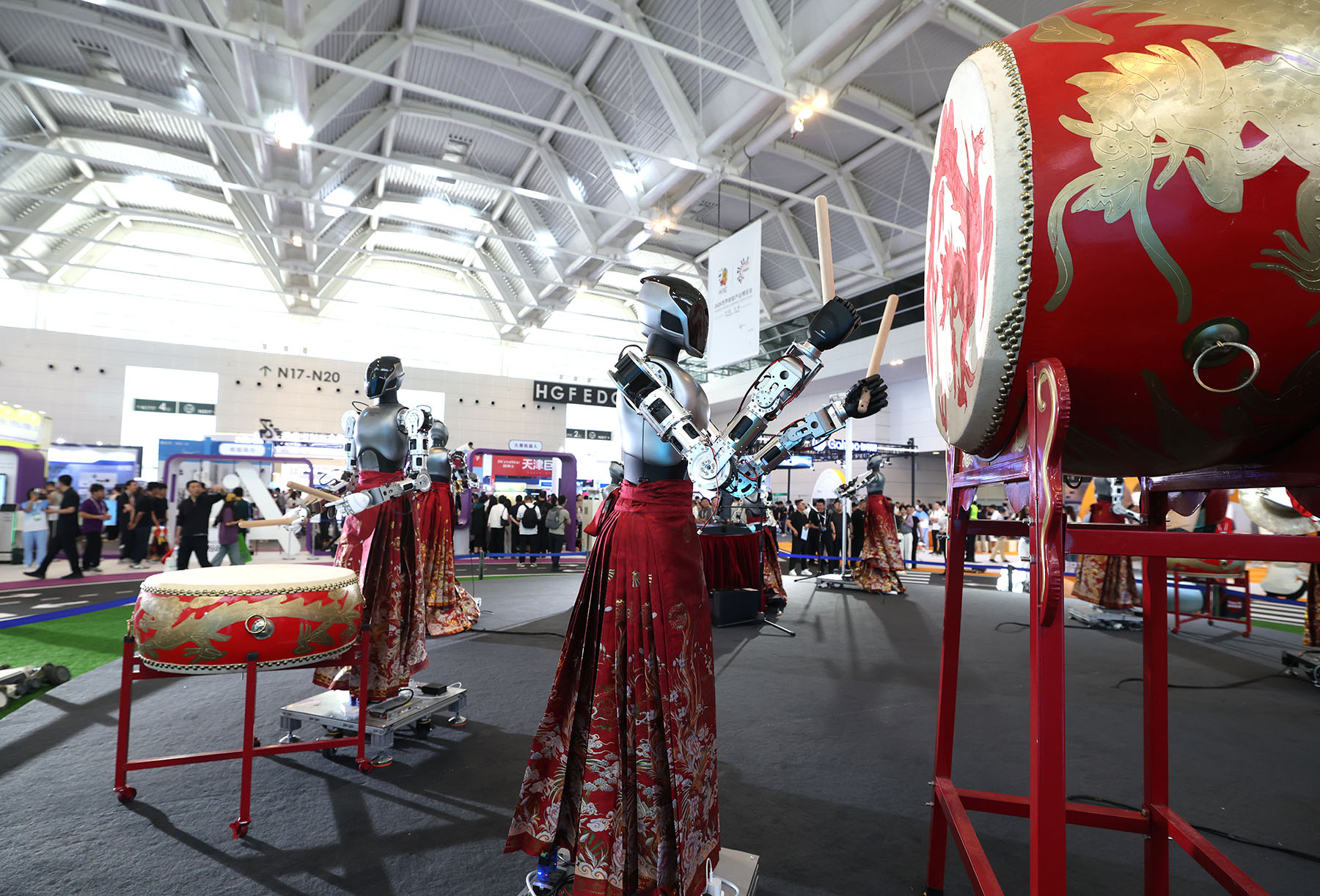
As leading Chinese humanoid robot makers unveil increasingly affordable models, advances in manufacturing, supply chain localization and growing production volumes are pushing the sector into a new phase of commercial adoption.
Unitree Robotics recently launched its dual-arm humanoid robot R1 with a starting price of 26,900 yuan ($3,968), making it the company's most affordable humanoid robot to date. Earlier, Noetix Robotics introduced its Bumi robot for 9,998 yuan, becoming one of the first consumer-oriented humanoid robots priced below the 10,000-yuan threshold. Around the same time, Booster Robotics also launched its K1 series with a starting price of 29,900 yuan.
The declining pricing trend is no longer limited to consumer products. Industrial humanoid robots have also begun entering the under 100,000-yuan range. Astribot's T1 humanoid robot, for example, starts at 89,900 yuan.
READ MORE: Humanoid robots move onto fast track
The shift marks a significant departure from just a few years ago, when humanoid robots in China typically sold for several hundred thousand yuan each.
According to Unitree's prospectus, the average selling price of its humanoid robots fell from around 593,000 yuan in 2023 to about 260,000 yuan in 2024, before declining further to 167,000 yuan during the first three quarters of 2025. Similarly, Leju Robotics said the average selling price of its Kuavo series dropped nearly 26 percent year-on-year in 2025 to 308,100 yuan per unit.
Guo Tao, a special researcher at domestic consultancy Internet Economy Institute, said the widespread decline in prices among domestic humanoid robots is being driven by multiple industry and market factors.
"As shipment volumes continue to expand, companies are able to spread previously high research and development expenses and production-line depreciation costs across a larger number of products, allowing unit costs to fall steadily," Guo said.
Industry data platform GGII said China's humanoid robot shipments reached 14,400 units in 2025 and output is expected to surpass 100,000 and potentially reach 200,000 units in 2026.
At the same time, Guo said domestic suppliers have made substantial progress in critical components such as reducers and servo systems, helping lower procurement costs across the industry.
Unitree, for example, said its company filings show that more than 90 percent of its core components — including motors, reducers and lidar sensors — are developed and manufactured in-house. As a result, the average production cost of its humanoid robots declined from 73,200 yuan in 2023 to 62,200 yuan by the third quarter of 2025.
Another important factor has been the industry's ability to leverage supply chains originally developed for electric vehicles and consumer electronics.
"More than half of the core components used in humanoid robots, including motors and reducers, can be sourced from existing new energy vehicle supply chains, so there is no need for large-scale new capacity investment, which helps keep manufacturing costs under control," Guo said.
The convergence between the automotive and robotics sectors is already bringing new opportunities for the automobile industry.
"Humanoid robots have opened up a new growth opportunity for the company and created a new development curve," said Wu Jianbin, chairman of automotive parts manufacturer Shuanglin Group, in an earlier interview.
ALSO READ: Finance sector keen to boost robotics industry
Wu said the firm decided to enter the humanoids' planetary roller screw segment because the technologies share common foundations with its existing automotive seat horizontal drive motor business — including expertise in thread machining and gear manufacturing.
Meanwhile, automakers themselves are becoming increasingly active participants in the embodied intelligence sector. To date, major carmakers, such as Tesla, Mercedes-Benz, Changan, SAIC, XPeng and GAC, have entered the field through either self-development, joint ventures or incubation programs.
Contact the writers at lijiaying@chinadaily.com.cn
