

Big data, artificial intelligence, IoT make futuristic services reality in Xiong'an
What does a city of the future look like?
In Hebei province's Xiong'an New Area, a traffic light adjusts its timing in milliseconds to ease a growing queue of vehicles. Beneath the streets, sensors quietly confirm that oxygen levels inside an underground utility tunnel remain stable. Nearby, residents return home by swiping their access cards as community systems automatically log their arrival.
Inside the Xiong'an Urban Computing Center — also known as the "Eye of Xiong'an" — a giant digital dashboard tracks the heartbeat of China's newest city in real time. Here, advanced technologies such as artificial intelligence, big data and the internet of things are designed not only to make urban management smarter, but also to make everyday life safer, more convenient and more responsive to people's needs.
"The computing center serves as the digital brain of Xiong'an," said Wang Zixuan, an official with the industry, information technology and data bureau of Xiong'an New Area.
READ MORE: 'City of the future' ready for liftoff
From the very beginning of planning, Xiong'an decided to adopt the concept of building three interconnected cities — one underground, one above ground and one in the cloud, and together, they provide the backbone for the dynamic virtual replica of the city, enabling managers to respond to urban operations in real time, Wang said.
For residents, however, much of that technology works quietly in the background.
One example is a community care service built on utility monitoring. "If an elderly resident living alone shows no water or gas activity for an unusually long period, the system automatically sends an alert to the local community, prompting staff to check on the resident," Wang said.
The same digital intelligence extends across the city's transportation network.
Every municipal road in Xiong'an has been built to digital road standards. As traffic patterns change throughout the day, signal timings can be adjusted automatically, helping ease congestion and improve travel efficiency, Wang added.
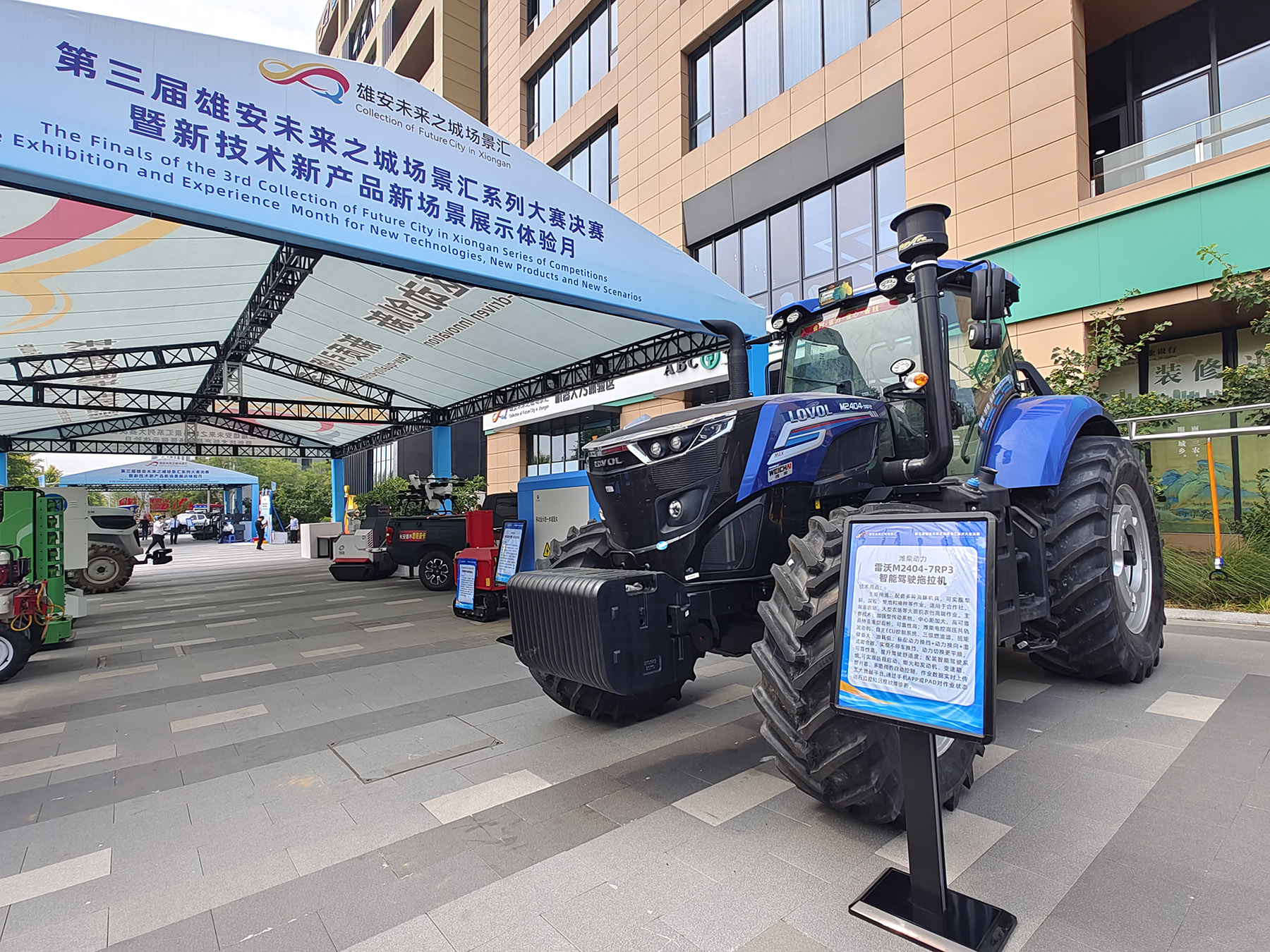
Supporting these services is an extensive digital infrastructure. Xiong'an has deployed more than one million connected sensing devices and built over 500 kilometers of digital roads.
Together, they form an interconnected network that helps manage transportation, public facilities, neighborhoods and underground utility systems more efficiently.
A short drive away, an exhibition hall offers visitors a different glimpse into the future of agriculture.
An apple-picking robot smoothly moves toward a tree on its tracked chassis. After scanning the branches with its vision system, its robotic arm gently reaches out, twists a ripe apple from the branch and places it into a collection basket — all in less than 10 seconds.
Developed by a research team at Hebei Agricultural University, the robot is capable of identifying fruit and distinguishing healthy apples from damaged ones before picking, with a fruit damage rate of less than 5 percent when picking, said Chen Chongchong, a professor from the university's mechanical and electrical engineering school.
"Most fruit growers today are elderly farmers, and labor shortages become especially severe during harvest season," Chen said, adding that this robot can significantly improve harvesting efficiency while reducing operating costs.
He added that the robot's strong climbing capability allows it to work in orchards with different terrains, while the research team is developing specialized AI models for harvesting other types of fruit.
ALSO READ: Xiong'an New Area gives helping hand to high-tech startup companies
From easing traffic congestion and caring for elderly residents to helping farmers harvest fruit, Xiong'an is leveraging advanced technologies to transform futuristic concepts into everyday experiences.
According to the new area's industry, information technology and data bureau, Xiong'an is building an innovation ecosystem centered on digital infrastructure, technology demonstration and real-world application scenarios.
"Application scenarios serve as the bridge between technology and industry, connecting research with the market," said Liu Xiang, deputy director of the bureau, adding that the new area is ramping up efforts to identify the most promising technologies, teams and projects, and provide them with the best possible environment to grow, mature and achieve commercial success.
Contact the writers at lijiaying@chinadaily.com.cn
