

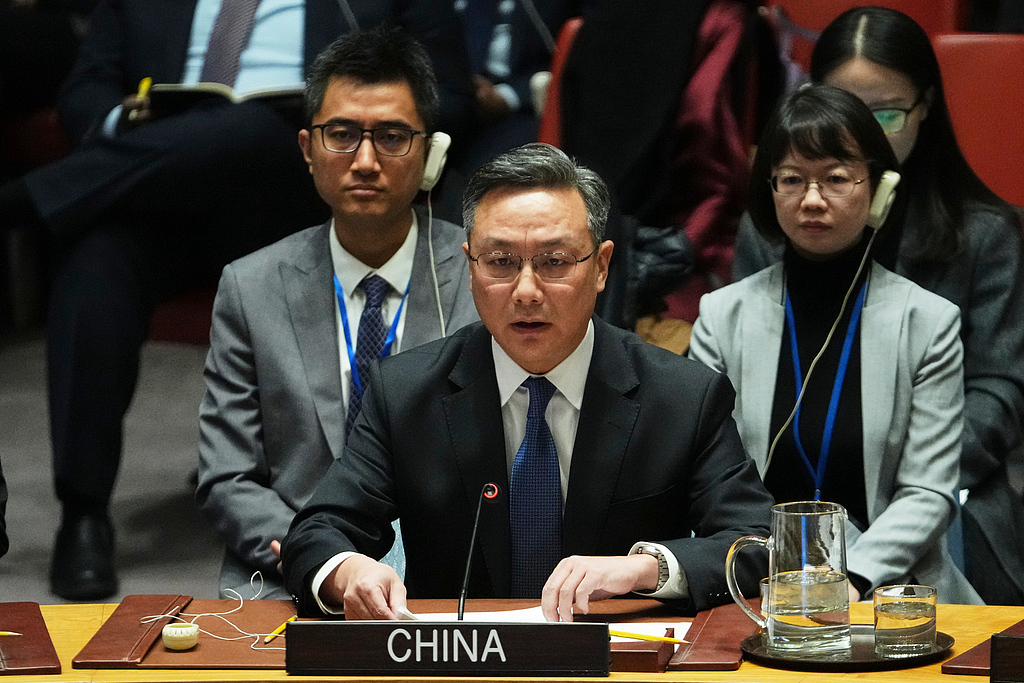
China's envoy to the United Nations on Tuesday called on the UN Security Council to exercise prudence and play a constructive role in addressing the Iranian nuclear issue, amid growing disagreement among Security Council members over the status of UN sanctions on Iran.
"I want to reiterate that the Security Council has ceased its consideration of the Iranian nuclear issue," Sun Lei, China's deputy permanent representative to the United Nations, told the council.
He said the proper resolution of the issue bears on the authority and effectiveness of the international nuclear non-proliferation regime, long-term peace and stability in the Middle East, and global peace and security.
Ahead of the meeting, eight countries — France, Bahrain, Denmark, Greece, Latvia, the United Arab Emirates, the United Kingdom and the US — issued a joint statement urging all UN member states to fully implement the recently reimposed Security Council sanctions against Iran.
ALSO READ: China urges efforts to honor ceasefire as Iran and Israel trade strikes
Speaking on behalf of the group, Jerome Bonnafont, French permanent representative to the UN, said Iran possesses more than 10 International Atomic Energy Agency significant quantities of highly enriched uranium, a level at which "the possibility of manufacturing a nuclear device cannot be excluded".
Sun stressed that "Iran's legitimate right to the peaceful use of nuclear energy should be addressed alongside non-proliferation concerns".
He noted "Iran's repeated commitment not to develop nuclear weapons", and said that, as a state party to the Treaty on the Non-Proliferation of Nuclear Weapons, "Iran enjoys the legitimate right to the peaceful use of nuclear energy."
The remarks were made during an open briefing of the Security Council on the work of the 1737 Committee, which was established to oversee sanctions on Iran prior to the 2015 Joint Comprehensive Plan of Action (JCPOA).
The committee had reported to the Security Council every three months before the adoption of the JCPOA in 2015, which suspended both the committee and its reporting requirements.
ALSO READ: China willing to continue constructive role in Iran nuclear issue
In August 2025, France, Germany and the United Kingdom, known as the E3 parties to the JCPOA, triggered the agreement's "snapback" mechanism to reimpose UN sanctions on Iran. In March this year, the United States, serving as Security Council president, sought to resume the committee's reporting by including its 90-day briefing in the council's program of work.
China and Russia challenged the legal and procedural basis for the move, saying that Security Council sanctions on Iran had been permanently lifted following the adoption of Resolution 2231 in 2015.
China and Russia had opposed the US proposal to include the committee briefing in the council's March agenda, as well as a draft report on the committee's activities proposed by the United States.
Sun said that the United States and Iran have reached a ceasefire and are exploring solutions through negotiations, and "the situation remains sensitive, complex and fragile".
"Under the current circumstances, the Security Council must stand on the side of peace and on the right side of history, and act with utmost caution when handling relevant issues," he said.
READ MORE: China welcomes efforts to sustain US-Iran ceasefire momentum
"China supports the US and Iran in resolving their differences through rational and pragmatic negotiations," Sun said, adding that such efforts could ensure Iran's orderly development of peaceful nuclear activities under the strict safeguards and monitoring of the IAEA while effectively reducing proliferation risks.
"Threats of force or the imposition of war will only push the Iranian nuclear issue and the situation in the Middle East into a dangerous abyss," he said.
Sun said the US withdrawal from the JCPOA and its two separate uses of force against Iran during the negotiation process "had severely undermined diplomatic efforts and contributed to the current difficulties".
He urged relevant parties to "abandon power politics, engage in sincere dialogue on an equal footing, commit to refraining from the use of force, and ensure the effective implementation of any future agreement".
"Maintaining the ceasefire is the overriding priority," Sun said, calling on all parties to work toward ending hostilities and reaching an agreement that serves the interests of those concerned.
"The world is an indivisible security community. One country's security should not come at the expense of another country's security," Sun said.
