

Award-winning photographer Cai Jialing dives into darkness to reveal the tiny, luminous lives most people will never see.
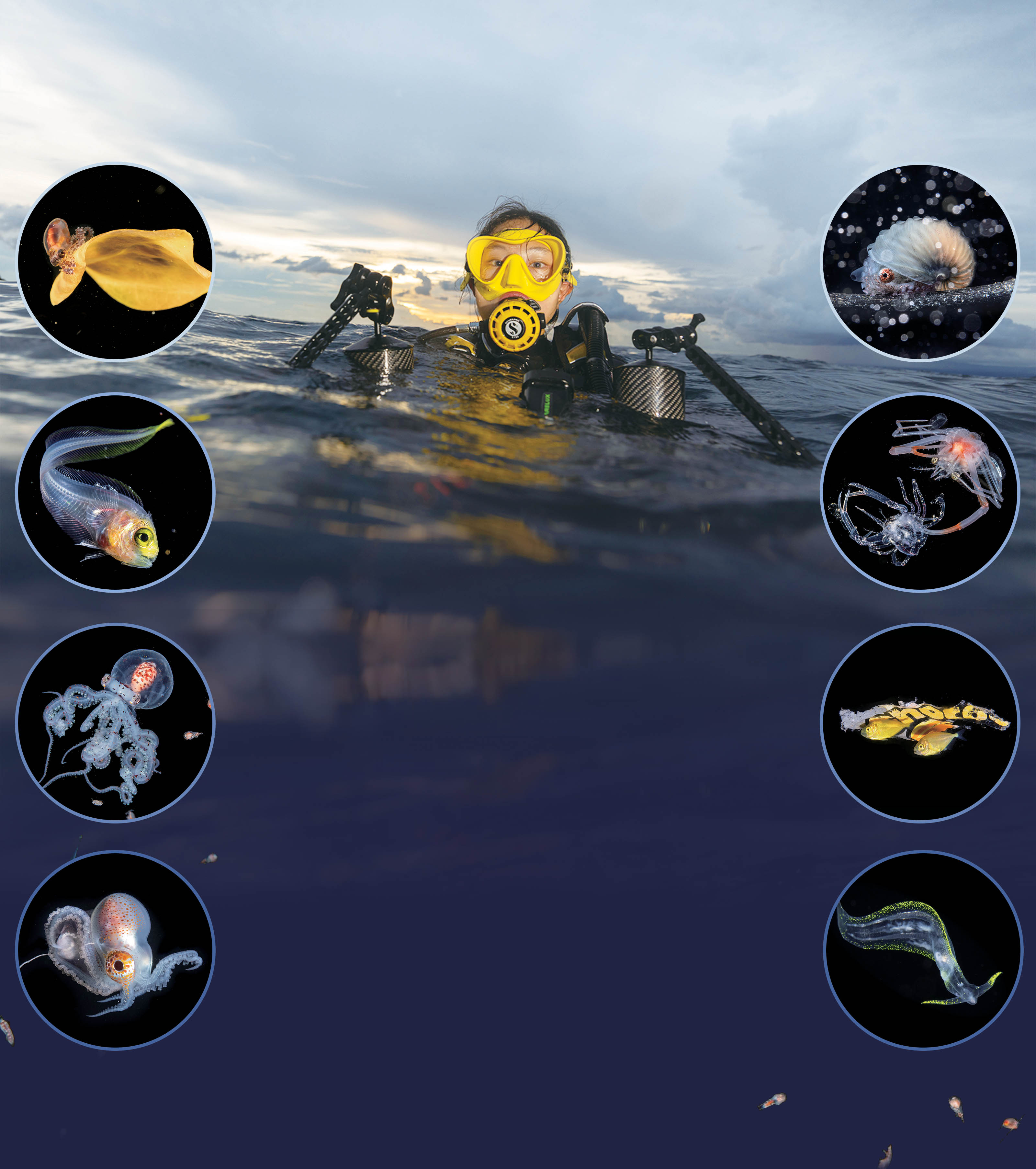
As night fell, the sea looked like a vast sheet of black silk.
With a backward roll from the edge of the boat, Cai Jialing slipped into the water and began her descent. Around her was endless darkness: no seabed in sight, no shoreline — only a surface buoy above, with a faintly glowing line dropping into the black below.
The creatures she had come to find were gathering around that thin column of light: sea butterflies, salps, transparent octopus larvae — some no bigger than a fingernail, yet so delicate and strange they seemed almost extraterrestrial.
Suspended almost weightlessly in the dark, Cai raised her camera and followed these tiny lives as they rose from the deep — hundreds of meters below.
This is blackwater photography: the art of capturing drifting marine life at night in the open ocean. Only a handful of people in the world do it well. Cai, 28, is one of the youngest.
READ MORE: Glories of a hidden world
Before finding her way into blackwater photography, Cai knew almost nothing about diving. She grew up in Chongqing, an inland city in Southwest China, and had no formal training in photography. Yet she had always had "a restless, adventurous spirit" — an instinct that eventually led her to the sea.
In 2016, while studying biology and environmental science at the University of Virginia, she took a highly specialized course in marine biology. Her professor introduced the class to diel vertical migration — the nightly ascent of zooplankton from the deep ocean toward the surface. By day, these animals stay hundreds of meters below to hide from predators; at night, they rise to feed.
This daily movement, often described as the greatest migration on Earth, left Cai in awe. "It felt like a summons from the sea," she recalled.
After the course, she began learning to dive, starting with recreational scuba before gradually moving into the far more demanding world of blackwater diving.
"Blackwater diving is completely different from diving at a typical resort site," Cai explained. "There's no visible seafloor. If you lose control of your buoyancy, you can rise too fast or sink rapidly — either can be life-threatening."
In 2018, Cai tried blackwater photography for the first time in the Philippines, home to one of the world's most experienced blackwater diving communities. Whenever she encountered something she did not understand, there was always someone she could turn to for advice. She would take those ideas underwater, test them on a dive, and come back with new questions.
"Through trial and error, and a lot of practice, I slowly figured it out," she said, and her work began reaching wider audiences.
Rethinking the frame
In 2023, one photograph changed Cai's career. The image, Snowy Night, earned her the title of Ocean Photographer of the Year 2023, awarded by Oceanographic Magazine, an international competition recognizing the world's best ocean imagery. It captures a female paper nautilus, or argonaut, riding a drifting wooden stick through dark water, surrounded by countless fine particles that scatter like snow.
The photograph was taken in the Philippines after a nearby volcano erupted, stirring sediment into the water.
While many photographers might have seen the poor visibility as reason enough to abandon the dive, Cai saw something different. For years, she had focused on perfecting her lighting to keep her backgrounds clean. This time, however, she embraced the tiny organisms and particles suspended in the water. The "snow" in Snowy Night — volcanic ash, plankton, and the ocean's own dust — became part of the image.
The award brought new opportunities. In January, Cai boarded an expedition vessel bound for Antarctica as a special correspondent for a citizen science project. Over the next two weeks, she completed seven dives in Antarctic waters, encountering penguins, leopard seals, and the plankton she loves most.
Few people knew, however, how anxious she had been before the trip. She had never used a dry suit — the insulated suit divers wear in freezing water — could barely lift the heavy scuba tanks and didn't even know how to assemble her own gear, because in Southeast Asia, there had always been someone to do it for her.
"I was spoiled by those days in 27 C Southeast Asian waters," she admitted.
She managed to fast-track her polar diving training and returned from the expedition with the photographs she had hoped to capture. Later, on her own website, she posted a detailed Antarctic diving guide titled "From 27 C to — 1 C", documenting every step of her preparation.
Cai rarely uses lofty terms like "environmental protection" or "conservation" to describe her relationship with the sea. She acknowledges the damage humans have done to the ocean, but she hopes her photographs evoke not guilt, but love, curiosity and awe.
ALSO READ: Seeing the wild side of life one frame at a time
Through her lens, the ocean is alive with tiny, fragile, transparent beings — many of them unnamed, and almost never seen by the public. She wants to make these overlooked creatures visible. For her, the vertical migration of plankton is "one of nature's gifts to explorers", allowing divers to glimpse worlds the human body could never otherwise reach.
Today, Cai continues to dive at blackwater sites around the globe. She has "graduated" from tropical waters, as she puts it, and now seeks out deeper, colder realms.
Eight years after her first blackwater dive, her ocean adventure may still be just beginning.
Contact the writers at guiqian@i21st.cn
