

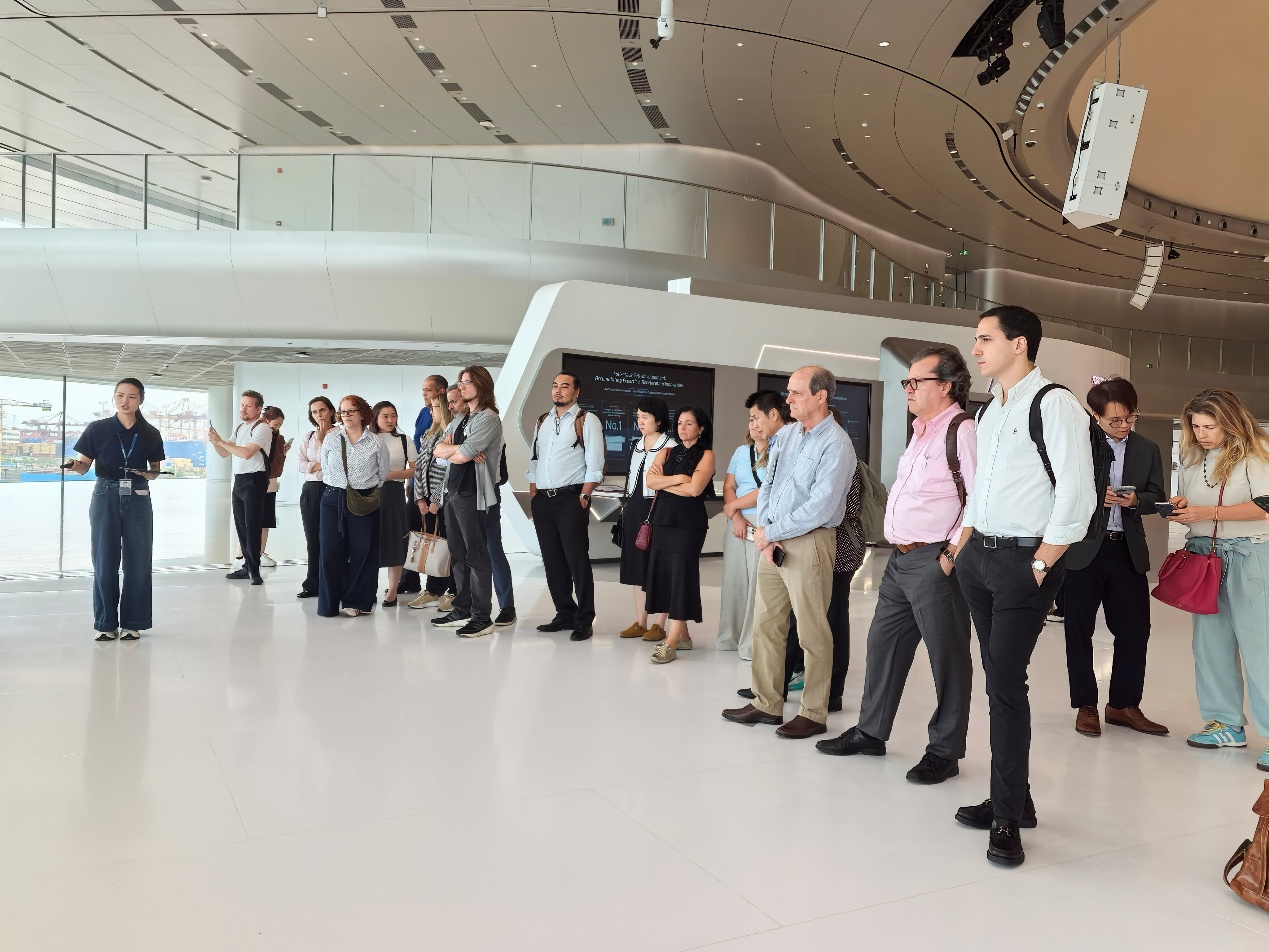
Brazilian businesses are looking to strengthen medical collaboration with the Guangdong-Hong Kong-Macao Greater Bay Area, noting that the region’s high-end medical technology will help boost the quality and efficiency of Brazil’s medical services.
Representatives said so after an industrial research tour to Shenzhen's Qianhai special economic zone on Monday, where they visited an entrepreneurial base, tech and life and health enterprises, a hospital, and a medical tech-applied healthcare center.
Murilo Buso, executive director of Parque Saude Medical Mall, a Brazil-based comprehensive health service enterprise, praised the Greater Bay Area’s business environment and technological capabilities.
He said he was amazed to see that the incentive policies and talent cultivation initiatives implemented by local governments in the Greater Bay Area have created a favorable business environment and a vibrant technological innovation ecosystem.
Buso expressed optimism over the region's future development and said he hopes to leverage China’s new technologies to help patients in remote areas of Brazil receive better healthcare services, especially elderly people.
Brazil is grappling with an aging population, with the number of people aged 65 years old and above reaching 10.9 percent of its population in 2022, up 57.4 percent from 2010, when the group only accounted for 7.4 percent of the population, according to the 2022 population census from the Brazilian Institute of Geography and Statistics. The South American country has a population of roughly 200 million.
“We also have a huge country and an elderly population. ... We have a lot of people living on farms, outside areas or (places) near the forests, and we have to give them the same care as you can give in big cities,” Buso said.
ALSO READ: Guangdong champions new industry model
Martha Oliveira, CEO of Grupo Lacos, an elderly care company in Brazil, was impressed by the patient care system in a maternal and child hospital, that offers seamless coordination between big data management and professional in-person care teams.
She discussed the disparities between how China and Brazil use medical technology. China has upgraded its medical technology rapidly to serve the general public, she said, noting that medical technology in Brazil has yet to be adopted on a widespread basis.
“Here, it (humans and technology) is all integrated together,” said the senior executive, who is a former director and president of ANS, Brazil’s national health insurance regulator.
Maristela Scenna-Romano, executive director of the Brazilian Chamber of Commerce in Hong Kong, spoke highly of the region’s advancing technologies. “This is mind-blowing. Like every corner we turn, what we are seeing is not the presence, not the future, but what comes after the future.”
As bilateral cooperation is extended, more Brazilian companies will come to the region, she said.
More Brazilian companies will collaborate with Greater Bay Area businesses by adapting to the local market and using the region as a gateway to tap the massive Chinese mainland market, Scenna-Romano added.
Davis Xu contributed to this story.
Contact the writer at sally@chinadailyhk.com
