

Ahead of conference in Athens, scholars stress importance of Sino-Greek philosophical dialogue
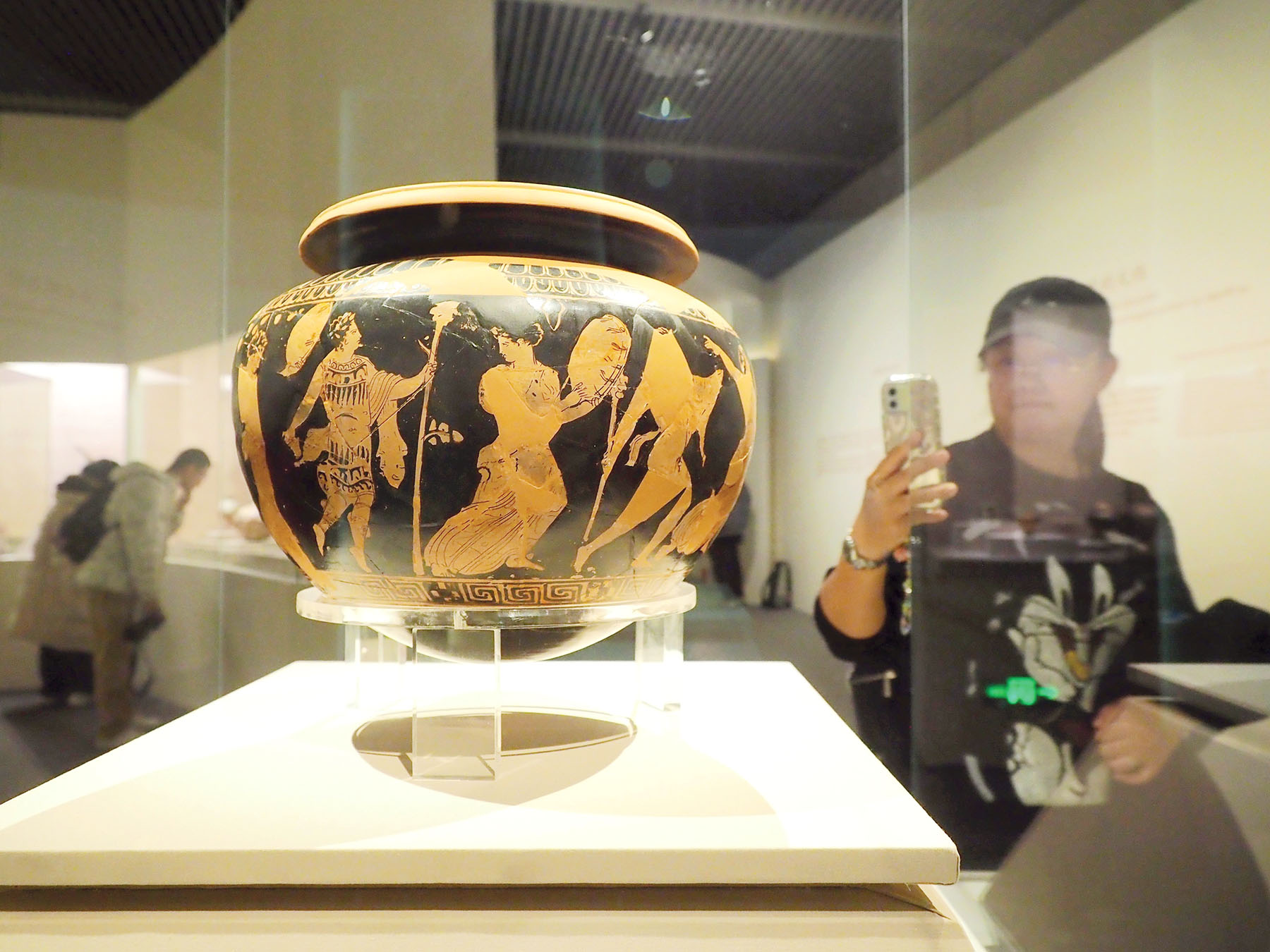
When asked which state he belonged to, the great ancient philosopher Socrates is said to have replied: “I am not an Athenian, nor a Greek, but a citizen of the world.” In ancient Greece, loyalty to one’s city-state was extremely important, but Socrates’ statement suggests a broader view; that people belong to a wider human community.
More than two millennia later, in an era marked by global challenges and deepening interconnection, that spirit of pursuing answers to the common questions of humanity across civilizations continues to resonate among scholars, who will gather in Athens, Greece, for the second World Conference of Classics to engage in discussions about eternal questions in a contemporary context.
Myrto Garani, professor of Latin literature at the National and Kapodistrian University of Athens, said classical studies have evolved significantly in recent decades. While philology and close textual analysis remain fundamental, the field has become increasingly interdisciplinary and comparative.
“One of the most important developments, in my view, is the increasing interest in comparing Greco-Roman philosophical thought with classical Chinese philosophy,” said Garani, who will attend the World Conference of Classics, scheduled from June 9 to 10.
“This comparison is especially valuable because it allows us to examine how two major classical civilizations, developing independently and in very different historical and cultural contexts, reflected upon remarkably similar human concerns,” Garani said.
Despite their historical and geographical distance, both traditions explored questions and developed sophisticated reflections on ethics, virtue, social harmony, self-knowledge, and the search for wisdom and a meaningful life, she said.
Pantelis Golitsis, associate professor of ancient and medieval philosophy at Aristotle University of Thessaloniki, echoed Garani’s view, saying that although the term “classical” has Roman origins and reflects a specifically Western interpretive category, cross-civilizational dialogue allows scholars to better understand Greek philosophy through comparison with other traditions.
Golitsis is also a member of the steering committee of the Center of Greek and Chinese Civilizations, which is a non-profit organization established in 2021 by four Greek universities, dedicated to the promotion of research into ancient Greek and ancient Chinese civilizations and their deeper understanding through a comparative approach.
“This is the noble aim of the relatively recent field of comparative philosophy. Chinese philosophy differs significantly from Greek philosophy in certain aspects; yet by understanding these differences, I, at least, have come to appreciate both traditions more fully. I feel like a participant in a global philosophical conversation,” said Golitsis.

Imre Galambos, professor emeritus of Chinese at the University of Cambridge, who specializes in medieval Chinese manuscripts from Dunhuang (in Gansu province), said the study of ancient manuscripts offers important lessons for today’s world, revealing that civilizations were far more interconnected in the past than many people realize.
Since 2023, Galambos has served as a Qiushi chair professor at Zhejiang University, and he attended the inaugural World Conference of Classics that was held in Beijing in 2024. Recalling his experience of the conference, Galambos said he truly believes that intercultural dialogue is the way forward in research and education.
“Classical studies — and the field of humanities in general — will no doubt play an important role in providing the foundation for intercultural understanding,” he said. “The way we understand the past has crucial ramifications for our own identity today.”
Drawing on examples from his research, Galambos compared the use of Chinese by non-Chinese-speaking communities with the spread of Latin texts across medieval Europe, saying such interactions generated “new texts, commentaries, and even entire written traditions in vernacular languages”.
“Much of the innovation that happened in pre-modern societies resulted from cultural contacts, from the adoption of foreign texts, objects, or ideas into new environments,” he explained. “Typically, this was not passive borrowing but rather creative adaptation, leading to entirely new developments. We can learn from such past examples and embrace the idea of dialogue.”
“Thinkers during the Warring States Period realized that no state could solve its problems alone,” said Yuri Pines, professor of Chinese studies at the Hebrew University of Jerusalem. “In conditions of constant competition and struggle, there can be no security for a single country without taking into consideration ‘all under heaven’ — the broader world order.
“In the Warring States the solution was to unify the entire Tianxia, or ‘all the world’ in a single universal state. Today this can be reinterpreted as something akin to ‘cosmopolitanism’, or the idea that individual problems cannot be solved without considering broader global challenges,” he said. “This logic, I think, is very relevant to the global initiatives of development and security.”
Pines said the diversity of the Hundred Schools of Thought during China’s classical period fostered a worldview that did not insist on a single exclusive truth to be imposed on everyone, and that such approach could facilitate mutual learning between civilizations.
“I think that it is very good for people nowadays to understand that there are different value systems because it will make people more tolerant, more open-minded, and maybe even more understanding of the advantages and disadvantages of their own civilization,” Pines said.
“There are different possibilities. There are different ways. Not because one of them is very good, and one of them is very bad, but because each one has its own choice, and its own route for development,” he added.
Contact the writers at xingyi@chinadaily.com.cn
