

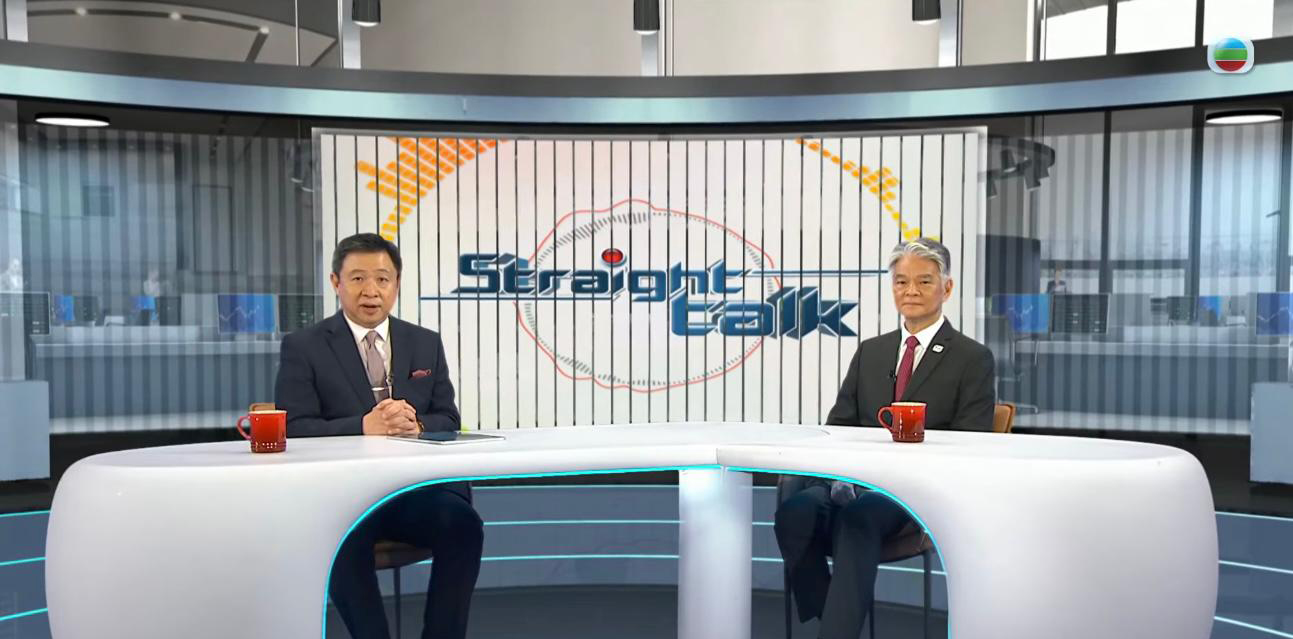
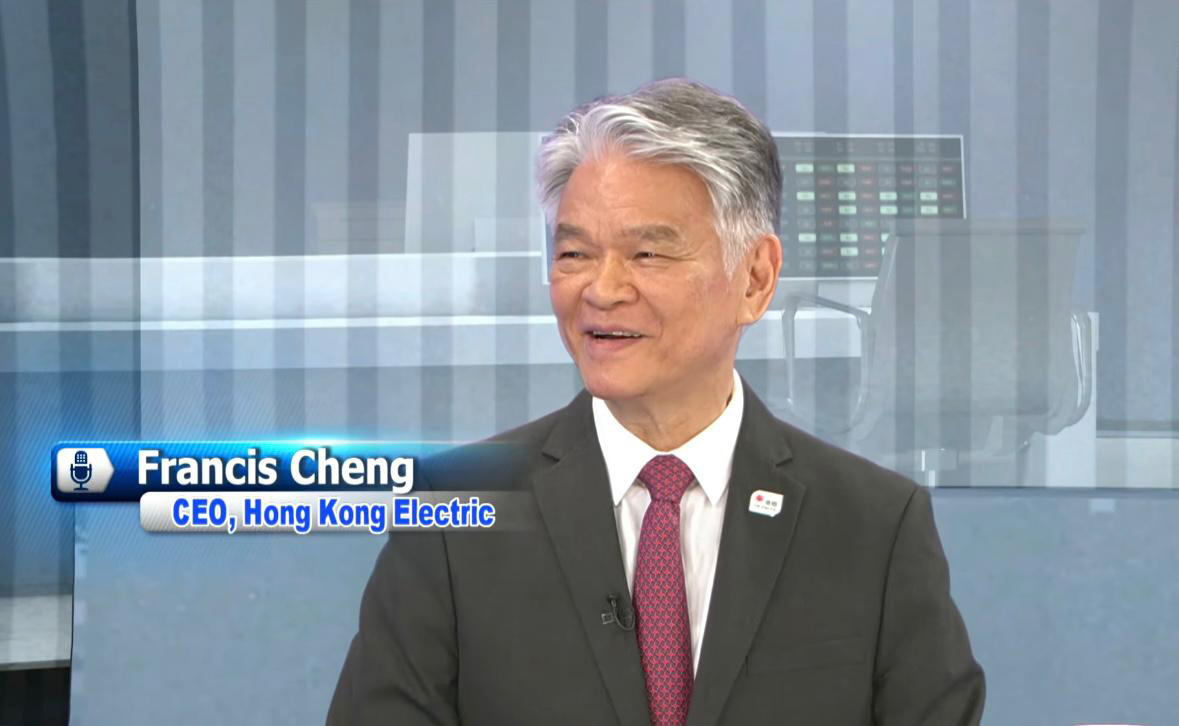
Managing Director of Hongkong Electric Company, Francis CY Cheng is on Straight Talk to talk about what's going on behind the scenes of electricity power generation and the improvements over the years, and what it really takes to keep the lights on for Hong Kong people.
Check out the full transcript of TVB’s Straight Talk host Eugene Chan Kin-keung’s interview with Francis Cheng:
Chan: Welcome to Straight Talk. I'm Eugene Chan, and with me this evening is the managing director of Hongkong Electric, Francis CY Cheng. Cheng joined the company in 1979 as a graduate trainee and has since witnessed and helped shape nearly half a century of Hong Kong's energy story. He brings a rare blend of scientific and engineering expertise with Fellowships of both the Royal Society of Chemistry and the Hong Kong Institution of Engineers. He's going to take us behind the scenes to understand what it really takes to keep the lights on for Hong Kong people. Welcome to the show for the first time, Francis!
Cheng: Hi, Eugene.
Fuel & tariff pressures
Chan: We have been talking about this episode for quite some time and finally the right time has come, especially with all the so-called energy crisis at the moment due to the Middle East war. I'm sure the viewers will feel that the fuel costs are going up all over the world and supply is really being squeezed like it had never been before. But your company, Hongkong Electric, has just announced a decrease in fuel clause charge and this is actually a further decrease of 4.4 cents per unit. Quite amazing news. And how have you managed to do this in this difficult time?
Cheng: We cannot make miracles. The fact of the matter is because of the present mechanism for determinations of what we call the fuel cost charge, or FCC, is based on a host of factors. And principally for determining the FCC for May this coming month, we have to rely on the fuel prices of January, February and March.
Chan: Right.
Cheng: So, in January and February, the fuel prices had been quite stable. The Middle East war started at the end of February, but soon after the crisis began, because of these restrictions of liquefied natural gas going through the Strait of Hormuz. So, we have to use an energy mix and we have to swap some of our energy supply arrangements to preserve the natural gas in our FSRU, what we call the Floating Storage and Regasification Unit. So, that is the reason why the March fuel prices were not sky-high compared to the international market.
Chan: Right, Francis, are you implying that price adjustment is going to be on the horizon? It's going to be very soon?
Cheng: Yeah, I think as we have revealed in our news release, starting from the middle of the year, the customer will have to expect a hike in the FCC.
Chan: Right. So, we must thank you for at least the current price decrease. But what if the actual, I mean, I'm sure the negotiations is happening right at this moment, what if they reach an agreement? Will everything be back to normal? Do we still expect to see the price increase or will we see a price increase no matter what in the next few months?
Cheng: Yeah, in the next few months I think the price increase will be there because the price hike has already appeared in the market. But going on, looking forward, if the war dies down quite quickly, then that price hike might be for a few months. But if the war continues, then the price hikes will continue.
Chan: Right, so you're saying that this Middle East war, although it's quite far away from us, I think all the Hong Kong people will be feeling the pressure, especially with all this supply squeeze and also the price increase in energy costs.
Cheng: Yeah, we expect so.
Chan: Right. So when that happens, I'm sure you, being in the driving seat, will think about, I think, coal in general is more accessible and it's sort of less volatile than the LNG that comes from Middle East. Why don't we rely on that for this moment? I know we're trying to go carbon neutrality, but in difficult times and say special time to do special things, right? So, is this the right time to rely back on coal?
Cheng: Yeah, I think in the past few years this coal-to-gas transition has been happening and we have been replacing four of our coal-fired units with gas-fired units. So, at the present moment we have four gas-fired units, three coal-fired units in order to meet the customers' supply demand. We cannot go back.
Chan: I see.
Cheng: So, for example, we cannot go back to using coal in these gas fire units. So, basically we have to have natural gas.
Chan: I see. Francis, so, if that's the case, what you're saying is whether the war sort of, whether it lasts longer, that will have a lot more long-term effects on us.
Cheng: Yes.
Chan: I'm sure you have to be considering, with all this geopolitical tension that's happening all over the world right now, especially with the Middle East, what contingency plans do we have in place and what is the worst scenario it's going to look like for Hong Kong?
Cheng: Well, the worst scenario is you do not have enough gas supply to sustain our electricity output. That will be the worst situation. But before you come to that worst situation, of course you have other alternatives. So, whether we can get gas from other regions rather than the Middle East, and if we have oil, then our gas-fired units will be able to burn oil even though this is not desirable and there are some technical difficulties in doing so. So, worst comes to the worst, we can use oil. But oil, you have to remember, is still very expensive. And if oil is used, then the emissions will be worse off as compared to gas.
Chan: Right. So, Francis, I think now you have given the picture of really challenging times ahead …
Cheng: Yes.
Chan: … not only for the company, for households and for businesses. As we know, Hongkong Electric supplies electricity to Hong Kong Island and Lamma Island. So, what practical tips will you give to the viewers tonight? What can we do? How can we mitigate this sort of anticipated rising energy costs? What can we do to minimize our energy, sort of try to minimize costs in the coming months?
Cheng: Yeah, I think we have to save energy; we have to save electricity. So, customers will have to make use of this relatively low-price window to develop their habits of saving energy. Say, for example, turn off the air conditioner when it is not required or use a fan together with the air conditioner.
Chan: I see.
Cheng: So, this would help to lower the energy cost. Switch off electrical appliances when they are not necessary. Keep the fridge maybe 70 percent full in order to make it more efficient. And for businesses, maybe doing some energy orders to see whether there are ways or measures to lower the energy bill. So, all in all, if you do these energy-saving measures, in the end, maybe the energy bill will come down or even come down and not go up.
Chan: From a practical point of view, can we approach your company if I'm clients of Hongkong Electric to ask for advice?
Cheng: Yeah, we provide free energy audits to businesses looking at ways to save their energy. We also provide some smart power services for subsidizing business to change to energy-efficient appliances.
Chan: So, viewers listen to this, I mean, the Hongkong Electric managing director has said that we can go up to this company to get more advice to minimize our energy costs in the months to come.
Cheng: Yes.
Reliability & AI
Chan: Thank you very much. Let's move on further to the current situation. I know that reliability is something that Hong Kong is very proud of. I know that you have what we call a “six-9s”, meaning your reliability level exceeds 99.9999 percent. So, what exactly is meant by that? And I'm sure people who have been served by your company didn't realize that we have been served by one of the most reliable power companies in the world. So, what exactly is this?
Cheng: One of the main things that we can achieve is most of our cables are put underground.
Chan: I see.
Cheng: And that was a thing that was not started by me, but by many generations of our forerunners. And even 100 years ago, when we did the energy supply to urban areas, we used underground cables rather than overhead lines. So, in Hong Kong, you won't see overhead lines in the urban areas. But in fact, in some other areas, even in some advanced cities, maybe Tokyo or other Asian countries, you can find overhead lines in urban areas. So, this is one of the things that our forerunners had the foresight to do. And then along that line, we have been undergrounding all our cables or most of our cables.
Chan: Right.
Cheng: And we have used cable tunnels to replace overhead lines so that these underground cables and cables and tunnels are shielded from the extreme weather effects in recent years.
Chan: So, maybe that's why Hong Kong has been enjoying this high reliability.
Cheng: Yeah, that is one factor. The other factor is our company has been some of … a forerunner in many of the technical aspects. For example, in the automation of our transmission and distribution network, our company is in fact one of the few companies in the world that have an impact on this and that carry out this type of thing. In fact, some of the equipment that was not available in the market and our engineers designed and manufactured themselves.
Chan: I see.
Cheng: So, we are keeping on this spirit and we are extending these automations to our low-voltage language now using Internet of Things, using AI and other advanced technologies.
Chan: Right, Francis, time for a short break now. We'll be right back with more Straight Talk.
Chan: Welcome back to Straight Talk. Earlier, we looked at how Hongkong Electric keeps our electricity system running with exceptional reliability. But beyond keeping the lights on, there's growing pressure to reduce emissions. Can Hongkong Electric meet the government's emission reduction targets? That's something that we will find out later on in the show. Francis, before we go into that area, I'd like to just reiterate that you have told us that in the coming months, the energy cost bill will be rising because of the Middle East war and all the geopolitical tensions. And what we can do is we try to learn to save our electricity, and going up to your company for advice is one of the options that we can do. And also you mentioned why Hong Kong is able to enjoy such a high reliability is all the substations that you put down and all the underground cables you have done. When you mentioned that, I'm sure the viewers is going to ask you, how do you actually monitor? For example, if you're going to have power towers, you can see them if there's something wrong. But of course, that's not good for health. But while we have all those advantages, how do you actually maintain their reliability because you can't see them?
Cheng: Yeah, I think for the network, what we call the transmission and distribution network, we have all the sensors to sense whether there are problems in the network. And if things happen or there are any faults that have been detected, then this automatic system will isolate the fault automatically.
Chan: I see.
Cheng: And our people in the control room will be able to see what has happened and then do the follow-up or mitigation measures correspondingly.
Chan: Right. So, apart from all these sensors, I think earlier before we started the show, I've asked you, you've been there for like maybe a few decades, and you said to me, with the advancement of technology, you have actually reduced your workforce from over 1,000 to now 400 people. So, do things like AI help in your day-to-day work as well?
Cheng: Yeah, we have to qualify when we said 1,200 to 400-something people is with the power stations. For the whole company, I think we have reduced from 3,000-something or maybe 3,300 to 1,800 now, over a span of 30 to 40 years. In terms of AI, what we are doing is we have been using AI for different fronts in our business. The first one is customer service. So, we make use of AI to respond to customers' written messages and requests. And we also use AI to try to analyze the customer’s call to see how we deal with them and whether we deal with these customer calls effectively. So, this is the first area. The second area that we have been using AI is in our work processes: how we could improve our work processes and how we could streamline the workflow, how we could automate the workflow. And we are doing these by using our line department general staff. So, they are not AI experts, but they can use these AI tools to improve these work processes. The third area that we have been using AI is how to do the on-condition measurement of the health of our equipment. So, for example, we have been developing an in-house AI model to make use of the past test data of around 5,000 cables, underground cables, and then to determine what are those cables that have not been tested, but we have some background information on these cables in order to select those risky cables for testing so that they will not fail whilst being applied to the customers.
Chan: Right, so Francis, it looks like you have been using AI applications in many aspects. Is it because you have done some background work on your company? Is it because of your collaboration with your stakeholder from State Grid Corporation of China that they are basically specialists in AI applications and technology? Has that been the major reason why you've been able to apply all this effectively?
Cheng: I think both. In fact, we started off our AI journey for quite some time. So, internally, we have been promoting the use of AI throughout our own businesses. And we have our own innovation steering structure in order to drive this innovation. And at the same time, we have been cooperating with mainland companies as well as the local universities in trying to make use of these AI and other advanced technologies to improve the on-condition monitoring of our equipment.
Chan: I see.
Cheng: So State Grid is one of our major shareholders. So, we have been cooperating with them in many aspects, because they have good manufacturing capability and our people have the experience and the design capability. So, we have been co-inventing with them some of the new equipment. We have been using their equipment in our local context in some scenarios that they have not made use of. And also we have been using the standard products to develop add-on capabilities.
Emissions, energy mix & regional strategy
Chan: Right, Francis, I'm going to ask you an even more important question. Thank you for telling me about the State Grid, what they can do for the company. I'm sure the viewers will be wondering when- I'm sure you'll be under pressure from all aspects, I mean, as driving the ship. You have the government, even the country, we're looking at reducing emissions. At the same time, we have gas supply constraints that you can get away from, especially what's happening. So, realistically, can both objectives be met and what have to give if it doesn't work? I think I'm sure the viewers will want to know.
Cheng: Yeah, I think Hong Kong has already declared, the Hong Kong Special Administrative Region government has declared its carbon reduction plan and that is by the year 2035 the city's carbon emissions will have to be halved as compared to the 2005 level.
Chan: Right.
Cheng: And then we are targeting for carbon neutrality by the year 2050. So, the journey has to go on, but in this journey, Hong Kong cannot generate its own zero-carbon electricity. So, we have to do regional cooperation.
Chan: I see.
Cheng: We are discussing how to import zero-carbon electricity from the Chinese mainland to this area.
Chan: Francis, recently I'm sure everybody will be aware that we have the 15th Five Year Plan from national level and then Hong Kong is doing our five-year plan as well. Are you saying that because one of the aims is to have energy security, given what's happening in the world and also green energy for our development, will we be relying more and more with cooperation with the mainland because they have all this cleaner or so-called renewable energy like nuclear or wind or even solar? Is that the direction we're moving?
Cheng: Yeah, I think at least in the interim, to achieve the 2035 goal, the carbon reduction by half, and we have to do this regional cooperation. And looking moving forward further along and whether there would be other zero carbon technology that has come up that can do the job, say for example, hydrogen, green hydrogen, whether we can have the green hydrogen economy by then, and then we have to wait and see. But I think if there are no other suitable alternatives, then regional cooperation is the direction they have to head for.
Chan: Right, Francis, I'm going to ask you the last final question that I'm sure the viewers will be really keen to know. That you know, as our life goes on, a lot of cost of living has increased, some has decreased. And you mentioned that in the foreseeable future there will be increases in energy costs. So, with all these things along the line, with working with the mainland, with cooperation and everything, do you foresee that we have to spend more money on infrastructure, meaning that will be passed on to the customers, or do you think in the long run, energy costs are going to come down?
Cheng: In order to bring the zero-carbon electricity from the Chinese mainland to Hong Kong SAR, you have to inevitably build a big transmission network for it. So, that would be quite a substantial investment.
Chan: You mentioned that, yes.
Cheng: But the consequence would be that in the long term, you have much more stable energy prices. And because of the advances in green energy in the mainland, then sure we will be able to benefit from it.
Chan: Right, Francis. I'm afraid we have to leave it there. And thank you so much for your insights.
As a former Saudi oil minister once said, “The Stone Age didn't end because we ran out of stones. It ended because we found something better.” The challenge for Hong Kong is not just securing supply, but embracing what comes next. Have a good evening and see you next week.
