

Cultivating 'most human' qualities best way to work with new tech, experts say
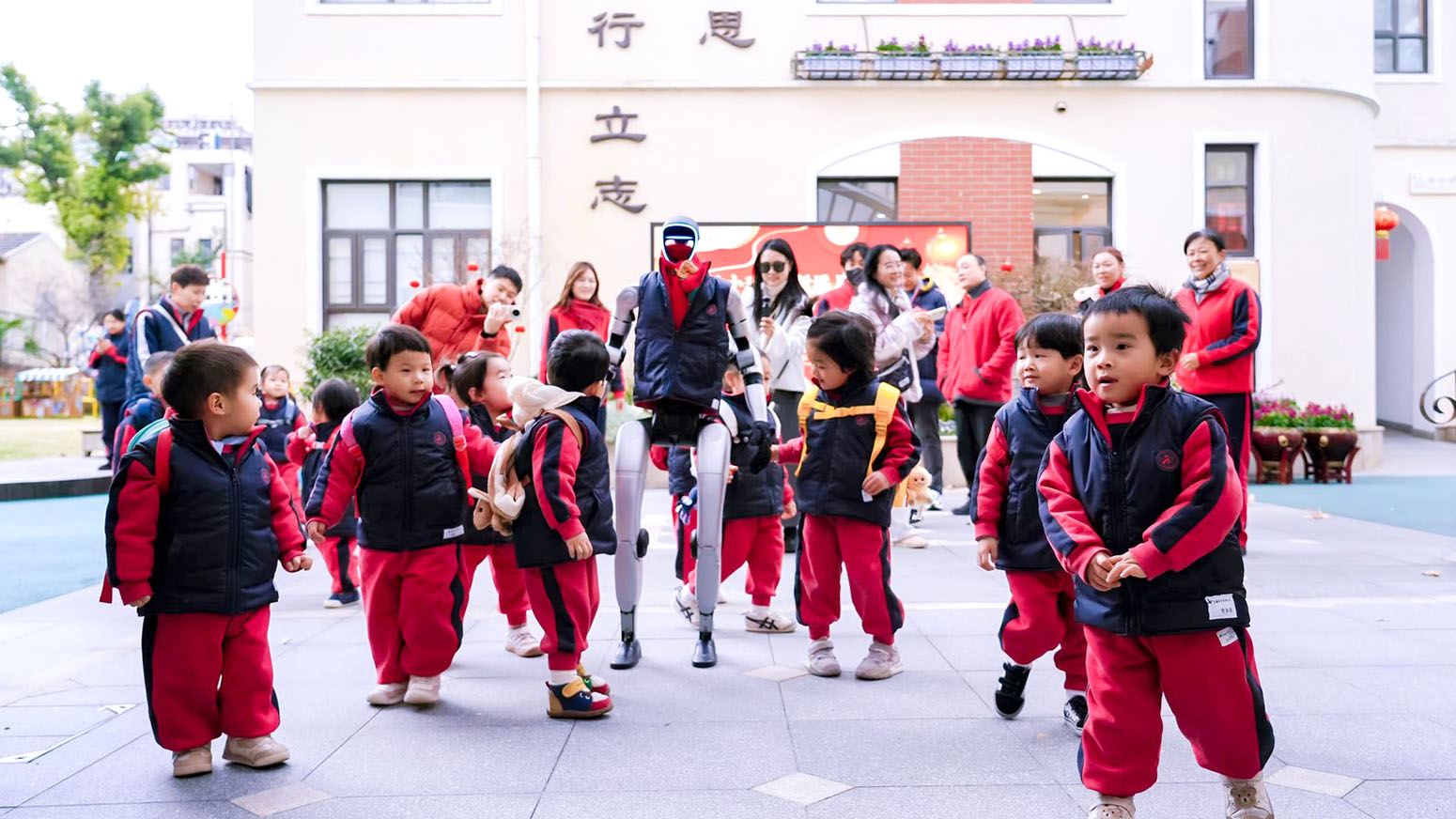
Four out of five parents in China with mid-to-high net worth are worried that artificial intelligence may affect their children's future job prospects, while 20 percent admit they have no idea how to prepare for the changes, a survey found.
Published by the Shanghai-based Fudan International School of Finance in April, the survey results confirm a public perception that AI is significantly reshaping the future job landscape. This has raised parents' anxiety about their children's education, and selecting the right career paths.
Despite these concerns, no one has yet clearly articulated what new skills and qualities young people will need to thrive in an AI-driven future. However, there is a growing consensus in teaching and academic circles about the value of "emotional education".
"The more pervasive machines become, the more we need to cultivate the 'most human' qualities in the young generation," said Wu Rongjin, principal of Shanghai Huangpu Luwan No 1 Central Primary School.
Education experts believe preparing young people for the future involves developing and strengthening "uniquely human" qualities that cannot be replaced by machines, and fostering lifelong learning habits and the ability to keep acquiring new skills. School education should shift from merely acquiring knowledge to developing skills that cultivate human traits like empathy, creativity, ethics and collaboration, they said.
"In the legal field, AI can read thousands of pages in seconds but doesn't understand justice; and AI in medicine can diagnose health conditions but cannot hold a patient's trembling hand," Wu explained."The magic of human-machine collaboration lies here: Machines are responsible for efficient execution, while value judgments and the development of a humane character are beyond their reach."
ALSO READ: 'Go West' teachers leave lasting mark
In some primary schools in Shanghai's Huangpu and Jiading districts, weekly "emotional education classes" have become a compulsory part of the curriculum. The ultimate goal is to help children grow into well-rounded individuals with positive emotions, a stable mood, and "noble" character traits, that is, the ability to show concern for others.
"These qualities distinguish humans from machines, and are essential for navigating future challenges and adapting to societal changes, especially in the AI era," said Wu.
"Emotional intelligence, along with independent critical thinking, logical reasoning, and perseverance, benefits an individual's lifelong development," she said.

Shining qualities
In emotional education classes, teachers typically focus on themes, such as self-awareness, emotional management, empathy, interpersonal communication, and the value of life. The classes also help students explore ways to relieve stress and adjust their mindset.
Teachers at Shanghai Huangpu Luwan No 1 Central Primary School said that during recent classes, students were encouraged to nominate "unsung heroes" around them.
"It was an opportunity to allow children to recognize the shining qualities in ordinary individuals who might not be highly visible and not receive the most academic awards, and inspire them to see the strengths in everyone," said Bao Yinglei, a teacher at the school.
She said the school had installed cameras in the corridors to quickly identify potential problems when students gather in groups. However, these cameras have now become a window for capturing moments of warmth and concern.
"The cameras record how surrounding children react if a student falls. These acts of kindness become topics for discussion in emotional education classes," Bao said.
Zhou Shuqun, master of Hiba Academy Shanghai, a bilingual school of Wellington College Education (China), said that over the last few years the school had implemented various practices to help students develop "uniquely human qualities".
One example is emphasizing oral expression in primary school classes to cultivate a pupil's ability to listen to others with respect and improve self-expression and group collaboration. For middle school students, debating competitions help develop critical thinking and oral expression skills, she said.
When someone makes others feel comfortable in interactions, it often leads to successful collaborations and business deals, experts pointed out.
Some kindergarten teachers are also changing the way they interact with their students.
Xu Hui, a kindergarten teacher in Shanghai, said when conflicts arise among children, instead of providing a direct judgment, she and her colleagues now encourage the children to express themselves and then switch roles to describe the situation.
"This process is more beneficial as it helps the minors gradually acquire the ability to better communicate and collaborate with others," she said.
Some kindergarten teachers believe that preparing children for the future must be rooted in moral development, the basis of humanity that AI cannot replace. Core competencies in this area include empathy, kindness, collaboration, and reverence for life, they said.
"Through daily interactions with young children in an atmosphere of passing on love and care, teachers instill these virtues and qualities into the minors' hearts," said Xu.
Lin Min, deputy principal of the Shanghai Municipal Kindergarten, said the school emphasizes that teachers should respond to children in a positive and encouraging way.
Since last year, the teachers at the school have been meeting regularly to discuss real-life cases that occur daily in their classes. They discuss how they should respond to the pupils in such situations, and whether there are better ways to address and guide them.
"The way a teacher responds to a child will influence how the child responds to others in their later lives. This is a gradual accumulation process that leads to qualitative changes in their characters," said Lin.
She said despite AI's development, the teachers believe that a positive outlook and a sense of national pride and responsibility, are human qualities that AI lacks.
She cited as an example the humanoid robot half-marathon in Beijing in April, saying what touched her the most was when a robot failed to complete the race, its programmer cradled it as they left.
"Machines will accomplish many things that surpass human physical limits, but they can never win over human emotions. Those moments when people give love and gain trust from each other cannot be replaced," said Lin.
Soft skills
With the belief AI will perform repetitive and standardized jobs, about 60 percent of parents now prioritize "soft skills", such as character building, interpersonal communication, and problem-solving for their children's development, the Fudan survey also found.
This compares with 43 percent who still place securing a seat in a top university first, according to the survey of 1,900 families across the country.
Wang Shuangchen, 39, from Chongqing, signed up her 12-year-old son for an extracurricular public speaking course a year ago after discussing it with him.
"Even though AI tools can assist in writing a speech draft, there is still a significant difference in the personal charisma each individual displays when speaking on stage," said Wang, a book editor.
"My husband and I believe that having the ability to deliver compelling and engaging speeches in public is a highly competitive skill in the future job market," she said.
The awareness that her 11-year-old daughter needs skills that are hard for machines to replicate prompted Lu Yiyi, a mother from Shanghai, to make changes in their lives. Since September, the fifth-grader has been taking the subway to and from school alone, a 60-minute journey that includes transferring between lines.
"For my child, traveling between home and school alone involves finding the way, taking charge of her own safety, managing her time, and coping with unexpected situations," said Lu, adding that her experience in the graphic design profession has heightened her awareness of the pressures brought by AI.
This personal experience led her to reconsider how to better equip her child for the future. "Communication skills and the capacity to tackle real-world challenges are not what kids can learn at school through exams. They are developed via real experiences like these," she said.
Such practices align with the new educational paradigm of "human flourishing" proposed by the Organization for Economic Co-operation and Development in recent years.
Michael Stevenson, founder of the OECD's High Performing Systems for Tomorrow Initiative, said under the concept of human flourishing, the goal of education is to help every youth develop core competencies, including adaptive problem-solving.
Chinese-style emotions
Wu, the principal, believes Chinese people possess unique qualities, such as humility, subtlety, diligence, and perseverance, which extend to a thirst for knowledge and a love for all aspects of life. She said it is important to highlight these qualities when implementing emotional education.
The country's rich culinary traditions are an embodiment of Chinese people's diligence in her eyes, so the school encourages students interested in cooking to experience this firsthand by preparing dishes.
When a group visits the school, the students are now capable of working together to organize and prepare a meal of typical Shanghai dishes for the guests.
Once a child is able to cook, he or she is willing to prepare food for the family, which improves the atmosphere at home, said Wu.
"Whenever a child's strengths are recognized and encouraged, they gain confidence and stand tall," said Wu, who believes that teachers should identify the potential in each child to help them succeed, which she believes is the essence of education: focusing on the growth of each individual.
Zhao Zizi, a senior middle school teacher in Shanghai for three decades, said even though AI has become powerful, it is not a "person" a child can aspire to emulate.
ALSO READ: Power of education shines in Xizang
"AI is just a tool to help us get closer to people who we admire and are worth learning from," she said.
Experts have pointed out that embracing AI, which will systematically enhance learning and work efficiency, is an irreversible trend.
The next generation will create AI, rather than just consume AI, and they will expand what's possible for the good of society and humanity, said Michael Levitt, 2013 Nobel laureate in chemistry, during the World Laureates Forum 2025 held in Shanghai in October.
Many primary and middle schools have been encouraging young people to use AI to solve social problems they encounter. For instance, a group of primary school students in Shanghai's Huangpu district attempted to use large language models to create movie descriptions for the visually impaired.
Through this process, the children not only mastered a technological skill, but also understood that technology should always serve human welfare, said teachers involved in the project.
Contact the writers at zhouwenting@chinadaily.com.cn
