

China's fast-growing NPC performances are under scrutiny after a performer's interactions with visitors triggered criticism over how far immersive experiences should go, Yang Feiyue reports.
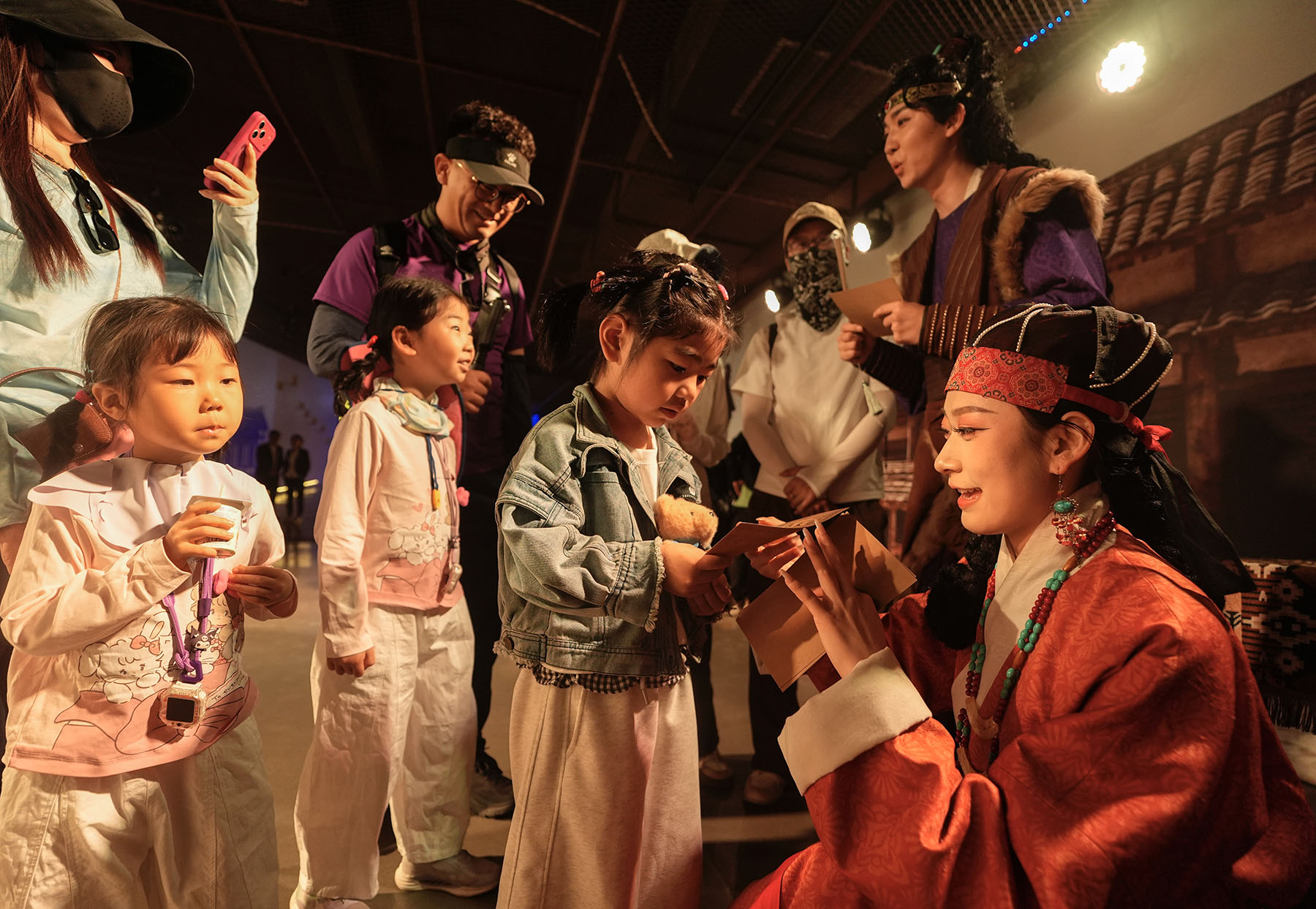
A viral video of a costumed performer feeding candy to a tourist has forced China's immersive tourism industry to ask a difficult question: where does hospitality end and impropriety begin? A bell rings. A curtain parts. A young man in a crimson-and-black robe steps out, smiling. He lifts a red veil, bites a lollipop and leans toward a visitor.
Phones rise across the crowd.
The performer, known by the stage name Little Yellow Fish, became one of the most recognizable non-player characters (NPCs) at Gexian Village Resort in Shangrao, East China's Jiangxi province. His performances relied on improvisation and close interaction with visitors.
For young women, he might drape a red veil over their heads, lightly touch a lollipop to their cheeks or interlace fingers. For young men, the interactions were often more playful, including mock kisses through a veil or exaggerated teasing.
READ MORE: Tang canal rises as a glowing destination
The formula worked. Clips spread rapidly across Douyin, China's version of TikTok, helping turn the resort into a viral tourist destination.
Then came the "blackfish". On May 1, People's Daily's Minsheng Weekly published a commentary citing Little Yellow Fish as an example of tourism performances that blurred the line between entertainment and inappropriate behavior in pursuit of online traffic. The following day, both the performer and the resort issued public apologies.
The changes were immediate. The lollipop is now handed directly to visitors rather than shared through physical interaction. The resort also announced revised performance guidelines, expanded cultural training for NPC actors and a long-term public feedback mechanism.
"We extend our sincerest apologies to netizens and tourists," the resort said in a statement.
The incident has drawn attention to one of the fastest-growing sectors in China's tourism industry: immersive NPC performances designed to turn scenic areas into interactive experiences.
The new economy
China's tourism market continues to expand. During the five-day May Day holiday, domestic trips reached 325 million, up 3.6 percent year-on-year, according to the Ministry of Culture and Tourism. Tourism spending rose 2.9 percent to 185.5 billion yuan ($27.1 billion).
At the same time, travelers are increasingly seeking interactive and emotionally engaging experiences rather than traditional sightseeing alone.
According to market consultancy iiMedia Research, China's "emotion economy" — consumer spending driven by emotional connection, social interaction and immersive participation — reached 2.31 trillion yuan in 2024 and is projected to grow to 4.5 trillion yuan by 2029.
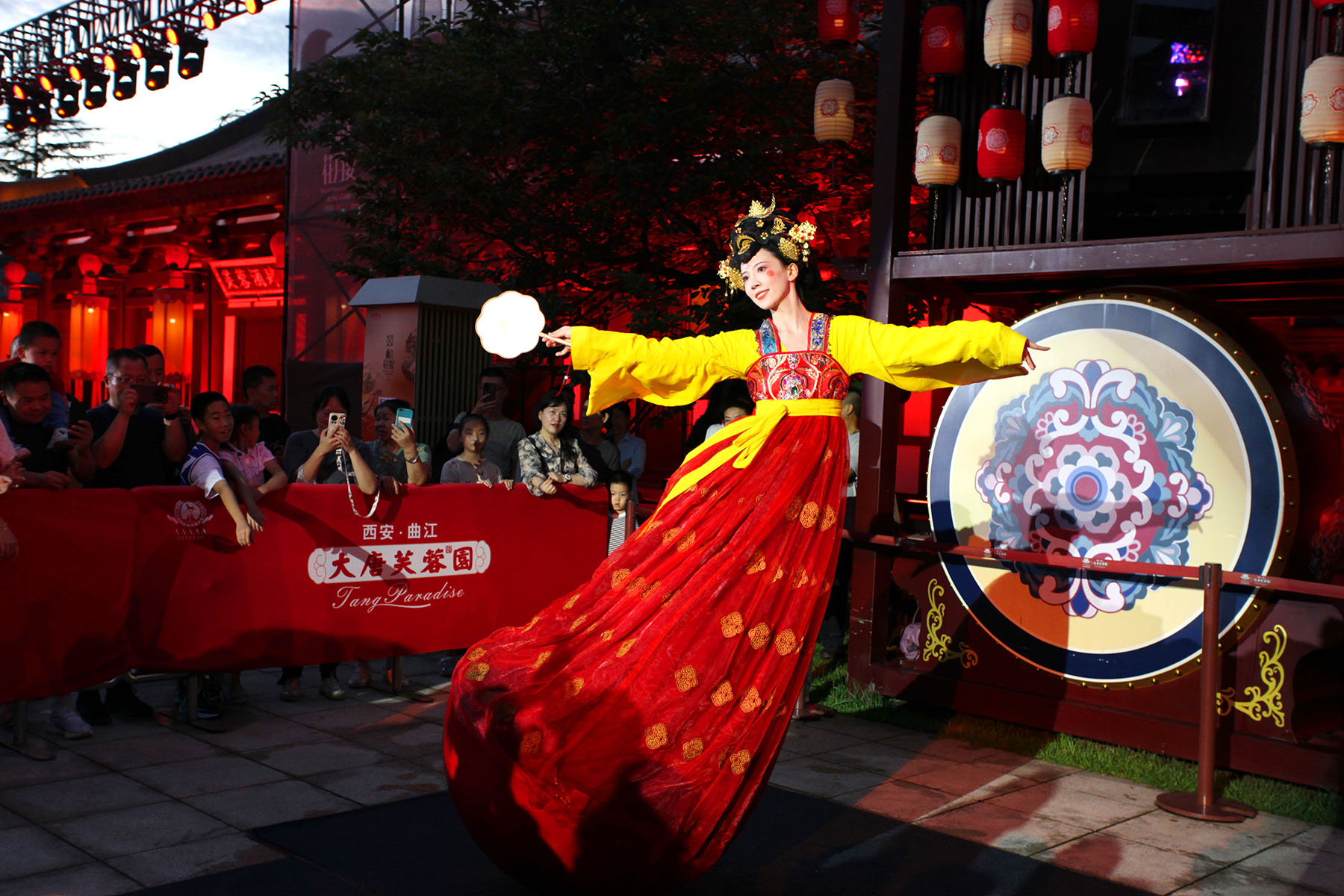
NPC performers have emerged at the center of that trend. Scenic areas across China now employ actors portraying historical, literary or fictional characters who interact directly with tourists. A successful NPC can generate repeat visits and, in some cases, nationwide online attention.
The rapid growth of the industry has produced sharply different styles.
Some performances rely heavily on exaggerated physical interaction and short-video appeal. Others focus more on storytelling and cultural interpretation.
In Tangshan, in North China's Hebei province, for example, an NPC portraying the Tang Dynasty (618-907) poet Li Bai has become a popular attraction by improvising classical poetry, exchanging couplets with visitors and offering humorous advice to young tourists. The character has drawn repeat family visitors without relying on controversy or provocative interactions.
The commercial impact of successful NPC performances has been significant.
In Kaifeng, in Central China's Henan province, Wansui Mountain resort introduced a matchmaking character based on Wang Po from the classic Chinese novel Outlaws of the Marsh, also known as The Water Margin. The elderly matchmaker character became a viral sensation online. According to the resort, annual revenue reached 1.27 billion yuan in 2025, up sharply from three years earlier. The resort now stages more than 2,000 performances daily and employs over 1,000 NPC performers.
In Changchun Zoological and Botanical Park, in Northeast China's Jilin province, a performer portraying the Monkey King from Journey to the West gained national attention after joking during a performance that snacks, including dry rice crackers thrown by visitors, were "too dry". The clip spread widely online, and the performer later became known as "Snow Cake Monkey" after those crackers. The park authorities expect annual attendance to reach 3 million visitors in 2025, compared with around 700,000 previously.
For Zeng Bowei, director of the research center for China's tourism economy and policy at Beijing Union University, the NPC boom reflects broader changes within China's tourism market.
"About 80 to 90 percent of China's roughly 16,000 A-grade scenic spots face a certain degree of homogenization," Zeng says. "Not every destination has world-famous natural scenery. In a highly competitive market, relying only on landscapes is no longer enough."
He points out that demand for immersive participation accelerated after the pandemic.
"Tourists no longer simply want to sightsee, they want interaction and participation. NPCs meet that demand," he explains.
At the same time, growing competition among scenic areas has increased pressure on operators to attract online attention.
"Trip numbers are increasing, but per capita spending is declining. Operators are under pressure to find lower-cost ways to generate visibility," he adds.

The boundary question
The debate surrounding Little Yellow Fish also revealed divided public opinion online.
While some commentators supported tighter oversight of tourism performances, many young social media users defended the interactions as voluntary and harmless.
Zeng believes the controversy reflects the lack of clear industry standards.
"Personally, I do not support this kind of performance style," he says bluntly.
"But the challenge is that there is no clearly defined boundary. Certain behavior may not violate regulations, yet some people still consider it vulgar or inappropriate."
He cautions against discouraging innovation altogether.
"If every attempt at innovation immediately becomes a public controversy, operators may become afraid to experiment at all," he says.
Industry observers say the rapid expansion of NPC tourism has outpaced the development of professional training and oversight systems.
Wu Guoping, a senior official with the China Tourism Association, has proposed formally recognizing NPC performance as a profession, including the establishment of training programs, industry standards, and stronger labor protections.
Experts concur that the most sustainable NPC performances are those closely tied to local culture and storytelling rather than short-lived online trends.
Zeng considers that successful characters should reflect the history and identity of their destinations while offering different forms of interaction for different visitor groups.
ALSO READ: Cruising through the capital
"Not every NPC needs to rely on exaggerated performances. Some can succeed through language, knowledge or cultural interpretation," he says.
In its apology letter, Gexian Village Resort claims that it will place greater emphasis on local cultural themes, including tea culture, Southern Song Dynasty (1127-1279) poetry and traditional crafts.
For China's tourism industry, the debate surrounding a single lollipop performance has become part of a broader discussion about how immersive tourism should develop as the market continues to grow.
The lollipop was a warning, not a verdict. For China's fast-growing immersive tourism industry, it became a test of how far performance, intimacy and online attention can go before the experience stops feeling welcoming.
Contact the writer at yangfeiyue@chinadaily.com.cn
