

The Chinese National Geography magazine's new nature center allows visitors to learn about and connect with the country's largest desert, Yang Feiyue reports.

East of Alar in the Xinjiang Uygur autonomous region, across the Tarim River, the city's green landscape gives way to an expanse of ocher. This is the northern edge of China's largest desert, the Taklimakan, one of the thresholds where ancient Silk Road travelers once stepped into the sea of sand.
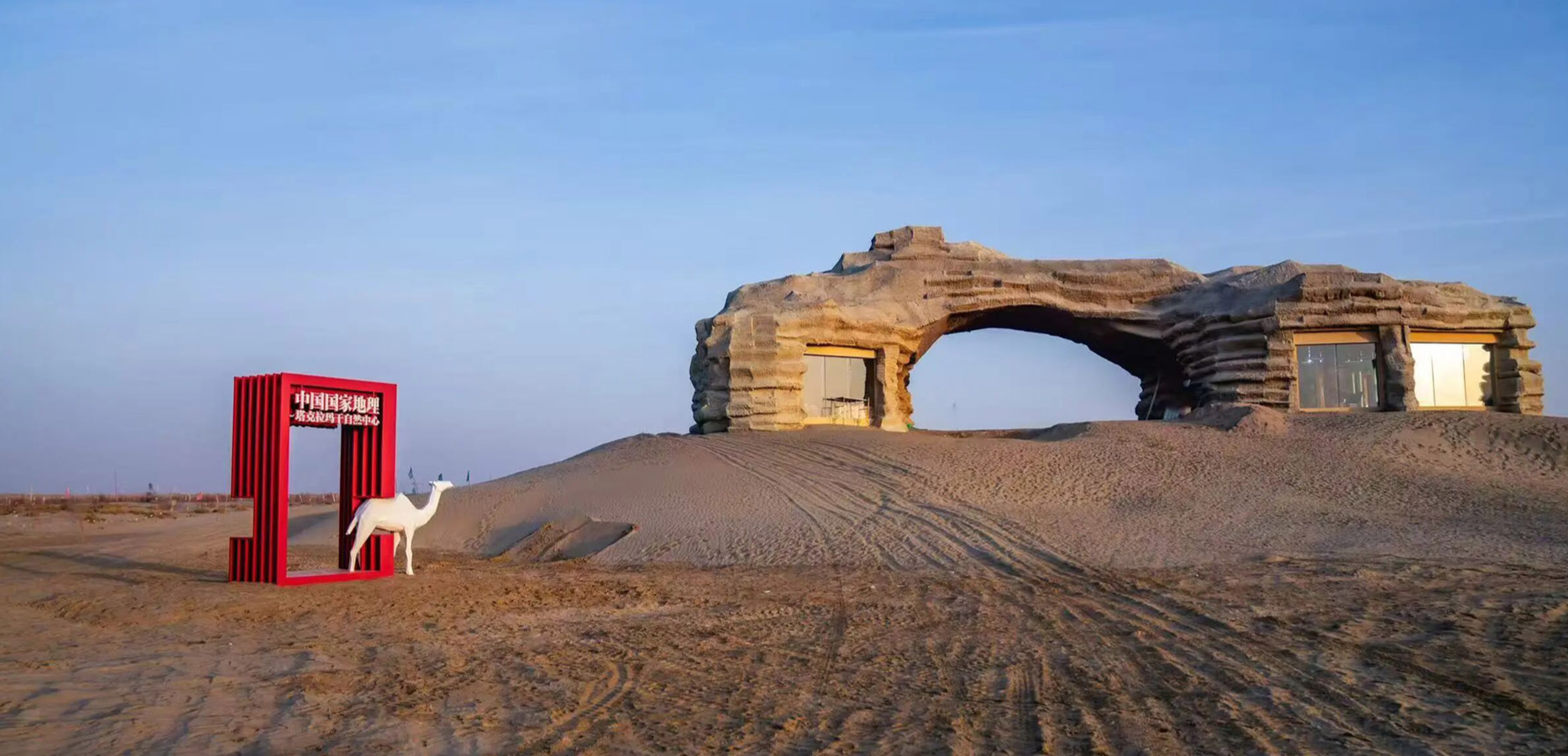
Here, a new building has recently risen from the earth, its color indistinguishable from the dunes around it. Next to the building is a layered red frame, the signature of the Chinese National Geography magazine, standing against an expanse of ocher sand and brilliant blue sky — this is the Taklimakan Nature Center.
"Nature centers are small-to-medium integrated experience spaces, mostly under 1,000 square meters, that use scientific and artistic means to offer a deep, systematic interpretation of nature," says Guo Yingqian, general manager of the Chinese National Geography Camp.
Three narrative threads — The Realm of Life, The Way of Survival, The Path of Ecology — unfold across the exhibition space, offering a systematic decoding of what makes the Taklimakan tick.
READ MORE: Diversity powers ancient Silk Road hub's modern development
Approaching it, a nine-layer topographical model meticulously carved from contour data brings the region's scale into focus. The snow-capped Tomur Peak, the highest point of the Tianshan Mountains, rises to 7,443 meters, while the desert floor lies at an elevation of just over 1,000 meters. A glowing globe reveals that even from space, this sandy expanse is unmistakable.
Surrounding mountains trap moisture, leaving the desert with an average annual rainfall of just 26 millimeters. At the center, visitors can turn the device and watch sand swirl, creating their own miniature dust storm. Additionally, a massive interactive thermometer lets visitors feel the region's wild swing between scorching days and freezing nights.

But one of the most astonishing revelations is when a mirror installation shows visitors a staggering amount of meltwater from surrounding peaks seeping underground, accumulating over eons into a subterranean sea beneath the sand.
Other artfully reproduced images include snow-brushed dunes and the ancient cities of Loulan and Niya buried beneath the sand.
"The Realm of Life chapter opens with the Extreme Realm exhibits, reshaping people's perception of the desert," Guo explains.
It then moves into the Desert Creatures section, which systematically presents the survival strategies of dozens of endemic animals and plants that have evolved to survive drought and high temperatures.
Among them, the wild camel takes center stage. Visitors can stand beside a life-size model to touch its head and hip, then push a button to hear the sound of a satar, a Uygur bow-stringed instrument.
"The idea is to make learning tactile and memorable," she says.
Visitors learn that wild and domestic camels diverged 800,000 years ago. Fewer than 1,000 wild camels remain today, making them rarer than giant pandas.
Many have found it fascinating that these wild camels' oval red blood cells keep flowing even in extreme dehydration, and their specialized coats deflect the desert's searing heat, Guo says.

Nearby, a massive dune-shaped installation teems with hand-drawn, meticulously detailed life.
Tarim hares and foxes use oversized ears to radiate heat. Desert beetles have fused wing covers that function like personal "air conditioners", capturing exhaled moisture. Long-eared jerboas are the desert's "jumping stars", while great gerbils, or "desert rats", build sprawling underground cities with distinct quarters for sleeping and storage.
"We've added interactive elements throughout," Guo notes, adding that 30 scientific models are on display.
The nature center's staff expect visitors to find the most delightful surprise in the Shifting Dunes section, where six classic dune types, ranging from crescent and linear to parabolic, transverse and dome, have been reimagined as sculptural "little cakes" displayed in jewel cases.
The nature center also weaves in human stories in a colorful reconstructed Oasis Dwellers area that re-creates domestic life along the desert's edge.
Patterns of almonds, pomegranates and grapevines bloom on fabric stamped by traditional wooden molds. Local distinctive Atlas silk shimmers, while four traditional housing models, such as the wind-resistant Ayiwan (a square, protruding-top structure), depict daily life.
Recordings of the Muqam suite fill the air, featuring eight instruments. An interactive backdrop invites visitors to "join" the ensemble, reaching through cutouts to strum a dutar, a two-stringed lute that is characterized by its long neck and pear-shaped body, alongside illustrated musicians.
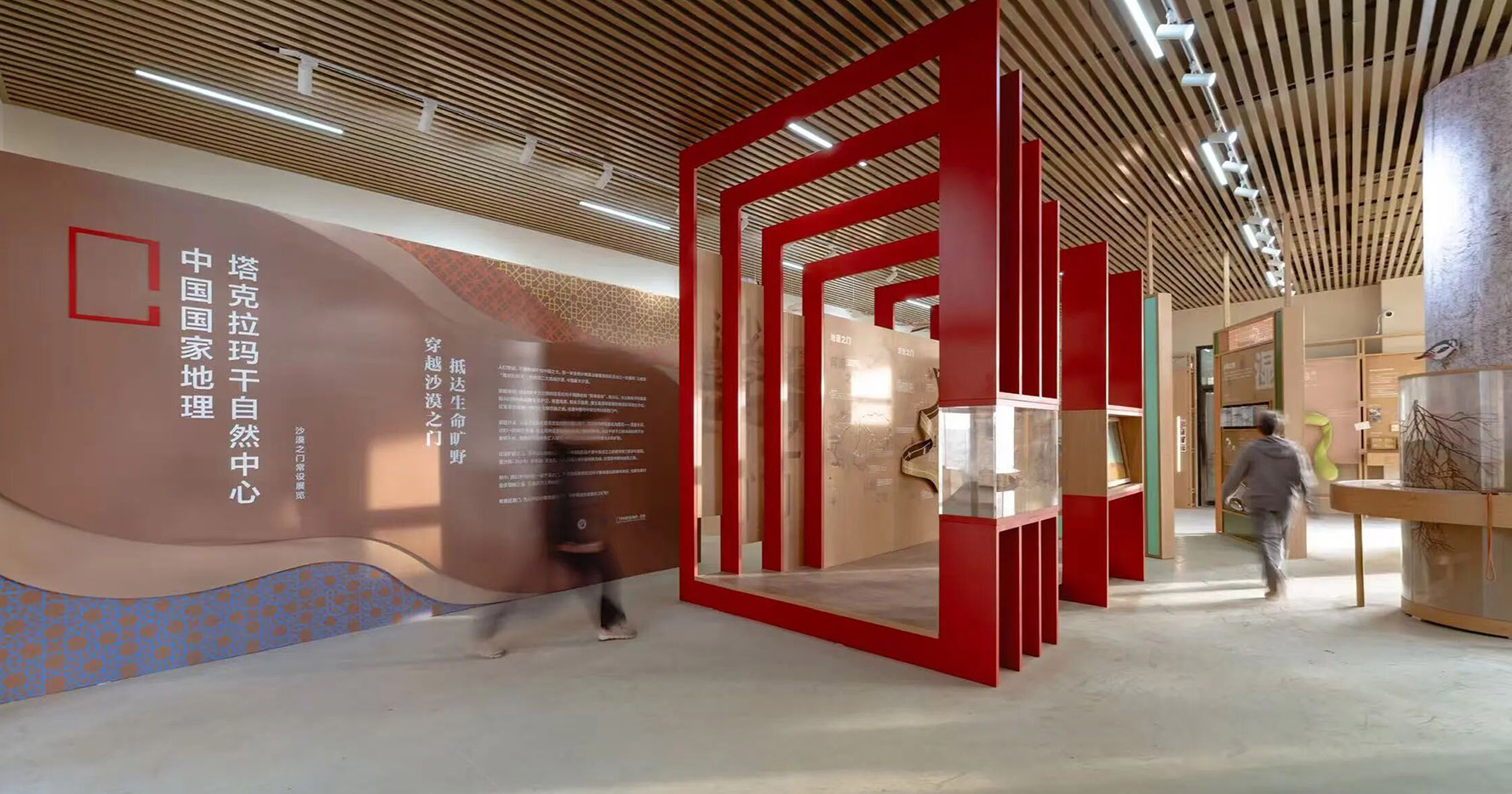
The Way of Survival chapter then turns to the wisdom of coexistence between people and the desert.
"The 'Alar Miracle' section shows how the local residents created agricultural miracles on the Gobi Desert, ingeniously using saline-alkali water to cultivate 'inland seafood'," Guo says.
Seventy years ago, though this area was barren, locals managed to grow cotton and farm blue crabs and prawns to ship across China.
"The people here didn't just endure. They created beauty, music and poetry," she notes.
The final section, Desert Arteries, celebrates the roads and railways that now traverse the sands. It exposes visitors to the challenges in building those engineering marvels on shifting dunes and defending against relentless erosion.
The exhibition's showstopper is the Green Belt display, one of humanity's longest-running desert-containment projects. Over 46 years, multiple generations have built a 3,046-kilometer-long green belt around the Taklimakan. Satellite imagery shows the once-barren land now encircled by green.
Visitors can literally touch the belt. A strip of Xinjiang long-staple cotton invites handling, and they can stamp a card with images of the plants that made it possible — poplar, saxaul, tamarisk, and calligonum.
"Put on the green scarf, and feel the desert's embrace," the display says.
The Taklimakan Nature Center is part of a broader vision that extends far beyond Xinjiang.
On the opposite edge of the country, another Chinese National Geography project has taken shape — the Qianhai Nature Center in Shenzhen, Guangdong province.
Sitting along the shores of Lingdingyang Bay, the center transforms the daily drama of dusk into a hands-on science experience. Visitors can use dark filters to safely watch the sun sink into the sea, flatten the solar disc with a curved prism that mimics Earth's atmosphere, and learn about the elusive "green flash" that sometimes crowns the vanishing sun.
A large interactive screen offers real-time sunset forecasts and simulations that show the timing and position of the sunset's shift throughout the year along the bay's 68-km coastline.
The two centers represent a growing network of the Chinese National Geography Camp's aim to transform how people experience the natural world, according to Guo.
The Xinjiang center is already resonating with local officials.
Dan Hong, director of the local culture, sports, radio, television, and tourism center, notes that the nature center allows visitors to experience both the unique natural beauty of the Taklimakan Desert and the vibrant cultural atmosphere of the oasis.
ALSO READ: An oasis of time and memory
It offers a relaxing, enjoyable, and educational experience, and visitors can gather more information here before heading out to other local attractions, Dan says.
At the same time, visitors can learn about how the Xinjiang Production and Construction Corps is developing the frontier region in Alar and gain a new understanding of this young city, Dan adds.
The center will connect with the nature imaging center in Kashgar and other nature centers in Aksu, as well as in Makit county, all of which contribute to a growing network of southern Xinjiang's scattered landscapes and deep heritage.
The ultimate goal is to enable visitors to systematically understand and experience how mountains shape the desert, how oases nurture civilization, and how humans wisely coexist with extreme environments, Guo says.
Contact the writer at yangfeiyue@chinadaily.com.cn
