

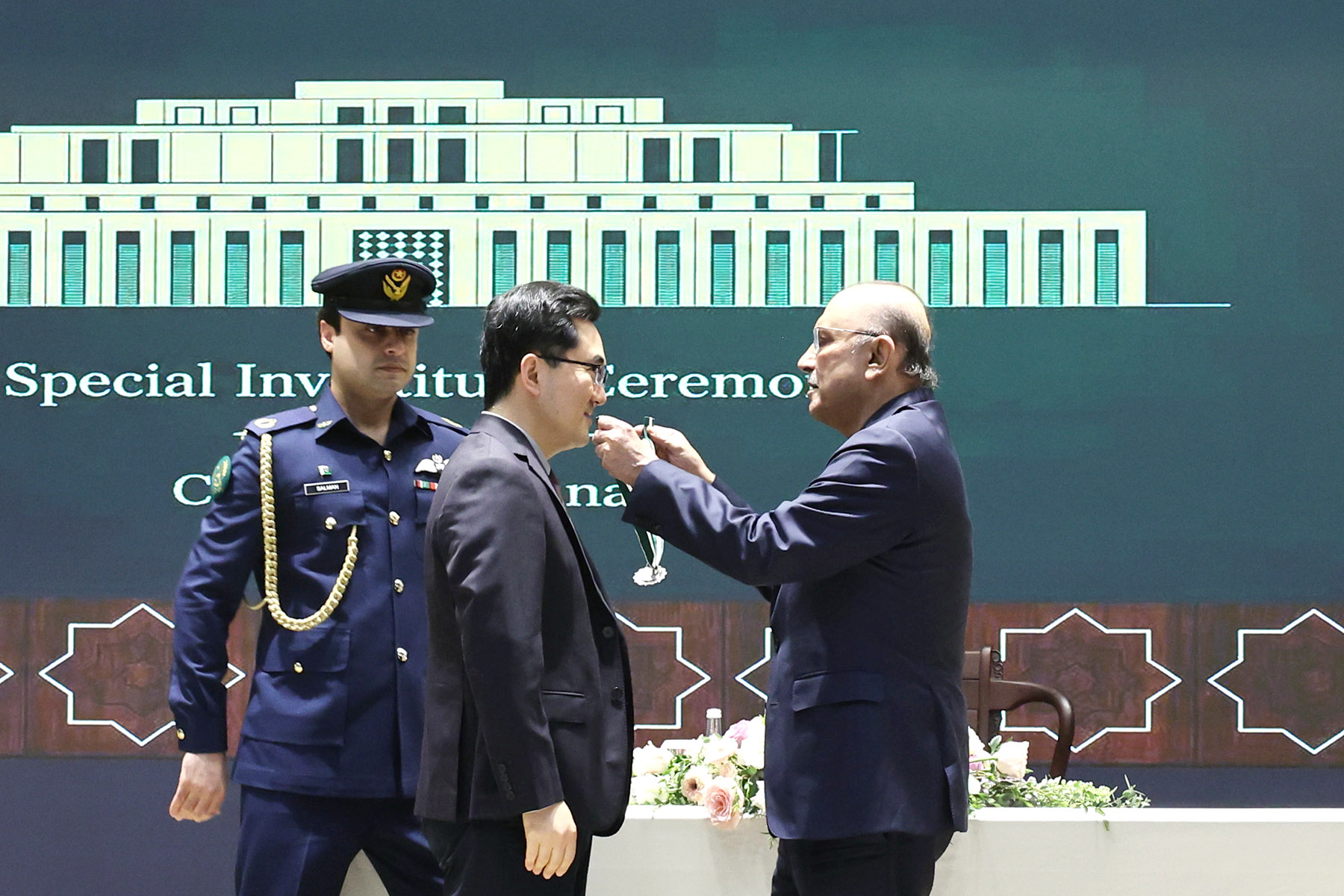
Chinese surgeon Pan Xiangbin, recently honored with Pakistan's "Star of Pakistan", aims to further leverage advanced technologies such as artificial intelligence to extend life-saving care to more patients worldwide.
Pakistani President Asif Ali Zardari presented Pan with the award in Changsha, Hunan province, on April 26, in recognition of his crossborder work providing heart surgeries for children.
Pan dedicated the honor to his team, describing it as a reflection of the 75th anniversary of diplomatic ties between China and Pakistan.
READ MORE: Sino-Pakistani economic ties emphasized
According to Qassim Naveed Qamar, an official of the Sindh provincial government in Pakistan, Pan has become a well-known figure in Pakistan, given his ability to perform the complex procedures he specializes in.
In January 2025, Pan, a deputy director of China's National Center for Cardiovascular Diseases, led a team to Pakistan to treat children with congenital heart disease. They performed a series of free surgeries, with patients recovering well.
One of the patients, Afrah Amir, described the doctors as "angels from a distant land" who gave her a chance at a better future.
"For my daughter and me, no friend has ever been as supportive in our time of need as the Chinese doctors," the girl's mother said."They are truly our friends."
The positive outcomes were made possible by a minimally invasive technique developed by Pan's team, known as the percutaneous and non-fluoroscopic procedure. Using ultrasound imaging instead of traditional X-ray guidance, the method allows doctors to treat heart conditions through blood vessels without open-heart surgery, while avoiding radiation exposure for both patients and medical personnel.
First included in a United Nations project in 2023 to improve access to cardiovascular treatment in developing countries, the procedure has since been adopted by more than 1,000 hospitals across over 60 countries, benefiting more than 200,000 patients.
Pan said China's medical assistance goes beyond sending doctors abroad.
"Our surgical vehicles can reach remote villages, bringing cardiac procedures directly to patients' doorsteps," he said. "More importantly, we are willing to share these technologies with local doctors so they can treat even more people."
During their time in Pakistan, his team also trained around 200 local medical workers.
Now, Pan is looking to push those efforts further by integrating AI and robotics.
In April, using a domestically developed surgical robot system, his team in France carried out a fully ultrasound-guided, robot-assisted mitral valve repair on a patient thousands of kilometers away — marking a new step in remote, high-precision cardiac care.
"We will use AI and other advanced technologies to improve efficiency and save more lives," Pan said.
ALSO READ: Chinese submarines seen to boost Pakistan’s defense
China's medical outreach, he added, is also evolving in another direction — bringing patients to China for treatment.
At Fuwai Yunnan Hospital of the Chinese Academy of Medical Sciences in Kunming, where Pan serves as executive director, children from neighboring countries have received life-saving surgeries as part of international programs such as the China-Cambodia "Love Heart Journey".
According to Chea Munyrith, president of the Cambodian Chinese Evolution Researcher Association, many young patients treated there return home sharing their experiences, helping more families learn about available care — and in some cases even inspiring them to begin learning Chinese.
Pan said the hospital's growing regional role reflects the progress of China's medical system, which now not only serves domestic needs but is increasingly able to compete internationally and support other countries.
Contact the writers at yanyj@chinadaily.com.cn
