

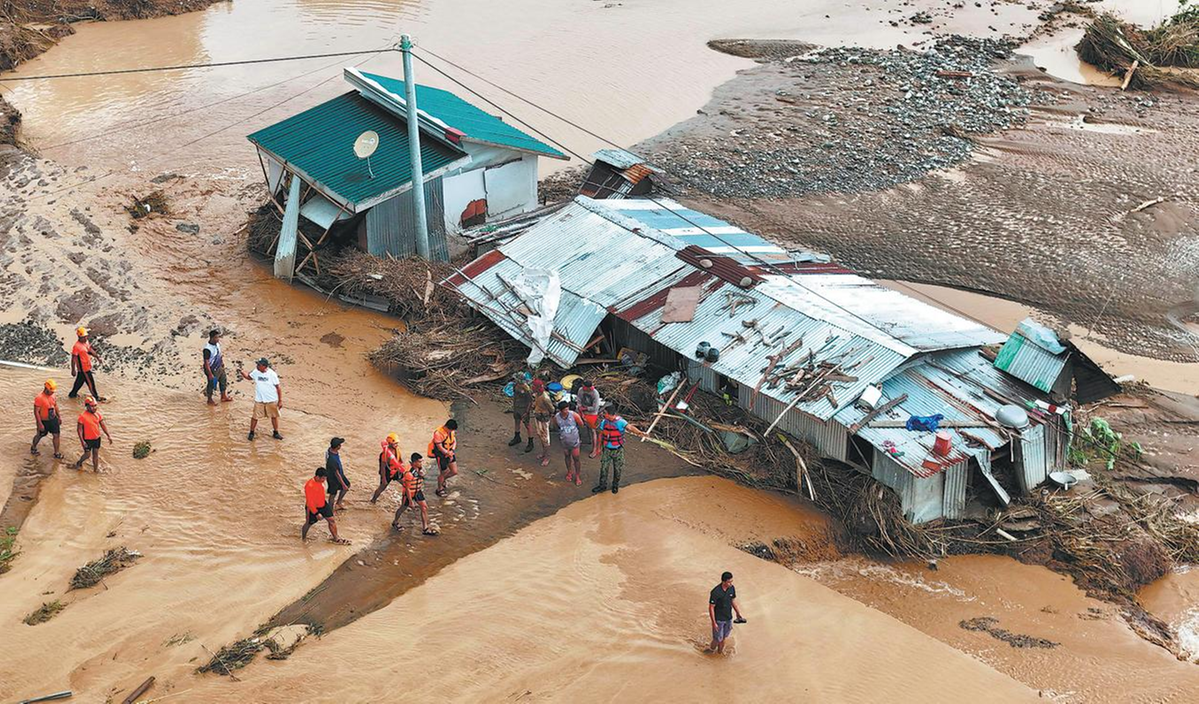
Asia-Pacific countries are confronting intensified economic, social and environmental risks amid climate change and geopolitical tensions, a United Nations agency warns, calling for joint efforts to build a sustainable future.
With regional countries becoming more integrated than ever, their challenges are increasingly similar, including tempered growth, evolving global trade patterns and rapid technological change, said a report from the UN Economic and Social Commission for Asia and the Pacific, as it kicked off its 82nd session in Bangkok on Monday.
The five-day event, under the theme "Leaving no one behind: Advancing a society for all ages in Asia and the Pacific", offers a platform to discuss current and emerging demographic trends and socioeconomic priorities.
READ MORE: Asia-Pacific reels from soaring energy prices
After navigating a period of high global commodity prices and elevated interest rates, the Asia-Pacific region is grappling with higher tariffs and economic policy uncertainty, which together result in economic slowdown, trade fragmentation and fiscal and debt vulnerability, the ESCAP report said.
In addition, some countries are experiencing rapid aging while others continue to have large youth populations.
This transformation poses a critical policy challenge: Creating decent jobs, enhancing labor productivity, and building cohesive and inclusive societies amid demographic shifts and the mega trends of climate change, urbanization, digitization and AI.
"Despite external pressures, we have strong reasons for optimism as the Asia-Pacific is home to the world's most dynamic economies and we have navigated past crises before and consistently emerged stronger," said Armida Salsiah Alisjahbana, executive secretary of the ESCAP.
"Our leaders have demonstrated what is possible when countries learn from one another and codevelop solutions," she said.
Resilient to shocks
Alisjahbana called for intensified regional cooperation to codesign development models that are simultaneously resilient to external shocks.
"Sustained progress hinges on joint capacity-building, knowledge exchange across national experiences, the scaling of context-appropriate innovations and forward-looking institution-building," she said.
In his remarks, Thailand's Prime Minister Anutin Charnvirakul said at the event that the commitment to leave no one behind can only be met by ensuring that everyone is empowered and able to attain their full potential.
He emphasized the need to reform education systems to foster adaptability, embedding lifelong learning as a universal norm.
Chinese Vice-Foreign Minister Ma Zhaoxu said international peace and development are facing multiple challenges amid rising unilateralism and power politics that threaten global stability.
"ESCAP member countries should deepen solidarity and cooperation to help forge an open, inclusive and mutually beneficial Asia-Pacific community of shared destiny, uphold the purposes and principles of the UN Charter, support UN reform and enhanced effectiveness, and strengthen performance through regional mechanisms," Ma said.
A steadfast commitment to openness and the multilateral trading system must be preserved, he said. He urged regional countries to seize the opportunities to boost cooperation and exchanges on innovation and technology, particularly new materials, clean energy and artificial intelligence.
Contact the writers at yangwanli@chinadaily.com.cn
