

German leader’s China visit showcases potential for more business partnerships, cooperation
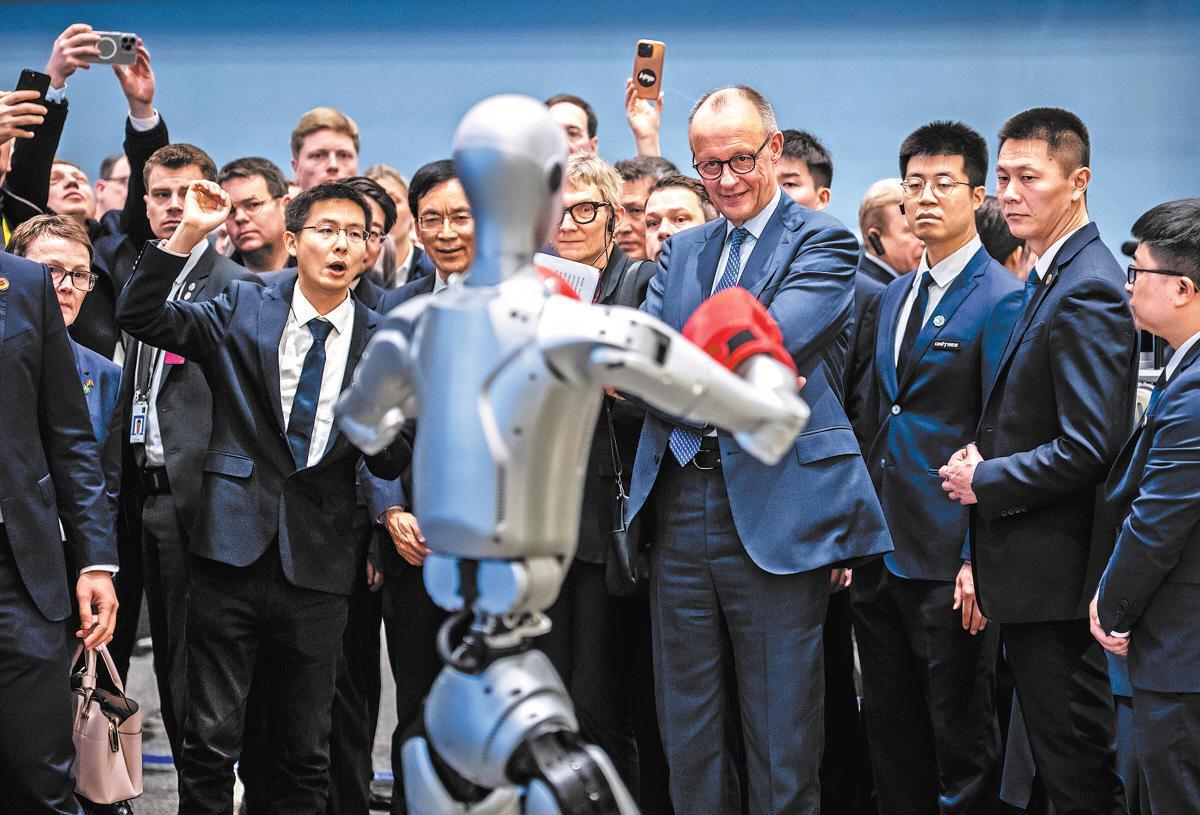
On Feb 26, German Chancellor Friedrich Merz walked into a leading Chinese robotics company in Hangzhou, Zhejiang province, for a tour and a robotic performance before wrapping up a two-day China visit that was both fruitful and significant.
At Unitree, Merz watched the same martial arts performance by quadruped robots that was showcased during the 2026 Spring Festival Gala, which was livestreamed to hundreds of millions of viewers at home and abroad.
Merz was the first foreign leader received by China in the Year of the Horse. Upon his arrival on Feb 25, he wrote in Chinese in a social media post: “Berlin and Beijing are nearly 7,500 kilometers apart. For many years, we have been very happy to bridge this distance. For me, it is very important to maintain and deepen our diplomatic and economic relations. To achieve this goal, we need open channels of dialogue.”
President Xi Jinping and Premier Li Qiang met separately and held talks with Merz on Feb 25 in Beijing. Together with over 60 Chinese and German business leaders, Merz and Li also attended a symposium of the China-Germany economic advisory committee. The two countries inked a number of cooperative agreements in green transition, customs, sports and media. They also issued a joint media statement in which the two sides agreed to properly resolve each other’s concerns through dialogue.
Speaking to reporters at the end of his trip, Merz said he witnessed and supported the launch of new business partnerships during the visit.
“For me, it was important to gain a firsthand impression of the country, including through discussions with government leaders and business representatives,” he said, noting that he was impressed by China’s high level of technological development.
For example, he said he was impressed by “Mercedes-Benz’s advances in autonomous driving in China, Unitree’s progress in robotics, and companies producing in China for the global market”.
Siemens CEO Roland Busch, who was among senior executives from about 30 leading German companies accompanying Merz, said Hangzhou is a highly innovative city — “perhaps the Tech Valley of China”.
Busch noted that China is seeking to boost productivity through automation and digitalization, areas in which Siemens holds strong global advantages — in industrial software and automation.
As 2026 marks the start of China’s 15th Five-Year Plan (2026-30) period, the world’s two major economies are expected to foster greater synergy between the plan and Germany’s development strategies, in order to achieve mutually beneficial cooperation at higher standards, analysts said.
Michael Schumann, chairman of the German Federal Association for Economic Development and Foreign Trade, said China’s rapid progress in robotics and industrial artificial intelligence — visible during Merz’s visit to Unitree — creates significant opportunities to combine German strengths in precision engineering, automation and industrial software with China’s scale and speed of technological deployment.
Jin Ling, director of the Department for Global Governance and International Organization Studies at the China Institute of International Studies, said Merz’s visit carries significance against the backdrop of debate within Europe over how to approach China.
By emphasizing partnership and a cooperative tone, Merz has sent a signal aimed at filtering out “noise” and external interference, she said.
Merz was the latest in a string of Western leaders to visit Beijing within just a few months, following visits by French President Emmanuel Macron, Irish Taoiseach, or prime minister, Micheal Martin, Canadian Prime Minister Mark Carney, Finnish Prime Minister Petteri Orpo and British Prime Minister Keir Starmer.
Xing Yi in London and Zhang Zhouxiang in Brussels contributed to this story.
Contact the writers at mojingxi@chinadaily.com.cn
