

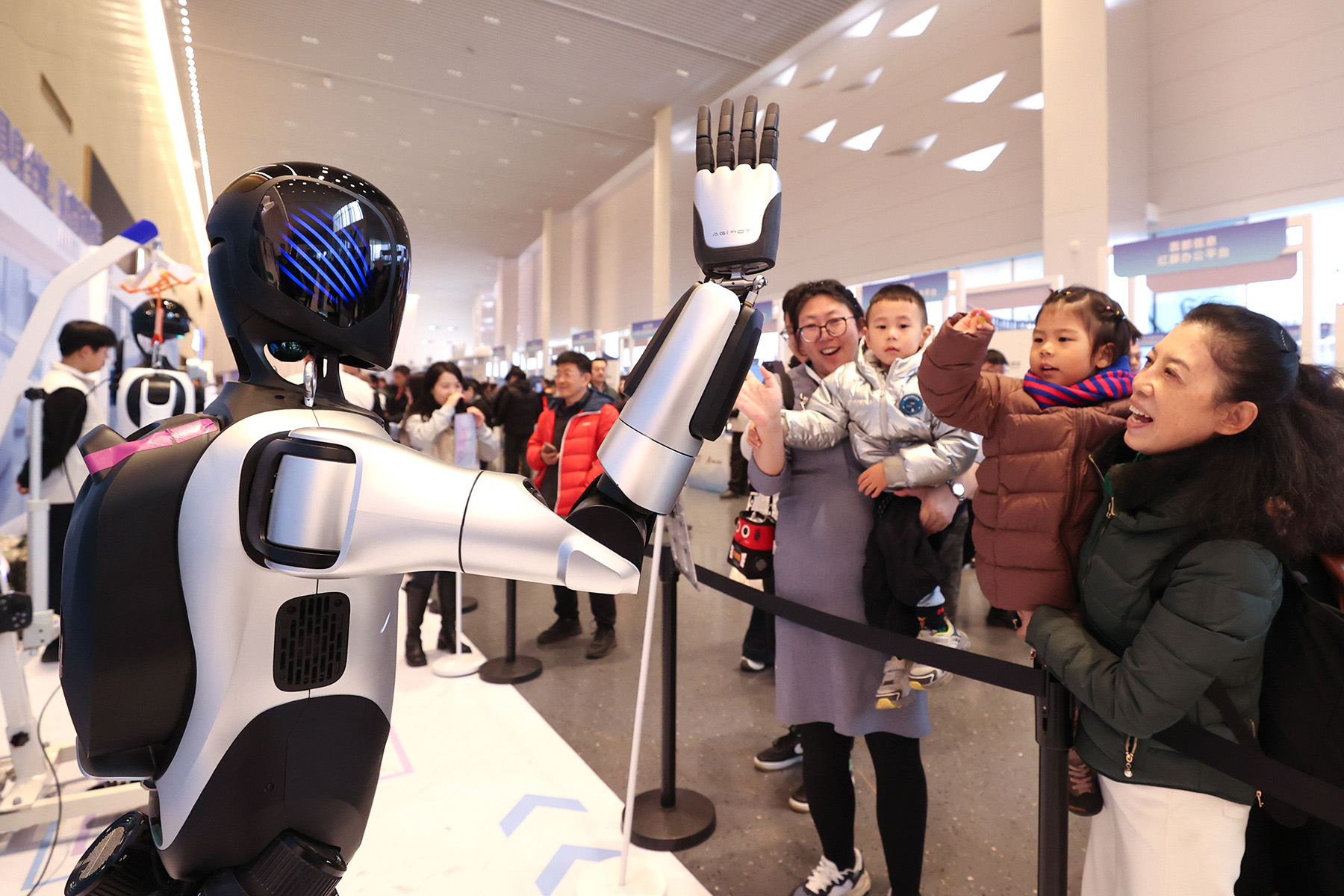
China has unveiled a framework to standardize its rapidly expanding humanoid robotics industry, as policymakers, companies and researchers seek to address growing technical fragmentation in the sector.
The 2026 edition of the humanoid robots and embodied intelligence standard system was released on Saturday at the annual meeting of the humanoid robots and embodied intelligence standardization technical committee in Beijing's E-Town.
Organizers described it as the country's first top-level design covering the entire industry chain and life-cycle of humanoid robotics and embodied intelligence.
The framework comes at a pivotal moment.
READ MORE: First 7S humanoid store turns heads
According to figures disclosed by Ministry of Industry and Information Technology in January, the country has more than 140 humanoid robot manufacturers and over 330 product models. Executives widely refer to 2026 as a transitional year for mass production in the sector.
Public interest has also accelerated. E-commerce giant JD reported a surge in robotics-related sales following humanoid robots' recent high-profile Spring Festival performances, underscoring rising consumer visibility, said Zheng Xiaodan, head of embodied intelligent robotics business at JD. Yet scaling remains complex.
In roundtable discussions, company executives pointed to manufacturing consistency as a key challenge.
"Humanoid robots involve long supply chains stretching from supply networks and components to complete systems, operating systems and algorithms," said Chen Jianyu, founder of Robotera.
Gao Jiyang, founder of Galaxea, added that even subtle mechanical differences between units can be amplified when integrated with large foundation models, requiring systematic calibration to align sensors, structures and software within a unified framework.
Hardware maturity remains uneven. Participants noted that key components such as high-torque joints and dexterous hands have yet to achieve stable economies of scale, keeping costs high and limiting predictable expansion.
Beyond hardware, data was repeatedly described as a structural bottleneck.
"We are still lacking high-quality embodied data and relevant standards," said Wang Zhongyuan, director of the Beijing Academy of Artificial Intelligence, adding that inconsistent data formats and labeling methods across firms have created isolated silos, forcing developers to duplicate work.
ALSO READ: Humanoid robots steal show at festival gala
The newly issued framework seeks to address these challenges, structured across six areas — foundational standards, brain-inspired computing and intelligent processing, body structures and components, complete systems, applications, alongside safety and ethics. It reflects coordinated input from government agencies, research institutes, enterprises and universities.
"To enable robots to truly work in real-world scenarios, industry-wide standards are indispensable," said Wang Xingxing, founder of Unitree Robotics and a committee vice-chair. He identified unified task definitions, evaluation systems and safety standards as immediate priorities.
Globally, no dominant humanoid robotics standards have yet emerged. Xu Jincheng, founder and CEO of tactile-sensing firm PaXini Tech, said China's achievements in embodied intelligence have drawn global attention, and that continued technological progress may position the country to play a significant role in shaping future international standards.
Contact the writers at guoyanqi@chinadaily.com.cn
