

Scholars expect the Hong Kong Special Administrative Region will play new super-connector roles as part of the country’s 15th Five-Year Plan (2026-30), by fortifying the city as the vital platform for Chinese mainland enterprises spreading their wings and as an international education hub.
“The particular role that Hong Kong can contribute is to attract top talents internationally. The goal of technology advancement relies on getting an increasing number of top talents in STEM (science, technology, engineering and mathematics) areas to work with mainland academic institutions and technology companies,” said Cai Hongbin, dean of HKU Business School.
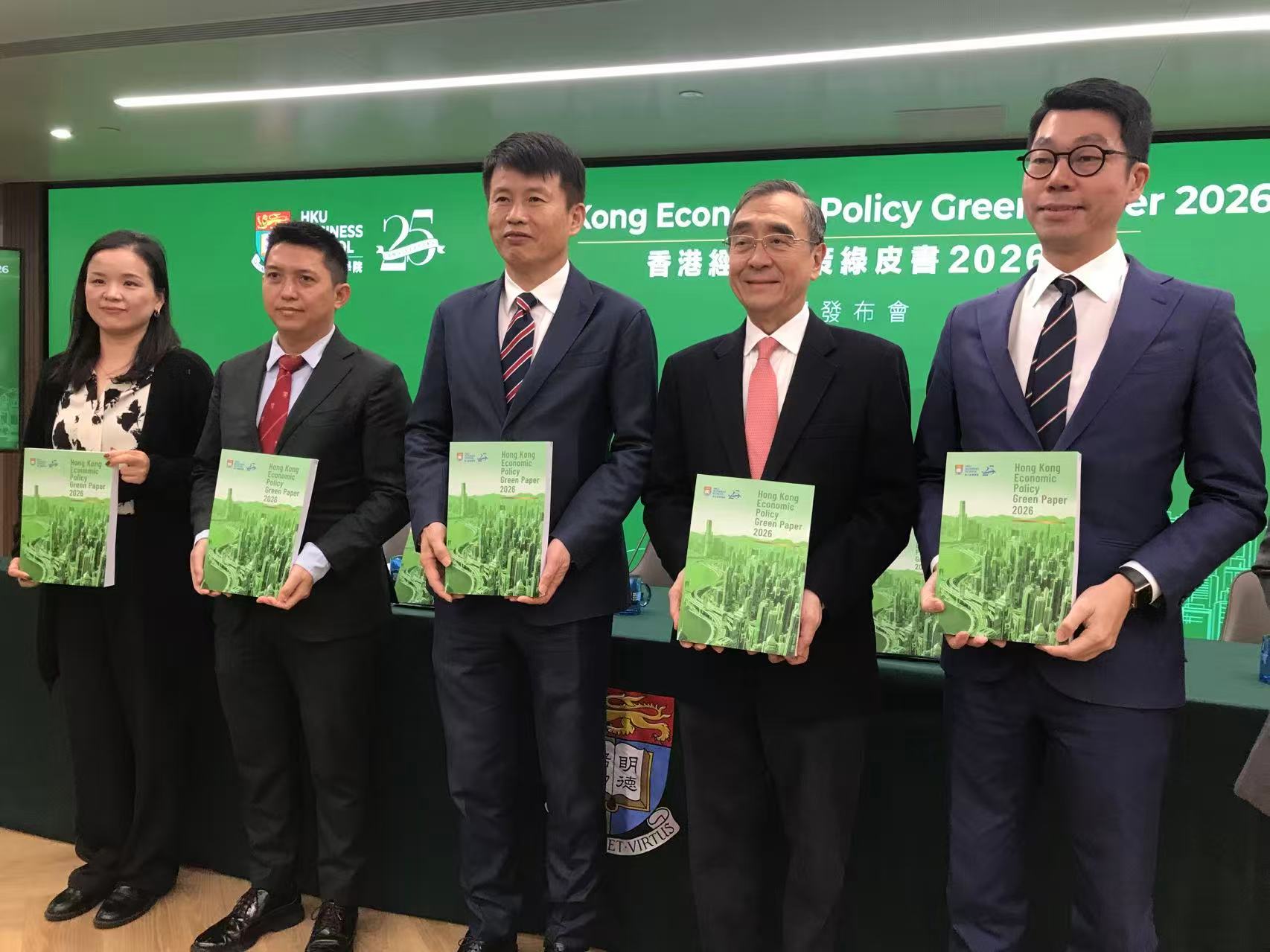
Cai and other HKU Business School’s professors held a press conference on Wednesday to introduce the “Hong Kong Economic Policy Green Paper 2026”, providing recommendations on how Hong Kong can effectively tackle challenges in various economic domains.
Cai said the positioning of Hong Kong as a super-connector remains unchanged, but new functions should evolve, given that the central government recently unveiled the 15th Five-Year Plan (2026-30) which emphasizes technology self-sufficiency and internal circulation.
“Hong Kong should deeply understand the needs of mainland enterprises and the mainland economy as well as cultivate a deep understanding of international markets and then connect these two parts together,” Cai said. “Hong Kong should fully embrace integration with the mainland while maintaining deep internationalization.”
Another new role Hong Kong can play is promoting itself as an international education hub. By attracting top academic scholars and talents to the city, it can help promoting industry development, societal development and innovation and technology (I&T) activities in Hong Kong, the dean said.
ALSO READ: HK builds up strength in I&T to foster future growth engine
According to the green paper, startup activities in the SAR slowed down after 2019. Although early-stage funding is accessible, there is a critical shortage of late-stage growth capital. Hong Kong should hasten research and development commercialization and integrate R&D activities in the Northern Metropolis with mature supply chains in the Guangdong-Hong Kong-Macao Greater Bay Area, the paper recommended.
Tang Hei-wai, associate vice-president of HKU and associate dean of HKU Business School, suggested Hong Kong should strengthen itself as the vital platform for mainland companies to embark on overseas expansion.
“Besides financing advice, mainland firms also need professional services related to setting up manufacturing plants, human resources training, insurance, legal and even cultural understanding. Some companies have embarked on overseas business expansion without such professional services support, which is a very high-risk gesture,” Tang noted.
The professor said the US imposition of tariffs on many countries since April last year has created new opportunities for Hong Kong's re-exports and trade with emerging markets in the Middle East, the Association of Southeast Asian Nations (ASEAN), and South America. Hong Kong has performed well in connecting with and expanding its trade with new markets, and the economy is expected to continue its steady growth this year although the comparison base has increased.
He added that the manpower efficiency and digitalization of operations in other ports of Guangdong province have been impacting Hong Kong's traditional maritime exports, making it difficult for Hong Kong to regain its advantages in the short term.
Therefore, Tang believes Hong Kong should develop an air-land intermodal transport network that can channel manufactured goods from the ASEAN region to Hong Kong for re-export. By increasing throughput, the city can consolidate its position as an air freight hub.
Hong Kong’s export sector performance this year depends on global demand, and Tang believes the development of global financial market and productivity gains brought by artificial intelligence adoption should sustain the demand at least for the first half of this year.
According to the green paper, domestic loans for trade finance in Hong Kong have recorded negative growth although trade is vital to Hong Kong’s economy. The total merchandise trade value roughly represented three times the city’s gross domestic product in 2024.
READ MORE: HK seen to cement global HQ status over economic, institutional strengths
The paper suggested Hong Kong should cement a trade finance ecosystem through strengthening the governance of digital trade platforms, standardizing and promoting digital trade instruments, deepening cross-border interoperability of trade data, and attracting multinational companies to set up their regional supply chain headquarters and procurement centers.
