

Nation has seen huge increase in student numbers on state-funded Mandarin program, Zheng Wanyin reports in London

Memories take Katharine Carruthers back to when she began studying Chinese at Durham University more than 40 years ago, a time when the subject was far less common in the United Kingdom than it is today.
She recalls that in 1985 there were only about 25 students studying Chinese across the entire country.
"It was a bit of a leap in the dark," she said, but clearly remembers how she was more than willing to take that leap and start studying Chinese. After Carruthers moved into teaching, she realized just how rewarding it was to be one of the trailblazers in promoting and developing Chinese language education in England.
Her job titles speak for themselves. Retiring this July, she served as director of the Center for Chinese Language Education at University College London Institute of Education, or UCL IOE, and director of the Mandarin Excellence Program, or MEP, a language program funded by the UK's Department for Education and delivered through state secondary schools in England. Carruthers has also served as the global strategic academic adviser for China for UCL.
READ MORE: Mandarin proves a winner in English schools
Over the years, she has witnessed the flourishing landscape of Mandarin learning in the UK.
A September report by the British Council noted that Mandarin is one of the few languages to have "significantly increased" in provision during the past decade. Entries for the General Certificate of Secondary Education, or GCSE, in Mandarin, rose from a little more than 3,000 in the 2012-13 academic year to more than 7,800 in 2023-24.
Heated discussions have also been taking place in the UK about how to build the country's China capabilities, with the report stressing that the education sector — which produces a pipeline of graduates with Mandarin language skills, knowledge of Chinese culture, politics and history, as well as firsthand experience of the country — must be included in the long-term investment strategy.
Among the many initiatives across the UK, both state-funded and voluntary, that have fueled the takeoff of Mandarin education, the MEP remains one of the most influential.

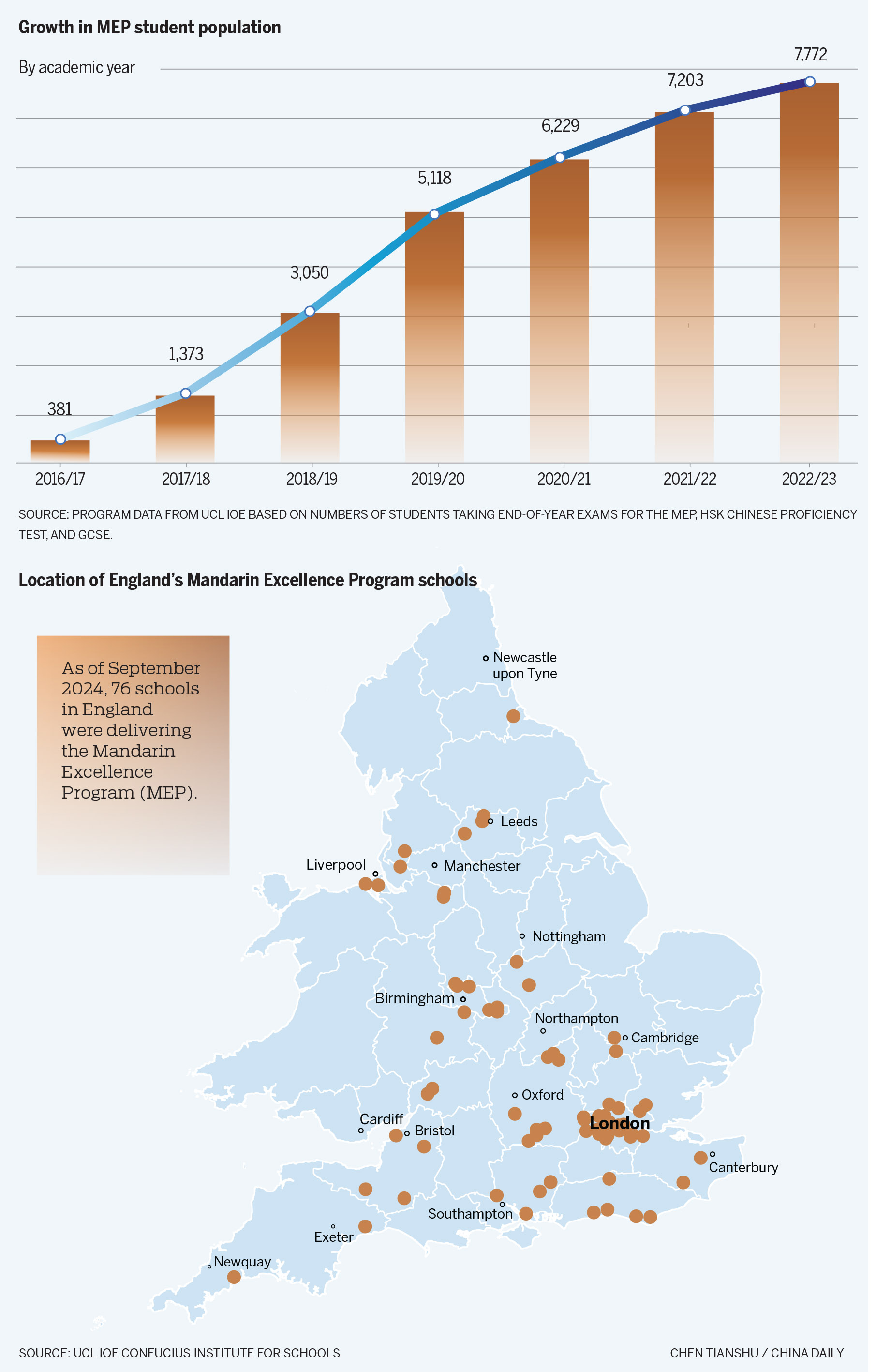
The program, which was launched in 2016, requires participating students to acclimatize themselves to the intensive nature of the project, with an average of eight hours of work per week which can consist of in-classroom lessons, after-school teaching, self-study and more.
It has far exceeded its initial target of seeing at least 5,000 students in England on track toward fluency in Mandarin by 2020, with the number surpassing 16,000 in 2025, significantly more than the less-than 400 participants in 14 schools taking part when it was set up, according to UCL IOE.
The MEP has continued to grow. After the first phase from 2016 to 2021, funded through the initial investment, the program received an additional minimum of four years of funding that has since been extended through August 2026.
In 2023, it was also expanded into the sixth form, the final two years of pre-university study in the English school system. Previously, the MEP had been designed to be completed before students started their sixth-form studies, but it was observed that larger numbers of MEP students would willingly continue their learning journey into the sixth form and beyond, if given the chance.
"The MEP has been a huge success," said Carruthers. "It has been proven nationally that if you give British children enough learning hours in a week, they too can become very accomplished language learners."
According to an independent evaluation report on the MEP's first five years, the 2021 GCSE exams saw the first cohort of MEP graduates achieve notable results in Mandarin Chinese, approaching the attainment levels of students in fee-paying independent schools, who are generally considered to devote more time and resources to language learning.
Prior to the MEP, Mandarin Chinese had been taught in only a small number of state schools in England.
The disparity in Mandarin provision between independent and state schools, even in comparison to other languages, is "particularly dramatic", the British Council report said.
Only approximately 7 percent of all school children in England are educated in independent schools, according to the Independent Schools Council, but data published by the Department for Education shows that in 2019, 33 percent of all entries for GCSE Chinese exams were from students in independent schools.

Clear benefits
Students who choose to give up some of their free time for the MEP are aware of the benefits brought about by learning Mandarin.
"Learning Chinese, especially in the finance world, will open many new doors for me because, obviously, the Chinese market is somewhat new to the European and the Western world," said Hojiakbar Sadullaev, who was an MEP student at Dartford Grammar School in Kent and who currently studies at Imperial College London. "So, personally, having a good knowledge of Chinese allows me to access more opportunities."
A better future also motivated Pijus Okunevicius, a student at Kingsford Community School in Newham, East London, who said the business world is definitely related to China, and that with Chinese he can become more recognizable. He said the learning journey has not always been smooth, but the prospect of achieving success has driven him forward.
"You can never succeed at something when the end is not hard to get. If it's easy, you can give up. If it's hard, you always keep trying, and I always have a future," he said.
Carruthers added: "Much more widely (speaking), obviously, the MEP has also given pupils the opportunity to broaden their horizons."
She said the "highlight we have been talking about is the intensive learning in China".
"For children, when they go to China, the vast majority won't have been there before, and, in fact, many have not been out of the UK necessarily before," Carruthers said. "It is allowing China to become real — to find out what it's really like, as opposed to the perceptions they might have had here (in the UK)."
As part of the MEP, students have the opportunity to participate in an extended period of intensive study in China.
This year, nearly 1,200 students from 62 schools across England traveled to China in July for an 11-day educational tour that combined both classroom study and immersive experience.
At a reception hosted on Oct 15 by the education section of the Chinese embassy in the UK to welcome home the MEP participants who had just completed their immersive trips, teenagers eagerly shared their fresh summer memories — the new buzzwords they had learned from their Chinese peers and how they had tried to haggle over prices in local markets.
Nathaniel Craske from Bishop Vesey's Grammar School in Birmingham said on-the-ground experiences had "added more depth" to his learning, because they allowed him to understand how Chinese people interact with each other in real life and how the language can be used in diverse ways.
"It was very nice trying to use what you learned in the classroom in a more native way," he said.
Being exposed to a whole new world — the characters, grammar, writing, tones and the culture embedded within the language — is what has kept Craske motivated.
"You will need to listen to what young people have said, that it (Mandarin learning) is changing their perspectives, and some of them said they want to go to China to study, to work in China, or to use Chinese in their future work," Carruthers said.
"That is my advice (for future Mandarin education in the UK), that China is full of opportunities, that we need to understand China from whatever perspectives, and that we cannot just be relying on Chinese young people to speak great English.
"It is just important to give students the opportunities," Carruthers added. "It is not that everybody has to become a sinologist, but you will need to have a lot more young people (understanding China)."
Looking to the future
Access to Mandarin education remains limited, despite Mandarin having grown to become one of the most sought-after languages in the UK, the British Council report said.
Beyond further expanding provision for school-age students, the report also recommended that the government and education providers increase opportunities for study exchanges and immersive experiences in China, examine whether existing university partnerships could be better utilized to encourage UK outward mobility to China, expand internship and job placement programs in China or within companies with strong China connections, and more.
While looking beyond the functional benefits of learning Mandarin, Carruthers believes equipping young people in the UK with international experience in an ever more interconnected and collaborative world is both critical and urgent — a commitment she has upheld through decades of ups and downs amid an evolving geopolitical landscape.
Countless benefits could be named, she said, but what remains most vivid in her memory are the moments when peers from the two countries meet. Like the time, in one class she visited, when a British girl had sat looking slightly bored, twirling her hair before the Chinese students arrived.
Within minutes, she said, the British girl's face lit up as she began chatting with a new friend, and the Chinese girl, who had entered looking upright with her hair neatly pulled back, was no longer as quiet as she had seemed at first.
"And for me, that is what is all about," Carruthers said. "They are the future. If you give young people the chance, they will talk to each other, and only by talking, can countries understand each other."
Contact the writer at zhengwanyin@mail.chinadailyuk.com
