

The capital of numerous dynasties, the metropolis tells of imperial power and brings insight into the lives of ancient people, Wang Ru reports in Luoyang, Henan.

Luoyang emerges from the mists of time — a city where history whispers through every street and alley. As the capital city of more than a dozen dynasties, its name has been a constant presence throughout Chinese history. However, it was only upon visiting that I truly understood its significance as a stage for countless legendary tales of the past.
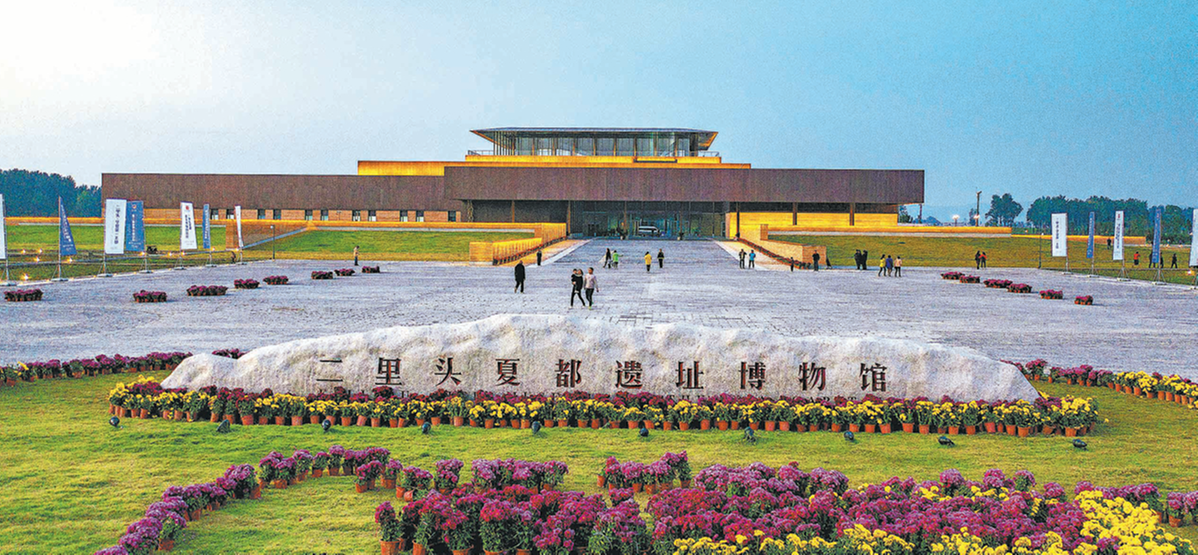
After a four-hour high-speed train ride from Beijing, I arrived in Luoyang, Henan province. Interested in its long history as a capital city, I decided to start at "the beginning" and went to the Erlitou site, which is widely believed to have been the capital of the Xia Dynasty (c. 21st century-16th century BC) and can now be found in a suburban area of the city.
An archaeological park has been built at the site, along with the Erlitou site museum. Liu Chenyu, a tour guide at the museum, showed me around.
I asked why this area was chosen, and Liu explained that in ancient times, the area was situated on elevated land near the Luohe and Yihe rivers, providing easy access to water while ensuring safety from floods. The flat landscape also made it an ideal location for habitation.
Today, the area includes sites of workshops for bronze casting and turquoise crafting, along with a palace area and locations dedicated to burial and sacrificial ceremonies.
The road we stood on was part of the ancient road network with the city laid out in a grid system, and different areas having specific functions. The governing bodies at the time created a real sense of order in Erlitou.

I then visited the museum to see the jade, turquoise, pottery and lacquerware artifacts that had been discovered at the site. An interactive facility was also available, allowing visitors to "call" the Erlitou people and ask them questions.
"What did you eat?" I heard a man asking.
"We mainly eat millet, supplemented by the meat of domestic and wild animals. We also collect wild fruits and nuts," the voice from history answered.
The visit brought me closer to the people of Erlitou and what life must have been like for them.
Although the site holds huge significance in Chinese history — archaeological excavations began in the 1950s — it is difficult for people today to feel any kind of connection with the period; it is just too long ago.
But by seeing the artifacts they left behind, I got a glimpse into their world and a realization that we still have much in common.

A flourishing city
My next stop in time was Luoyang during the Sui (581-618) and Tang (618-907) dynasties, a significant period in the city's history. In 605, Emperor Yang of the Sui Dynasty ordered the construction of Luoyang as the Sui's eastern capital. He also launched the building of the Grand Canal, with Luoyang serving as a key transportation hub.
This network enabled the transportation of grain from the southern regions around the lower reaches of the Yangtze River to Luoyang, which housed two of the Sui's largest granaries, Hanjia and Huiluo. Thus, Luoyang grew in prominence.
The city further flourished under Empress Wu Zetian. After succeeding to the throne — defying the tradition that only men could rule — she sought to distance herself from the Tang royal family, based in Chang'an (present-day Xi'an, Shaanxi province) and establish a new political order. She chose Luoyang as her capital city and called it the "Divine Capital".
ALSO READ: Tastes & traditions of the Yellow River
Under her rule, a central axis, an ensemble of palaces, ceremonial and public buildings, roads and other structures gradually took shape.
Many were huge, as high as 150 meters, according to records. "If Chang'an reflects the duration of the Tang Dynasty, as it was used by the Tang as the capital for more than 200 years, then Luoyang represents the pinnacle of architectural achievement of that time," says Wang Kai, a local historian.
Today, the buildings are gone, but visitors can still see some of their unearthed foundations and tour replicas of some of the city's ancient components.
At the Dingdingmen Site Museum, the southern gate of Luoyang's outer city, visitors can see a re-creation of a Tang-era roadway featuring traces of wheel ruts, footprints and hoof prints. It is easy to imagine the bustle of trade along the ancient Silk Road, which linked Luoyang with Xiyu, a historical term used to describe modern-day Xinjiang Uygur autonomous region and Central Asia.
Because of this significance, the gate was named part of the UNESCO World Heritage site, "Silk Roads: the Routes Network of Chang'an-Tianshan Corridor", in 2014.
At night, I visited Yingtian Gate, the southern entrance to Luoyang's palace city. Reconstructed according to historical records and archaeological findings, the preserved foundations reveal its huge scale and complex structure, with replicas conveying the former splendor of the complex.
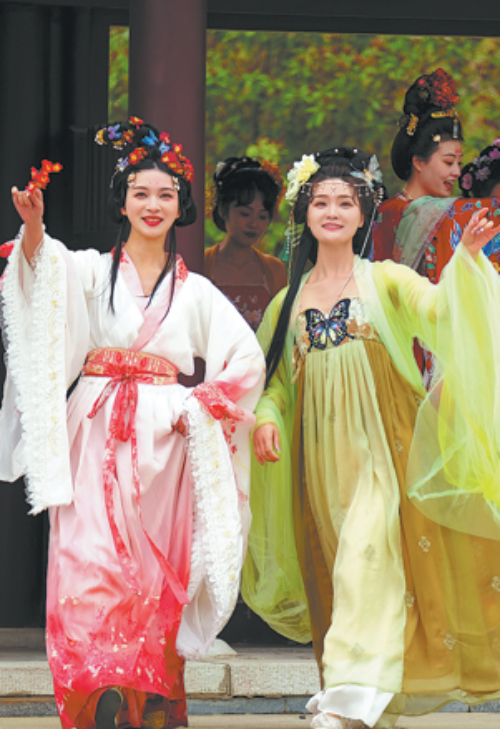
Many young people dressed in traditional Chinese clothing posed for photos against the backdrop of the towering gate, where Empress Wu ascended to the throne more than 1,000 years ago.
Underground trove
In the north of Luoyang stands Mangshan Mountain. When Luoyang served as the capital for multiple dynasties, countless individuals were buried on the mountain, which was believed to possess good feng shui.
Consequently, Mangshan is famous for its tombs, which span more than 2,000 years of history.
In recent years, the Luoyang Museum of Ancient Tombs has gained popularity as a museum dedicated to the city's burial culture.
Before my visit, Wang told me that during the construction of an amusement park covering 58.4 hectares, more than 1,000 ancient tombs were discovered, evidence of Luoyang's long history as a densely populated capital city.
The concentration of tombs on Mangshan Mountain is more surprising. According to Fan Wenjia, a tour guide at the museum, it is home to hundreds of thousands of burial sites.

The museum has relocated 25 representative tombs that could no longer be preserved in situ, bringing them together for better protection.
Visiting the museum was a novel experience, because I had never seen so many tombs from different historical periods in one place.
Located six meters underground, the museum allows visitors to enter most of the burial chambers. Although the human remains have vanished over time, the tombs themselves are artistic treasures, revealing the lives of the people who built them.
I was struck by the patterns and murals in the chambers, which may have been made to convey blessings upon the dead ascending to immortality. Entering the tomb of Song Silang from the Northern Song Dynasty (960-1127), I could see the exquisite door of the chamber, which was constructed from stone and brick to resemble a wooden gate with sunmao (mortise-and-tenon) joints. It made me think that this was not the entrance to a tomb but the door into a family's home.
This reflects a common belief in ancient China: Treat the dead as if they were alive. In the burial chamber, there are murals of two people drinking, two maids cooking, and scenes of music and dancing.
The whole atmosphere is not solemn or cold, but lively and dreamlike, giving the impression that death is merely the beginning of the next journey.
READ MORE: Where two rivers turn gold in a realm of wonder
The most striking feature of this tomb is an inscribed brick above the doorway, indicating that the tomb was built in the eighth year of Xuanhe (1126). However, the title of this reign does not exist in historical literature. Officially, although the year 1125 was known as the seventh year of Xuanhe, 1126 was known as the first year of Jiankang because a new emperor had ascended the throne.
Those who built Song's tomb seem to have been unaware of the transition. Scholars believe this reflects the slow transmission of news among ordinary people, a fact that could have led to the error.
It would be difficult to find such historical details in books, but it is easy when visiting a site in person. Fan told me that during tours, they tell students such details to give them a greater understanding of ancient Chinese people's outlooks on life and death.
I felt reluctant to end this journey, knowing that I had captured only a glimpse of the city's vast history.
This was not my first visit to Luoyang, but with its wealth of history, each trip continues to bring new surprises.
Shi Baoyin contributed to this story.
Contact the writer at wangru1@chinadaily.com.cn
