

Through creative short videos, students at North Minzu University are bridging cultural gaps, showcasing China's history and traditions to the world.
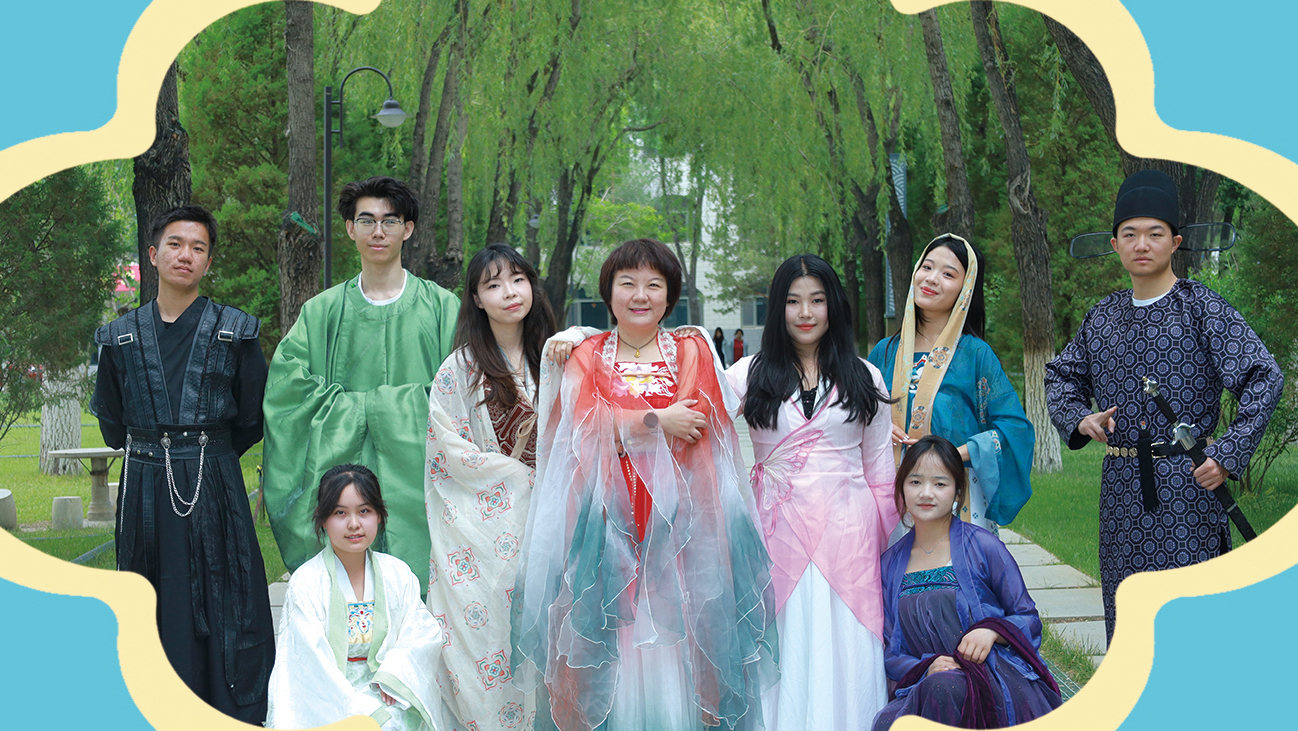
When Chen Wenbo, a 21-year-old student from North Minzu University in the Ningxia Hui autonomous region, logged onto overseas social media platforms, he was thrilled to see foreign users commenting on his team's short videos about the Xixia Imperial Tombs. Phrases like "so thrilling" and "want to learn more about Chinese history" flooded the posts. Chen could hardly contain his excitement.
"I used to think international communication was the domain of major media organizations, but now I realize that ordinary students can participate too, as long as they have the opportunity and the will," he said.
As the current deputy head of the university's Dao Zhonghua (Telling China's Stories) Bilingual Cultural Communication Studio, Chen has helped produce 16 short videos in the Xixia Imperial Tombs series, which attracted over 140,000 views within their first week online.
The studio evolved from the Huayun Bilingual Cultural Communication Society, founded in 2021 by Professor Zhang Mei of the university's School of Foreign Studies. Since then, it has grown into an interdisciplinary organization encompassing 14 schools and more than 60 students. The team has created video series on 10 major themes, including Chinese idioms, intangible cultural heritage, and ethnic costume transformations.
Since releasing their first video on March 8, 2022, the team has followed a strict schedule, releasing one bilingual short video (with subtitles in both Chinese and English) every Tuesday. "From the studio's founding until now, we've never missed a single update," Chen said proudly.
By mid-December, the team had published 243 videos, 12 of which were reposted by various Chinese embassies, consulates, and foreign diplomats.
The team was initially led solely by Zhang, who guided more than 20 students. They began by filming with mobile phones and taught themselves scriptwriting, voice-over techniques, and editing. Soon, the university provided substantial support, offering venues and equipment. They also organized a Foreign Language and Culture Festival, where students had the opportunity to adapt their short videos into stage performances.
The collaboration then expanded to include six faculty members from four different schools. Teachers from the School of Foreign Studies ensured linguistic accuracy while faculty from the School of Marxism reviewed the scripts for factual correctness. The School of Design and Art helped with the visual presentation and the School of Electrical and Information Engineering launched an elective video editing course for the studio, cultivating a group of technical talents.
With the university's support, the quality of the society's work steadily improved, and its influence began to grow. On April 13,2023, it was upgraded to a provincial studio.
"With the central task of fostering a strong sense of community for the Chinese nation, we have infused our university with an ethos of openness and inclusivity, following a dual approach of 'bringing in' and 'going global'," said Wang Hongxiao, vice-president and a member of the Standing Committee of the CPC Committee at the university.
The School of Foreign Studies has also made the international dissemination of Chinese culture a key focus of student development. In addition to supporting the growth of the Dao Zhonghua studio, the school actively encourages student participation in volunteer work for major international events, promotes student-led teams to manage multilingual new media accounts, and has established a unique curriculum that integrates language, traditional culture, and communication.
For the students involved, the opportunities offered by the studio and the school far exceeded expectations. Zhang noted that some students gained admission to directing programs based on their video production experience, others applied to prestigious universities abroad using their cross-cultural communication skills, and many transformed from "cultural observers" to "cultural promoters".
One of these students is Wu Jingwei, 24, the former head of the society. She performed in several of the society's English-language plays about traditional Chinese stories, including those of heroic women like Hua Mulan and Wang Zhaojun. These experiences gave her a newfound appreciation for traditional culture.
"My understanding of tradition was quite vague before, mainly because I didn't know much about it," she explained."But through the society, I've become a true guardian and communicator of it."
Pursuing excellence
One of the studio's most popular video series focuses on the transformation of ethnic costumes. Featuring a student as the model, the series uses traditional Chinese colors as a unifying theme, weaving together the clothing and culture of over 50 different ethnic groups.
"This series isn't just about changing clothes; we've also incorporated accessories and elements of ethnic dance, paying close attention to every detail,"Zhang said.
When discussing the series' appeal to international audiences, Wu offered an important insight: they likely prefer formats that feature real people on camera and strong storytelling."We need to make cultural communication more vivid and relatable," she suggested."Incorporating real-life atmosphere and emotions would be highly beneficial."
One of the team's key abilities is uncovering the cultural significance behind trending events. For example, when news broke in July about the UNESCO World Heritage designation of the Xixia Imperial Tombs, Zhang saw an opportunity to lead the team in creating a video series on this historical site.
However, producing content on such topics came with its own set of challenges, especially concerning factual accuracy. To ensure the information was correct, Zhang invited a professor from Ningxia University, an expert in the history of the Xixia Dynasty (1038-1227), to write the script.
Creating a rich visual presentation also proved difficult. To effectively showcase the tombs and their past grandeur, students from the School of Electrical and Information Engineering used 3D modeling and AI technology to restore the relics' original appearance.
Looking toward the future, the studio has already mapped out its next big project. Chen revealed that the team is preparing a "China Travel" series and has completed over 60 scripts. This series will leverage China's recent visa-free policies to introduce foreign tourists to cities beyond Beijing and Shanghai, highlighting local cuisine, intangible cultural heritage, and the stories of notable historical figures.
"We might even recommend specific restaurants, making the videos more practical so that viewers can directly experience these places after watching,"Chen said.
According to him, the studio's goal has always been clear: to tell China's stories well in two languages.
For Zhang, this is more than just a slogan — it's a mission shared by every team member.
"As educators and students in foreign studies, learning languages is not only about seeing the world but also about allowing the world to see China," she said.
Contact the writers at guiqian@i21st.cn
