

Even as venue closures and a dwindling audience base raise serious concerns about the survival of Cantonese Opera, a new generation of artists, educators and aficionados are trying to revitalize it by injecting elements of contemporary culture and cutting-edge technology into the centuries-old performance-art form. Faye Bradley reports.

Few cities in the world are known to support the creation of massive, purpose-built infrastructure dedicated to an indigenous performance-art form the way that Hong Kong does. The opening of the Xiqu Centre in 2019 is a case in point. The multiple-venue complex meant for showcasing Chinese traditional theater, including Cantonese Opera, remains a rarity by world standards.
On Dec 19, the city will see the opening of another state-of-the-art performance venue. And, perhaps unsurprisingly, FutureScope — Hong Kong’s first-ever large-scale art dome at Kai Tak Sports Park — also has a Cantonese Opera component in its inaugural season of programs.
Waving Script, a piece of experiential art created by new-media artist Chris Cheung (h0nh1m) especially for FutureScope — a space where viewers are surrounded by 360 degrees of sight and sound — will see the coming together of Chinese calligrapher Xu Jing and Cantonese Opera performer Leung Fei-tung.
Waving Script attempts to highlight the resonance between the imagery created by brush strokes involved in the drawing of traditional Chinese calligraphy and water-sleeve dance movements generic to Cantonese Opera through an immersive multi-disciplinary experience. Though Cheung is known for applying cutting-edge technology to create immersive audio-visual experiences, his themes usually have to do with traditional Chinese culture.
READ MORE: The world of Cantonese Opera
“Water-sleeve dance is a profound, non-verbal language in itself, given the way the sleeves extend the performer’s emotional state, conveying joy, grief, fury, or longing through a flick of the wrist or a sweep of the arm,” he says.
Waving Script is one among Hong Kong’s latest attempts to broaden the audience base for Cantonese Opera while retaining its traditional core. Leung says that Cantonese Opera is a “living, breathing” evolving performance-art form that “absorbs the characteristics of each generation and the spirit of each era” through which it is handed down.
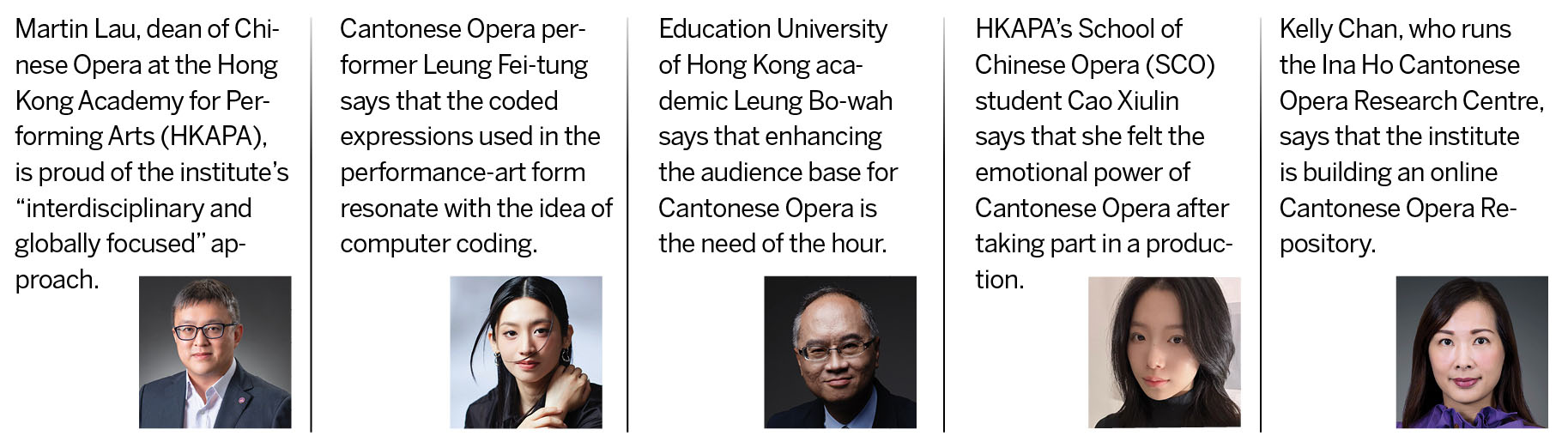
She adds that contrary to popular belief, Cantonese Opera chimes with our present-day experiences. The symbolic system of artistic expressions used in Cantonese Opera is in fact similar to the coded language of programming that drives the digital applications we use routinely.
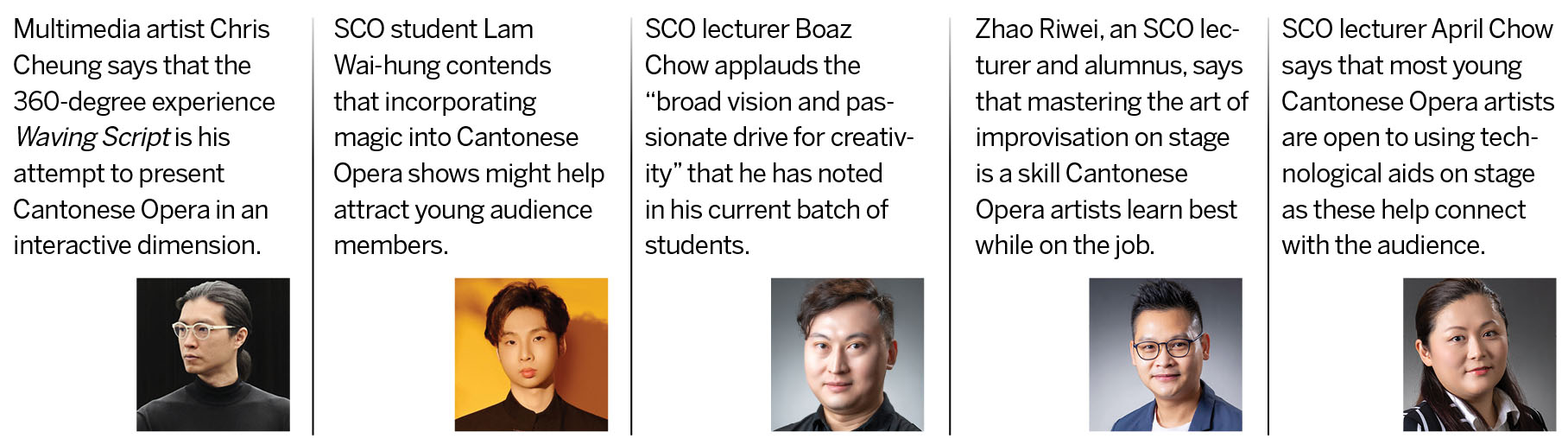
Cheung says that he wishes to present Cantonese Opera in a new, interactive dimension. “Ultimately, we are not seeking to replace tradition, but to expand its canvas. We hope that viewers will leave with a renewed appreciation for the elegance of Cantonese Opera and a sense of excitement about its future potential.”
Interest from youngsters
Cantonese Opera originated in Guangdong province in the late 13th century. While concerns about its declining popularity — the majority of Cantonese Opera-goers in Hong Kong is estimated to be above 60 — are valid, this is not reflected in the “record-high” number of applications received by the School of Chinese Opera (SCO) at the Hong Kong Academy for Performing Arts (HKAPA) in 2025. The school offers the world’s only accredited Bachelor of Fine Arts (Honors) in Chinese Opera, alongside diploma programs.
Martin Lau, dean of Chinese Opera at the HKAPA, says that the steadily-growing volume of applications received might be down to the institute’s “innovative, interdisciplinary, and globally focused” approach.
“We integrate advanced technologies to modernize pedagogy and assessments in Cantonese Opera, in order to enhance the reach and appeal of Chinese culture,” he adds.
Indeed, Cantonese Opera productions developed at the SCO are going places. Pearl Bay, an original SCO production, is touring Guangzhou, Macao and Beijing in 2025-26, supported by the China National Arts Fund as well as the city’s Culture, Sports and Tourism Bureau. A select group of SCO students performed in the Italian cities of Piacenza, Urbino, Pesaro and Siena in November, courtesy the Hong Kong Economic and Trade Office in Brussels.
Cultivating a new audience
However, even as the local government tries its best to preserve and promote a centuries-old performance-art form, the odds are stacked high against it. The shutting down of Sunbeam Theatre — an iconic Cantonese Opera venue started in 1972 — in March points toward a diminishing clientele.
Leung Bo-wah, a professor at the Education University of Hong Kong’s Department of Cultural and Creative Arts (CCA), and executive director of the Xiqu and Intangible Cultural Heritage Centre, agrees that “audience-building is the first and most important issue that we need to work on at the moment”.
“While the number of venues and artists has increased, that of the audience has not increased significantly,” he adds. “We should strive for audience growth, especially among the younger generation.”
Offering Cantonese Opera as an optional subject in primary and secondary school curricula has been only partially successful. The CCA academic reveals that there are not enough music teachers qualified to teach the subject, as most of them were trained in Western classical music.
He contends that a possible way of getting more young people interested in Cantonese Opera is to “mandate its teaching and integrate it into other subjects such as Chinese language, literature, and history”.
Kelly Chan Kar-yue, who runs the Ina Ho Cantonese Opera Research Centre, agrees. The organization is doing its bit toward raising awareness about the performance-art form. “We collaborate with partners such as the Hong Kong Metropolitan University library in building the Cantonese Opera Repository, which digitizes memorabilia, old scripts, and stage props.” Though meant primarily for institutional use, members of the public can gain access to such resources via online applications.
“We are also developing Cantonese Opera General Education courses, offered to university students. These combine traditional knowledge with new experiences that include visits to performance venues and interactions with professionals, in order to ensure that students gain both foundational knowledge as well as contemporary insights into the art form.”
The research center also runs translation projects, workshops, and outreach programs that include schools. Later this month, it will stage a show in which the librettos are presented with English surtitles, “linking research directly to live performances”.
“Through these initiatives, we hope to bring Cantonese Opera to life for younger generations,” Chan says.
Rewards and challenges
Cao Xiulin, who is majoring in Cantonese Opera Performance at the SCO, says she was inspired by her Cantonese Opera performer mother. Though she had been exposed to “the melodies of Cantonese Opera classics” since childhood, Cao says she became wholeheartedly committed to the performance-art form only after playing a lead role in Slaying in the Prayer Hall, produced as part of the HKAPA’s annual Cantonese Opera showcase in 2024.
“For the first time, I truly felt the emotional power of a character, understood the beauty and tension of their conflicts, and realized that Cantonese Opera is about both emotional resonance and cultural inheritance.”
She believes that it is possible to adapt Cantonese Opera pieces to suit the tastes of a contemporary audience without necessarily having to sacrifice the genre’s traditional essence, although “innovation should grow from a deep respect for tradition”. For instance, she says, introducing electronic synthesizers to create atmospheric soundscapes is fine, provided the bowed string instrument gaohu remains the main instrument.
“On stage, it’s important to uphold the aesthetic of ‘theatrical abstraction’ while also embracing modern technologies — such as actors wearing microphones, revolving stages, and digital screens,” Cao adds.
Lam Wai-hung, who is majoring in Cantonese Opera Music at the SCO, believes there is scope for incorporating elements of magic into Cantonese Opera. “Magic has the power to transform abstract ideas into tangible objects, helping audience members, especially young people, grasp meaning even if they do not fully understand the lyrics.”
Boaz Chow, a lecturer in Chinese music at the SCO, sounds particularly hopeful about the graduates of Bachelor of Fine Arts (Honours) in Chinese Opera program. “The new generation of performers possesses a broad vision and a passionate drive for creativity,” he says. “They are willing to question traditional art, which is crucial for the continued development of Cantonese Opera in today’s rapidly changing society.”
Fellow SCO lecturer April Chow says that most young Cantonese Opera professionals are open to technology-powered elements, such as programmed music and digital scenography, commonly used in stage shows today, as these could be useful tools in making centuries-old content speak to a contemporary audience.
“They are skilled at engaging audiences through online platforms and understand the importance of promoting their work as well as the brand they represent,” she adds.
Zhao Riwei, an SCO alumnus and now a lecturer at the school, says that learning the art of improvisation on stage is a huge challenge for anyone looking to be a professional artist. “Improvisation demands not only a solid theoretical foundation but also the gradual accumulation of performance experience,” he says, explaining that the SCO training, while “providing an important starting point, is only the beginning of a much longer artistic journey”.
Tradition and high tech
Be it building digital archives or conducting artificial-intelligence-assisted restoration of performance recordings, technology plays a crucial role in shaping the future of Cantonese Opera.
Chan shares that the Cantonese Opera Repository project uses high-tech equipment to film high-resolution images of donated memorabilia toward future research. “Virtual reality would be extremely useful to re-create historical scenes, and create immersive experiences,” she adds. “We can see that these technologies offer promising ways to keep the tradition alive and engage future generations.”
ALSO READ: The Lee way
Leung, the Education University of Hong Kong academic, points out that the Sunbeam Theatre’s closure in fact points to the beginning of a more hybrid, decentralized future. He contends that in Hong Kong, the matters of audience building, and justifying the teaching and learning of the genre, are of more paramount concern, compared to the scarcity of dedicated venues.
“There is a lack of academic research on Cantonese Opera, which needs to be addressed globally,” he says.
Be it in immersive domes, digital repositories, or innovative performances, Cantonese Opera seems to be entering a new era — one that bridges history, technology, and imagination.
“Traditional culture is no longer remote; it is within reach,” says Zhao. “I believe that through the fusion of tradition and technology, Cantonese Opera in Hong Kong will gain enduring vitality and shine even more brightly in the years ahead.”
