

CHENGDU -- At the foot of Mount Emei, a UNESCO World Heritage Site, in southwest China's Sichuan province, technician Xie Yunqiang tightened the metal hoops around a new oak cask at a just-opened factory.
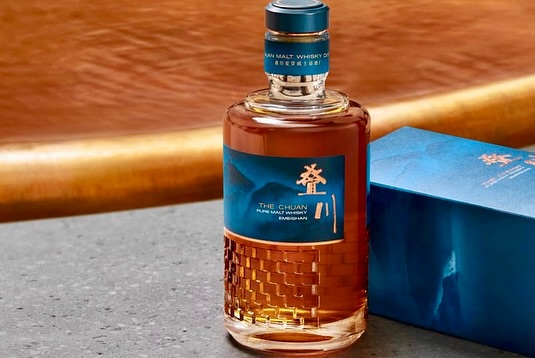
His craft supports an unlikely presence next door, The Chuan Malt Whisky Distillery, built by French spirits giant Pernod Ricard. Together, they are shaping what may become China's newest whisky region, right in the country's traditional baijiu heartland.
Pernod Ricard, the world's second-largest wine and spirits producer and owner of Chivas Regal and Martell, broke ground on the distillery in 2019. The project, with planned investment of 1 billion yuan (about $141 million) over 10 years, is one of the company's most ambitious bets on Chinese terroir and consumer appetite.
The city of Emeishan sits on the southwestern edge of the Sichuan Basin, with its slopes covered in thick forests and fed by mineral-rich mountain springs. The humid microclimate offers brewing conditions that whisky makers envy.
As The Chuan ramped up, a local industry cluster began to take shape, generating about 1.49 billion yuan in added value in 2024. The opening of the Jiuzhou oak cask factory, where Xie works, now gives the area a key missing link: local casks for maturation, the process responsible for roughly 70 percent of a whisky's final flavor.
READ MORE: China, France deepen cultural partnership
For Xie, who grew up surrounded by Sichuan's baijiu culture, making casks for whisky is unfamiliar terrain. Yet his new job illustrates how a Sino-French supply chain is extending deeper into the mountains.
The Chuan is the first malt whisky distillery established in China by a global liquor maker. The facility, created by a Chinese design team, blends into Mount Emei's slopes. It attracts about 10,000 visitors a year who come to see how Chinese ingredients and Scotch techniques intersect.
Locating whisky production -- an industry so dependent on terroir, craftsmanship and long-term capital -- on Mount Emei reflects foreign investors' confidence in China's business environment, said He Yong, secretary general of the China Alcoholic Drinks Association.
Local authorities are leaning into that momentum. Three whisky producers and two supporting enterprises have already signed on, with planned annual output exceeding 20,000 kiloliters, according to the municipal bureau of economy and information technology of Emeishan. The growth is drawing in related suppliers and even tourism services.
READ MORE: China, France pledge to strengthen economic, financial cooperation
Inside the distillery, The Chuan follows traditional Scotch methods but tailors the production to local conditions. As chief distiller Yang Tao noted, the region's humidity, stable temperatures and dense forests yield a spirit that is "milder, more balanced and longer-lasting," a profile he calls distinctly "Chinese".
Innovation extends to the casks. Alongside North American and European oak, the distillery uses casks from the Changbai Mountains in northeast China, imparting a long finish marked by notes of dried tangerine peel and agarwood.
"Terroir isn't a slogan; it's a structure on the palate," Yang said.
Though its main market is domestic, The Chuan has already reached several Asian countries. According to industry observers, the Chinese-origin flavor profile is adding a new variable to the global whisky landscape. French experts see the partnership as a new model, not just selling into each other's markets, but building supply chains together and co-developing new flavor profiles for global consumers.
The cask Xie completed on his first shift is more than a piece of equipment. On the slopes of Mount Emei, a quiet China-France experiment is coming of age.
