

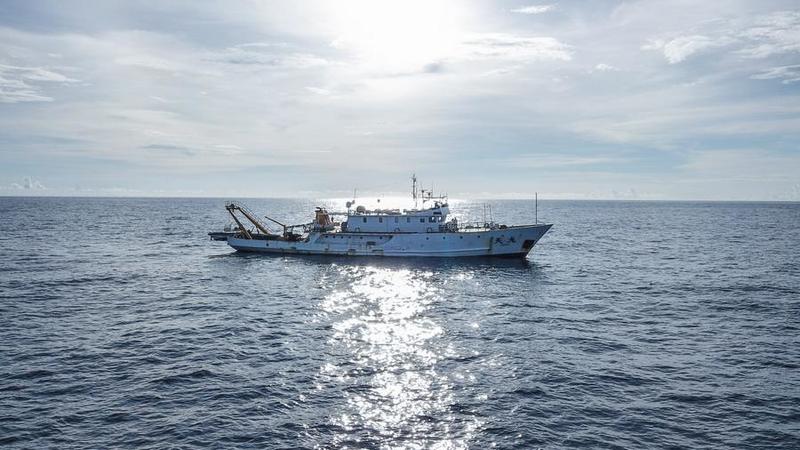
 This file photo dated July 13, 2020 shows an expedition vessel in the South China Sea. (PHOTO / XINHUA)
China, the Philippines and the United States need to explore ways of peaceful coexistence to ease tensions in the South China Sea, a forum heard on Feb 19.
“The best choice, I think is to calm down the narrative, calm down the operations to resolve (the tension),” Hu Bo, director of the South China Sea Strategic Situation Probing Initiative, a Beijing-based think tank, said in an online event organized by the Foreign Policy Community of Indonesia (FPCI).
The Philippines is one of the ten members of the Association of Southeast Asian Nations (ASEAN). The regional bloc and China are currently negotiating a code of conduct for the South China Sea
Dino Patti Djalal, a former Indonesian diplomat and FPCI chairman, moderated the discussion.
READ MORE: Wang refutes fallacy of aggressive China in South China Sea
The online forum was held amid a heated dispute over the strategic South China Sea waterway. The Southern Theater Command of the PLA issued a statement on Feb 19 criticizing the Philippines for organizing “joint aerial patrols” in the South China Sea with countries outside the region. The theater command said that “the situation is fully under control”.
Hu said during the forum that the US is using the dispute over the South China Sea to position its “Indo-Pacific” strategy against China. He said the Philippines “underestimated China’s determination to defend its maritime rights”, but at the same time “overestimated” the support that will be provided by the US.
Hu alluded to Philippine President Ferdinand Marcos Jr’s decision to expand his country’s military alliance with the US – which contrasts with the foreign policy of Marcos’ predecessor, Rodrigo Duterte. Marcos, who will be serving a six-year term, was elected in 2022.
He said the change in Philippine foreign policy is the “main reason” behind the rising tension over the South China Sea.
“The ball is not on China’s side,” Hu said, adding that Beijing has no choice but to react in the face of Philippines’ “consistent challenges” over disputed waterways.
The Philippines is one of the ten members of the Association of Southeast Asian Nations (ASEAN). The regional bloc and China are currently negotiating a code of conduct for the South China Sea.
US stands by its allies and has legal and moral obligation to the Philippines on the back of a Mutual Defense Treaty between the two countries
Renato de Castro, professor of international studies at the Manila-based De La Salle University, said even Duterte had to realign Philippines’ foreign policy during the latter part of his six-year term as the tension in the South China Sea was unresolved.
Mentioning incidents in the South China Sea that involved coast guard vessels from the Philippines and China, he said the Philippines is currently modernizing its naval and air force capabilities and is in the last stage of negotiating a reciprocal access agreement with Japan.
READ MORE: China Coast Guard expels Philippine vessel in S. China Sea
Gregory Poling, director of the Southeast Asia Program and Asia Maritime Transparency Initiative at the Washington-based Center for Strategic and International Studies, said that since 1990s the US has had interests in the South China Sea dispute.
“The first is defense of freedom of the seas, meaning the rules, the laws that govern maritime space. The second US interest is unique to the Philippines, and that’s the alliance commitment,” Poling said.
He said the US stands by its allies and has legal and moral obligation to the Philippines on the back of a Mutual Defense Treaty between the two countries. But he said the Philippines “needs more say in how the alliance works and that’s what that joint vision statement does”.
Leonardus Jegho is a freelance journalist for China Daily.
Contact the writers at prime@chinadailyapac.com
