

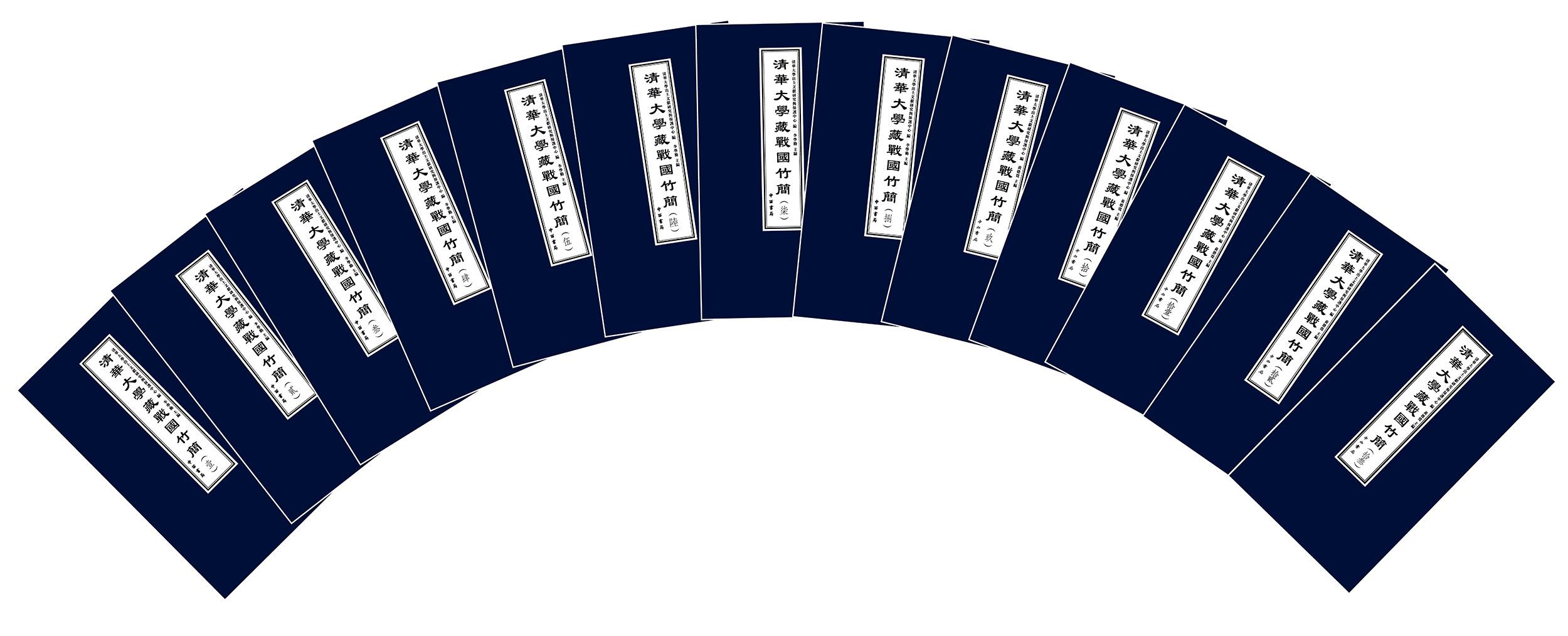
 Tsinghua University's Research and Conservation Center for Unearthed Texts has published 13 volumes of The Tsinghua University Warring States Bamboo Manuscripts since 2011. (PROVIDED TO CHINA DAILY)
Recent research findings of the bamboo manuscripts collected by Tsinghua University in Beijing have revealed a new insight into the ritual system, musicology and philosophy of the Warring States Period (475-221 BC).
The university's Research and Conservation Center for Unearthed Texts launched the 13th volume of The Tsinghua University Warring States Bamboo Manuscripts on Dec 10. They feature five recovered pieces of bamboo manuscripts that were unseen prior to now in any records transmitted through history.
Two of these texts, bonded as one scroll and complementary to each other, expound on banquet etiquette of the officials of the Chu state, encompassing today's Hubei and Hunan provinces.
They explain how the hosts should arrange the seats and place the utensils, when and how to order the serving of the grains, meat and wine, as well as how the guests should dine properly and respond to the host's hospitality.
The written rites cover the whole process of a feast, from the guests' coming to leaving, listing various situations, such as what happens should the host be of higher ranking than the guests, or if the guests outranked the host, according to Ma Nan, associate professor at the center.
She says, one of the bamboo books, Dafu Shili (Banquet Rites of Officials), woven on 51 bamboo strips, explains from an omniscient perspective the proprieties that ought to be practiced by the hosts and guests, respectively, and how the receptionists should drive the process and guide the etiquette in between.
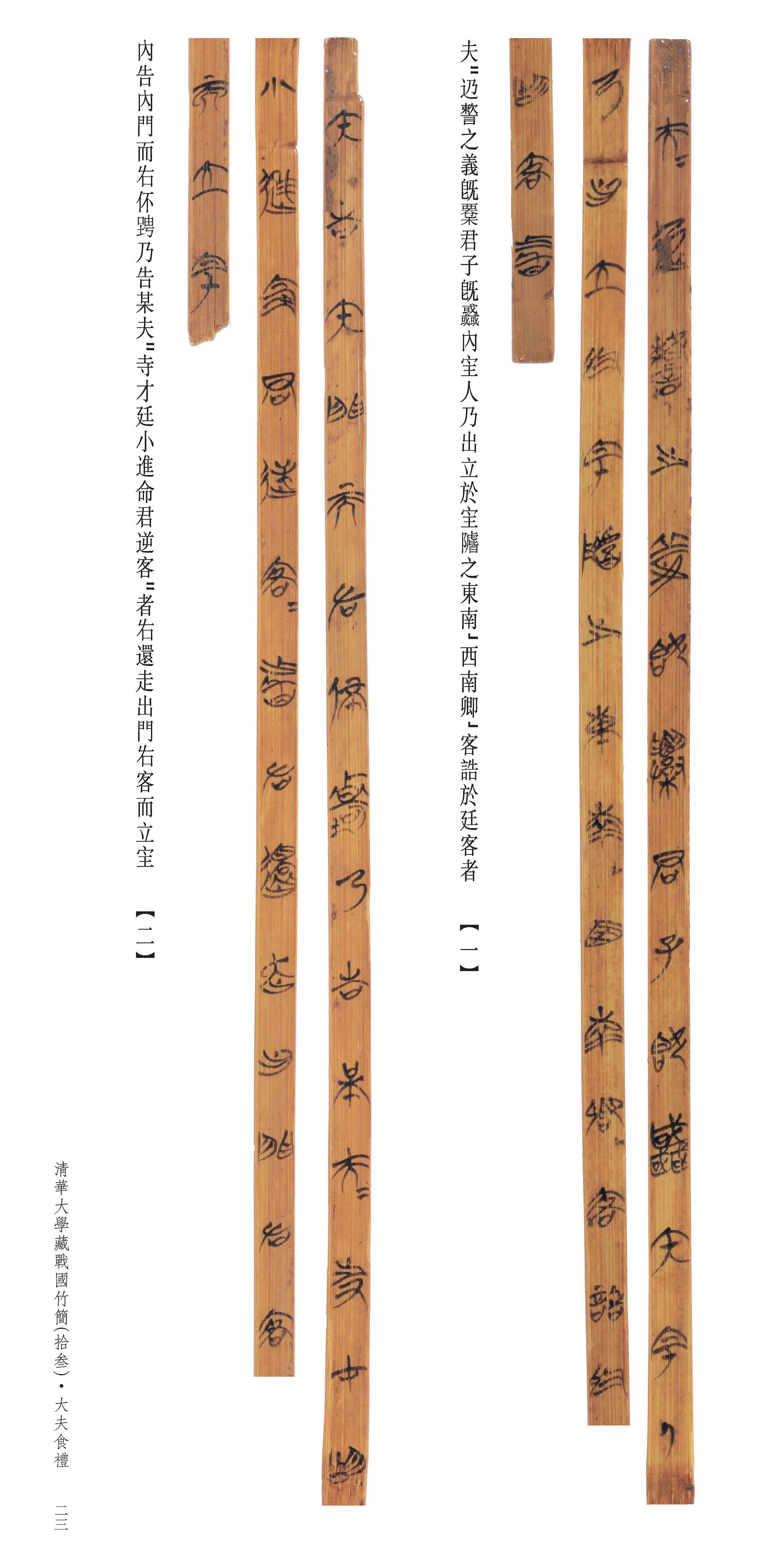 Part of the bamboo strips that records Dafu Shili (Banquet Rites of Officials). (PROVIDED TO CHINA DAILY)
The other book, Dafu Shili Ji (Addendum to Banquet Rites of Officials), on 14 bamboo strips, however, records in detail the ritual procedure for servants.
Ma says these two ritual texts were written and finalized in the mid-Warring States Period, and compares their content and use of words with Confucian classic Yi Li (Ceremonies and Rites).
These references have many similarities, despite the fact that the manuscripts collected by Tsinghua University have presented regional features of Chu, she says.
"It's the first time lost pre-Qin Dynasty (before 221 BC) ritual texts were found in bamboo manuscripts of the Warring States Period. They are an important reference for the study of the pre-Qin ritual system and the research into Yi Li," says Huang Dekuan, director of the Tsinghua center.
In 2008, the university received a collection of around 2,500 bamboo strips from alumni donations that are inscribed mainly with early Confucian classics and historical records.
Dating back more than 2,300 years, these manuscripts were written in the script of the Chu state.
Since 2011, the Tsinghua center has been publishing a volume of the manuscripts every year, with images of the original manuscripts, the texts transcribed in modern Chinese, meaning of words and annotations, as well as detailed information of the strips.
The work was at first led by late historian and paleographer Li Xueqin, and currently Huang.
One of the two musical texts released this year in the 13th volume, Wuyin Tu (Chart of Five Notes), is an illustration with a pentagram in the center.
Each of its projecting points is marked with one note that ancient Chinese people applied, and the extension lines on each side of the pentagram are marked with the certain note in different octaves.
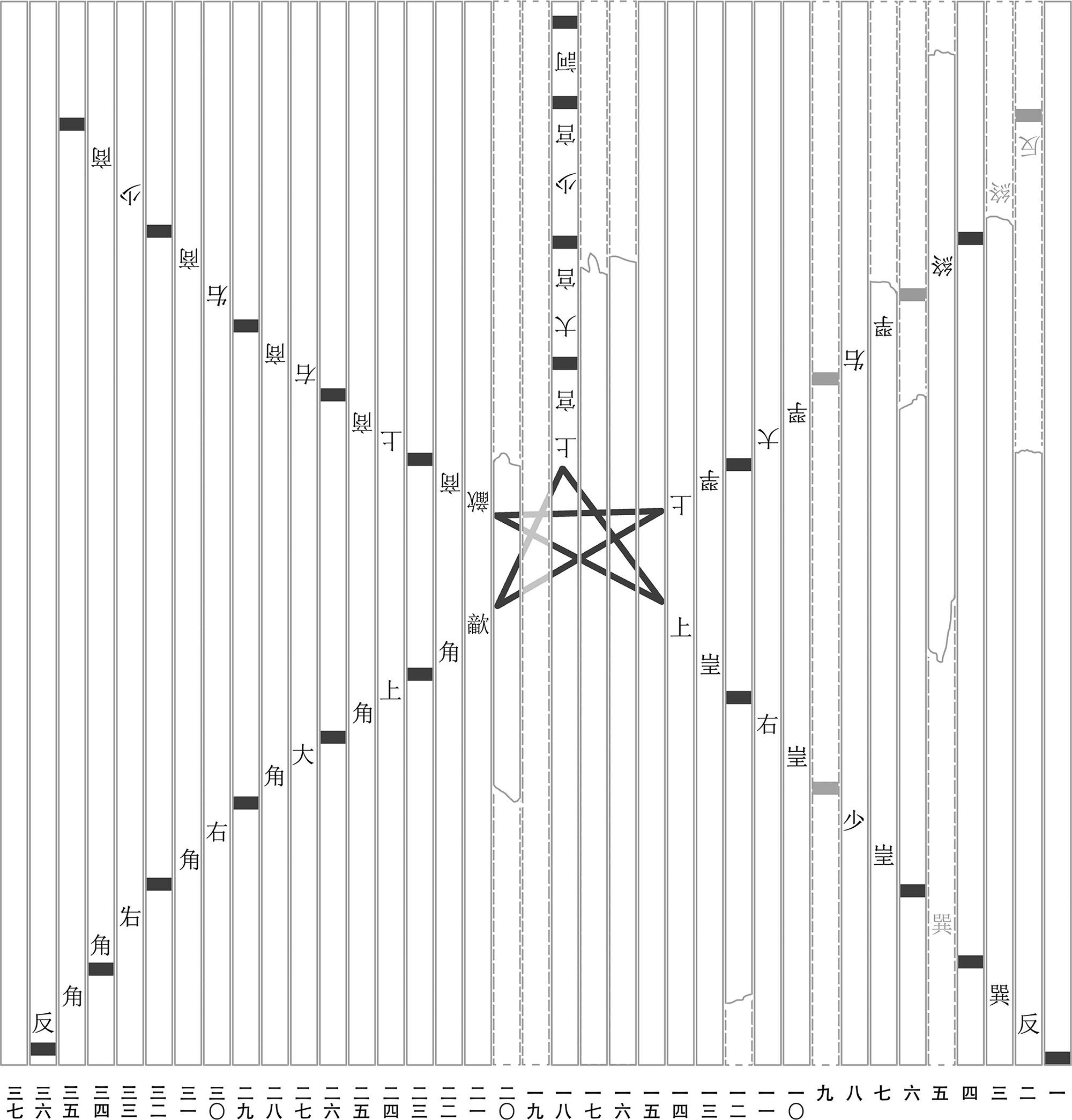 Wuyin Tu (Chart of Five Notes). (PROVIDED TO CHINA DAILY)
The five lines of the pentagram suggest the connection between the five notes and indicate their formation, which involves ancient mathematics and conforms to classics passed down through history like Guanzi and Huainanzi (Great Words From Huainan), according to Jia Lianxiang, associate professor at the center.
Another musical text, Yue Feng, also records notes' names — and more information that is yet to be interpreted — and therefore, has the potential to provide inspiration for the study of the pre-Qin music theory and history.
The strips for this text are only 9 centimeters long — the shortest in strip length seen in Warring States Period bamboo manuscripts — small in size and easy to carry, Jia says.
The last text, Weitian Yongshen (Fear of Heaven, Use of Body), discusses the relationship between heaven and humans and people's subjectivity, as the historical period valued a can-do spirit.
It stresses that people should give full play of their activeness to learn about the laws of nature and the dialectical relationship between things, and do their best with flexibility in mind, according to Shi Xiaoli, associate professor at the center.
He says, the piece of text points out the inevitable route to change one's life in a time of drastic changes and uncertainty in politics, economy and society.
Cheng Hao, associate professor at the center and assistant of Huang, says: "The bamboo manuscripts housed at Tsinghua prove that Chinese culture has been rich and diverse since its early stage, which partly explains its endurance."
He adds that the pre-Qin Chinese people had a great knowledge in culture, art and nature, and their philosophy has been a precious reference to today's governance and society.
According to him, there will be altogether 16 volumes of The Tsinghua University Warring States Bamboo Manuscripts. They will guarantee one volume being published annually.
