

Fun, chic stops mark a refreshing break in Kizilia scenic area and Baicheng stone forest
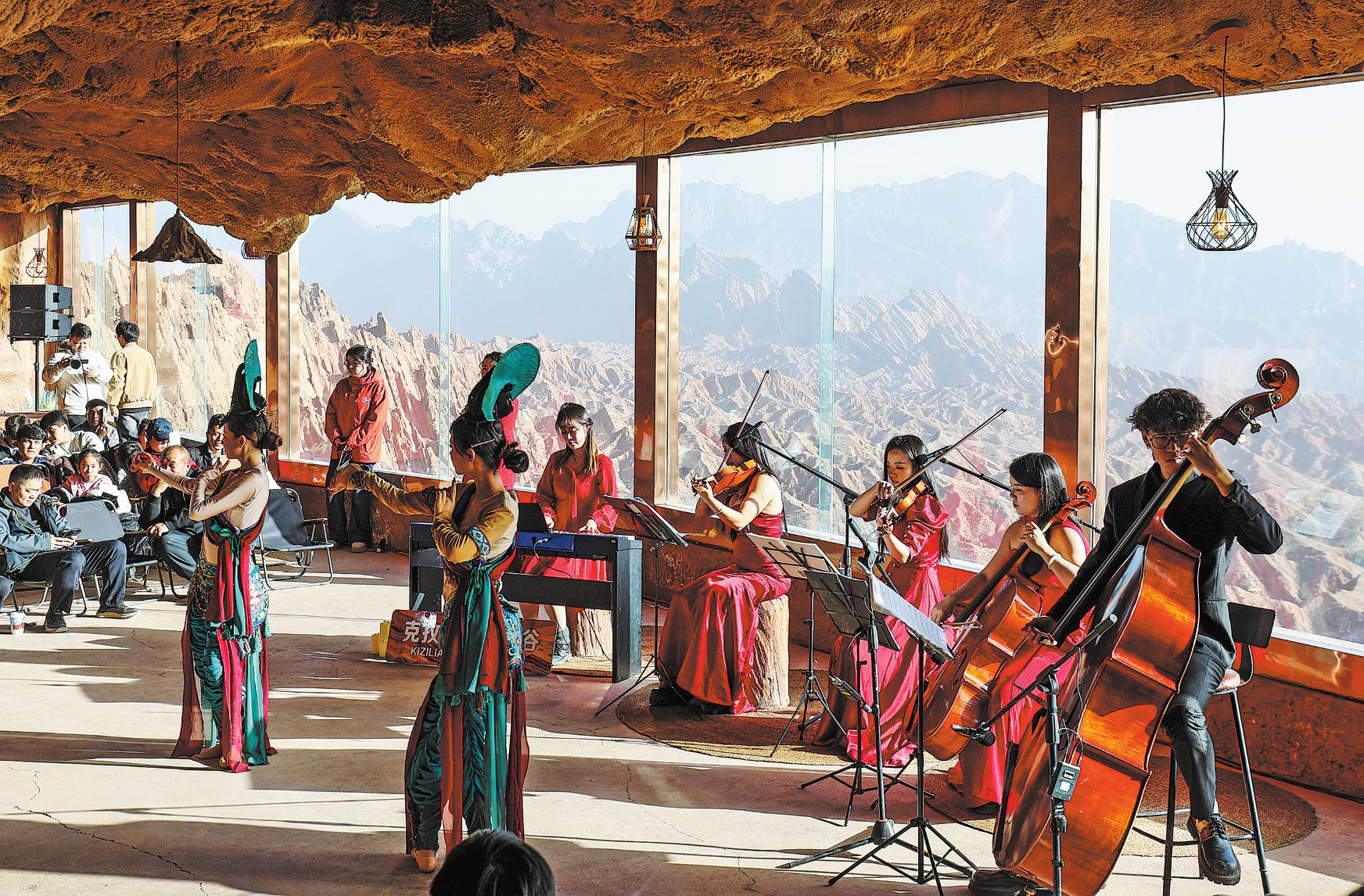
Somewhere in the Kizilia Grand Canyon Scenic Area, about a 40-minute drive north of Kuqa city, Xinjiang Uygur autonomous region, 144 steps bolted to crimson rock lead up to a cliffside cafe perched at an elevation of 2,664 meters.
Sit at the edge of the precipice, coffee in hand, and the rock face drops away beneath you. The cafe is tucked into the rock, cavelike inside; its floor-to-ceiling windows provide safety from the menacing cliff — and the wind and cold — while leaving you a cozy front-row seat to the canyon's grandeur.
Kizilia — meaning "red cliffs" in Uygur — is a panoply of Yardang and Danxia landforms. It is a rare canyon in southern Xinjiang where visitors can drive along winding gravel roads.
Wu Jianzhong, 39, a traveler from Sichuan province, detoured there in July. "The deeper we went, the narrower the road became," he said. "The red rocks on both sides looked as if they had been split open, and the wind slipped through the gaps — dry and crisp, not stuffy at all."
ALSO READ: More than daily bread
Wherever visitors go, all the routes end at the cliffside cafe. Wu said the mountains there offer not a commanding view but a folded one — like the wrinkles on an elderly person's skin, less vital, more desolate.
Xu Hao, who runs the cafe, said the idea was to add a fun, chic stop to a traditional self-driving adventure in nature.
He recalled scouting the location on a winter day, when a layer of white topped the crimson walls. Layered ridges rose like dragon scales, with fog and clouds stretching into the distance.
Summer is the rush season, he said, but quieter winter — and its blue hour — is still worth the trip.
Two intimate instrumental performances were held there earlier this month, one inside the cafe and another outside amid rock walls hundreds of millions of years old. Xu said more such events are planned for next year.
In neighboring Baicheng county, Li Yanjun has been running two branches of MOJ, a drink brand that originated in Wenzhou, Zhejiang province, in a sprawling stone forest since May.
An amphitheater-shaped cafe sits beside Lieyan Quan, or flaming spring, where the water itself catches fire. When underground gas seeps through fissures and mingles with the spring water, a spark sets it alight.
A 15-minute drive away, the matcha house's curved roof, formed from natural paper pulp rather than concrete, recreates between two mountain slopes the moment when a gust snatched a sheet of paper from the designer's hand.
ALSO READ: Shenzhen’s cliffside cafe offers breathtaking views of Xichong coastline
Meng Kaixin, a 26-year-old visitor from Henan province, described the house as utterly different from the "breathing space" manufactured in the urban hustle and bustle — a place that invites you to let go.
For Li, a Chengdu native, his long stay in Baicheng — where climate, food and culture differ sharply from home and the many places he'd worked in across the country — feels like the two venues themselves: growing from nowhere in barren land.
Accompanied by magnificent views and stories shared by visitors from home and abroad, he would not call it solitary but a quiet emptiness that calms him and leads him into subtle realms of thought that might otherwise be lost in the daily clamor.
He looks forward to the Zhaosu-Wensu Highway, scheduled to open next year, which will cross the Tianshan Mountains, linking northern and southern Xinjiang. Easier access may bring more visitors to explore the stone forest — and to his drinking houses.
Hu Dongyue contributed to this story.
Contact the writers at fangaiqing@chinadaily.com.cn
