

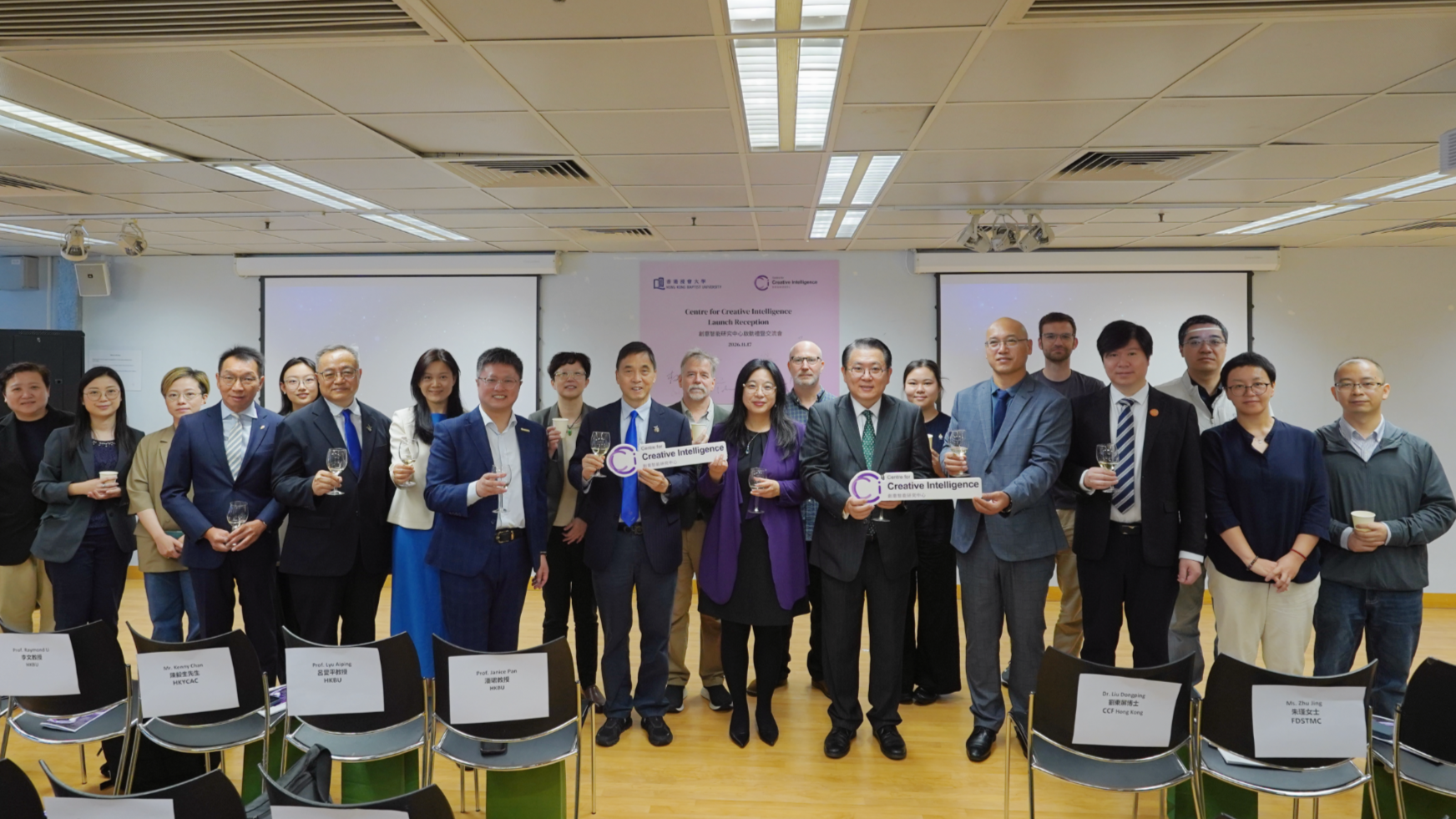
Hong Kong Baptist University (HKBU) held a launch reception for its Centre for Creative Intelligence (CCI) on Tuesday.
Themed "Shaping the Future through Creative Intelligence," the event brought together guests from artificial intelligence (AI), research and development, the technology sector and the news media to explore the future of creative intelligence and human-machine collaboration through cross-disciplinary dialogue.
Lyu Aiping, HKBU’s vice-president (research and development), said, "We hope the center will bridge technological advancement and societal needs through interdisciplinary research and collaboration among universities, research institutes and industry, driving original and socially valuable research as well as talent cultivation."
Johnny Poon, HKBU’s associate vice-president (interdisciplinary research), said that insights from the humanities and arts help guide technological innovation. He said he hoped that different disciplines will join hands to explore how intelligent technologies can expand creative boundaries while preserving human judgment and agency.
READ MORE: HKBU intl symposium champions ‘AI for social good’
Established on Sept 10, the CCI aims to connect technological research, education, and professional practice, allowing societal needs to guide research priorities.
Jun Pan, founding director of the center, introduced her vision: "We hope to build a mutually beneficial partnership between humans and technology, driving technological innovation through human creativity while expanding human capabilities via intelligent technologies.”
Leonard Chan, a board member of the Hong Kong Artificial Intelligence Research and Development Institute , used a fictional story about the closure of a shoe repair shop to illustrate how the same source material can be expressed differently depending on creative intent and target audience.
He said that human-AI co-creation should accommodate reasoned divergence, using original source materials and the responses of those involved as the basis for judgment.
"Universities should cultivate talents capable of explaining their creative choices and exercising judgment tailored to different audiences," he added.
ALSO READ: HK urged to establish regulatory framework for agentic AI, tokenization
Lily Sun, director of the Accelerator Team at Microsoft Research Asia (MSRA), shared insights on the evolving criteria for talent in the AI era.
"In the past, MSRA selected talent based on criteria such as 'strong mathematics, solid programming skills, and a proactive attitude,' whereas in the era of large models, the focus has shifted to 'foundation, exploration, and impact’," she said
She added that nurturing the next generation of innovators requires focusing on three keywords: "research taste", the ability to identify the most worthwhile questions when AI can easily generate results; "agency", proactively spotting problems and collaborating with AI to solve them rather than waiting for instructions; and "cross-boundary" collaboration, which translates AI into real-world impact.
From a media perspective, Raymond Li, professor of Practice and head of the Department of Journalism in HKBU's School of Communication, highlighted the hidden pitfalls of AI in creative fields.
Citing the Chinese mainland's micro-drama market as an example, he said: "In the first eight months of this year, 430,000 micro-dramas were produced on the mainland, with over 90 percent generated by AI, yet only 1.3 percent managed to break even.”
READ MORE: AI-made virtual sanctuaries draw young South Koreans
He added that uniformity and a lack of human warmth were the consequences of losing human agency.
"True creativity is not merely about what content is generated, but 'why it is generated.' It must embody human emotion, memory, and value judgment," Li said.
He called for a healthy "human-AI symbiosis" in which humans retain the rights to question, choose, and judge.
"The ultimate agency over creativity must always remain in human hands," he said.
During the "Educational Innovation in Practice" sharing session, Su Guanhua, a senior secondary student from Weifang Hansheng School in Shandong, China, presented a project titled "Real-Time Vision-Based Line Following on a Microcontroller without a GPU”, and described how he leveraged large language models to deepen his research and advance experimental validation.
Contact the writer at yancyfang@chinadailyhk.com
