

Investment of over 100 bln yuan to sharpen telecom carrier's edge in AI
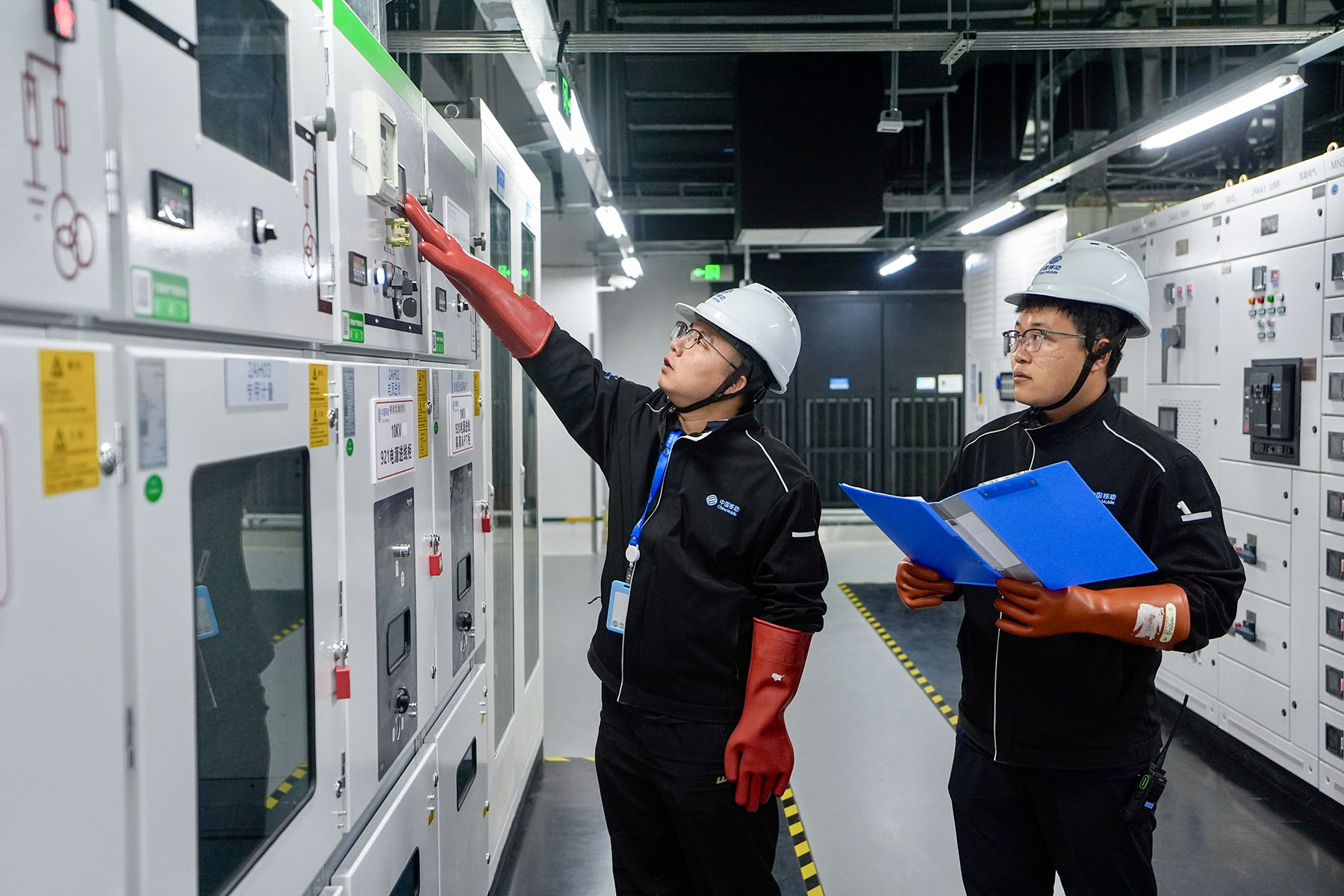
China Mobile will invest more than 100 billion yuan ($15 billion) in computing power in 2027 as part of a broader procurement plan expected to exceed 500 billion yuan next year, as the company steps up its push to cultivate artificial intelligence-driven growth.
Chen Zhongyue, chairman of China Mobile, said computing power is the company's largest incremental investment and it aims to double its intelligent computing capacity for two consecutive years.
"We broke ground on three gigawatt-level computing center parks this year and will build two more next year, bringing the total to seven," Chen said. Construction of multiple 10,000-card intelligent computing clusters is already complete and the company is now developing several ultra-large-scale clusters.
"Every economic form has infrastructure suited to it. The new intelligent economy needs new infrastructure," Chen said, adding that the industry's shift from internet data centers to AI data centers, central processing units (CPUs) to graphics processing units (GPUs), and from cloud resource pools to token factories is all part of computing buildout and must be judged not only by input, but also by output.
The plans align with national efforts.
Jiang Yi, a spokesman for the National Development and Reform Commission, said the 15th Five-Year Plan period (2026-30) will see 4 trillion yuan in new direct investment in computing network construction, mostly from enterprises, creating vast space for private investment.
Xie Cun, a spokesman for the Ministry of Industry and Information Technology, said China's intelligent computing capacity reached 2,592 exaflops — or exa floating-point operations — per second by the end of September, up 146 percent year-on-year.
Wang Weiming, chief engineer of the MIIT, said domestic computing chips and large models are increasingly compatible, with more than 1,000 application scenarios across 20 industries, including steel, automobiles and pharmaceuticals.
Experts nonetheless cautioned that computing network construction faces shortcomings, calling for a coordinated "hub-region-edge" supply system. The recently released 15th Five-Year Plan for the information and communications sector calls for accelerating the national integrated computing network, deploying inference facilities on demand, advancing "millisecond computing" in urban areas and promoting computing-power coordination.
According to the NDRC, China will focus on supply-demand alignment, strengthen coordination among computing networks, new power grids and next-generation communications networks, expand direct links between national hubs and enhance market-based scheduling.
He Baohong, chief engineer of the China Academy of Information and Communications Technology, said policy attention has shifted from building computing facilities to whether resources can be perceived, scheduled and ultimately used by enterprises and industries.
The country is carrying out special initiatives to empower small and medium-sized enterprises with inclusive computing power, exploring service models such as computing supermarkets and computing banks, lowering the threshold for SMEs and pushing computing resources into the real economy.
In the next stage, the focus will not only be on building resources, but also on connecting resources, networks, applications and services, said He.
Separately, Wang Xiaoyun, chief engineer at China Mobile and an academician at the Chinese Academy of Engineering, launched the company's 6G intelligent application co-creation initiative, aimed at identifying high-value 6G scenarios with industry partners and cultivating new products and business models.
Wang Xiaoyun said 6G will become the network foundation of the intelligent era, supporting ubiquitous applications of hundreds of billions of intelligent robots and AI phones. With less than 30 months until global 6G standards are frozen, she stressed acting "early" and "together" so that demand can better guide network design.
Under the initiative, China Mobile launched an action plan: one set of test facilities across multiple city nodes and scenarios for application incubation and end-to-end verification, and 10 high-value 6G domains including networked robots, AI terminals, immersive communications, space-air-ground-sea integration, swarm collaboration, industrial intelligence, smart energy, smart logistics, intelligent transportation and digital housing.
Contact the writers at masi@chinadaily.com.cn
