

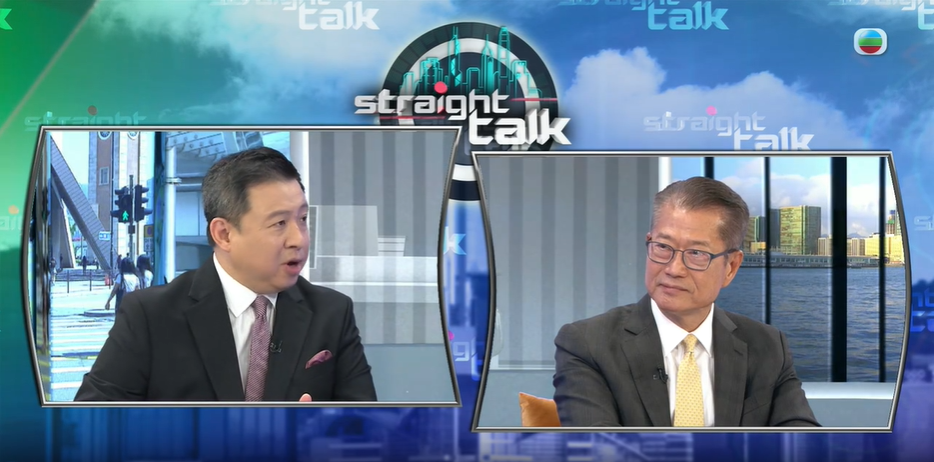
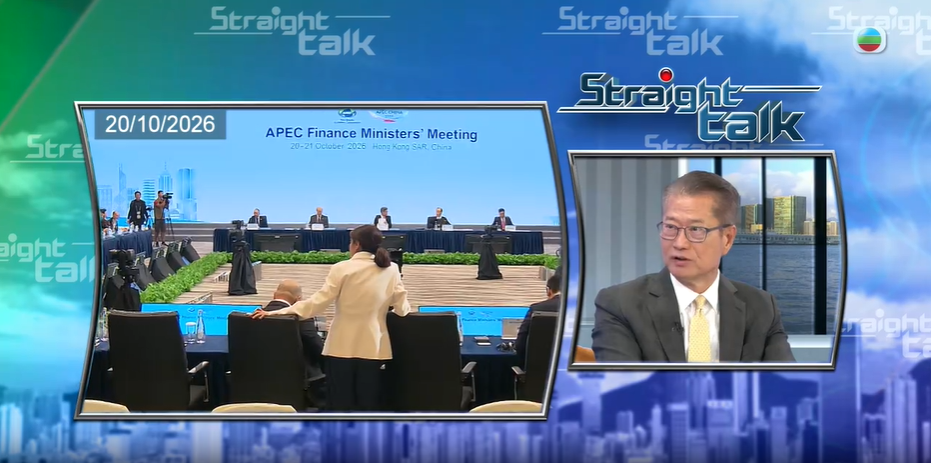
Less than a week after Hong Kong hosted the APEC Finance Ministerial Meeting, Financial Secretary Paul Chan Mo-po is on the show this week. The meeting put Hong Kong on the international stage. But what does it mean for our economy, our businesses and our people? And how can we turn this international exposure into real, lasting benefits for Hong Kong?
Check out the full transcript of TVB’s Straight Talk host Eugene Chan Kin-keung’s interview with Financial Secretary Paul Chan:
E. Chan: Good evening, and welcome to Straight Talk. I'm Eugene Chan. Hong Kong has just hosted the APEC Finance Ministerial Meeting for the first time. It is a great opportunity to put Hong Kong on the international stage. But the big question is, “what does it mean for our economy, our businesses, and our people? How can we turn this international exposure into real lasting benefits for Hong Kong?” To discuss this, I'm pleased to welcome back our financial secretary, Paul Chan, into the studio. FS, it's good to have you back in Straight Talk again!
P. Chan: Thank you, Eugene.
E. Chan: It's so familiar that we have you here, and it's happy to see Hong Kong's getting better and better in terms of our economy.
P. Chan: Yes.
Background
E. Chan: Before we get into the opportunities for Hong Kong, maybe we can start with the big picture.
P. Chan: Sure.
E. Chan: For viewers who may not be very familiar with APEC, I understand that it is 21-member economies …
P. Chan: Yes.
E. Chan: ... including China, US, Singapore, Australia and Russia. So, why is this important, this forum, so important for the region?
P. Chan: It is very important because on the one hand, it is a very important investment forum, for capital coming from the US, Europe – the more established economy. And at the same time, the closer collaboration between economies in the region is important so that we can better leverage our respective competitive strength and grow together, globally facing tough headwinds, geo-economic fragmentation, the challenge of climate change, but at the same time, this region, China, the Asia-Pacific, is growing very fast, much faster by the average global growth. So, this offers opportunities for them as well.
E. Chan: Right. So, in a way it's not just us looking for opportunities. I think many other economies are looking for similarly.
P. Chan: True, true.
E. Chan: Right.
P. Chan: And particularly for some of the Western economies, they see the technological innovation of the mainland so successful, and the valuation is comparatively still quite affordable. So, this is investment opportunities. For Hong Kong, this is opportunity for us to do not just fundraising, but also hand-holding these companies to go global, which will benefit our professional services and our local enterprises.
E. Chan: Right. So Paul, you know, this is the first time Hong Kong hosted an APEC …
P. Chan: True.
E. Chan: ... particularly the Finance Ministerial Meeting. I understand there are over 500 guests over two days. So, how did we do as a host?
P. Chan: Well, on the one hand, in the meeting, very constructive and lively debate. At the same time, we take the opportunity to showcase them to the different aspect of Hong Kong. Some of them are interested in technology, innovation, so we take them to Science Park. Some are more interested in the cultural aspect, and some just enjoy meeting with their friends, their people, and experience the vibrancy here.
E. Chan: So, what kind of feedback have you received? Maybe don't be too humble. And we'd like to know how happy has Hong Kong been able to treat them this weekend, these few days?
P. Chan: Well, from the feedback from the participants, they are very positive, very happy. On the one hand, they … from what they have observed and interact with their friends, Hong Kong is very vibrant, very positive. The atmosphere is obviously on the upward trend.
E. Chan: Right.
P. Chan: This is a little different from what they may have read from the overseas media, and they really treasure this opportunity. And in our discussion, I expect more business delegations coming from their part of the world to Hong Kong to take the opportunity of not just Hong Kong, but also the mainland's development.
E. Chan: Right. So it is indeed a very significant juncture for Hong Kong to hold such a major event.
P. Chan: I think so. I think so. Particularly, you know, over the past few years, because of COVID, a lot of people haven't traveled to this part of the world for quite some time.
E. Chan: True.
P. Chan: So this is important, not just for the business leaders, but for the political leaders. Because at the end of the day, policy formulation is very much on their hand. With their understanding and support, I would expect the cross-border collaboration in many fronts will be advanced.
How HK can contribute and benefit
E. Chan: Right. FS, you know that Hong Kong has always been pride of being the superconnector and also the super value-adder.
P. Chan: Yeah.
E. Chan: Understand there are a lot of businesses are going on. Would you be able to let the viewers know, even on the broad spectrum, can Hong Kong be able to connect international capital with the mainland for any businesses?
P. Chan: I'm very confident in this respect.
E. Chan: Right.
P. Chan: On one hand, from the investor's standpoint, they are looking for diversification. Hong Kong is a safe harbor in terms of parking their money here. But we offer more than safety. Actually, access to opportunities. When they come here, they are closer to the mainland market, get better information about the development there, and also convenient access to the technological development of the mainland in this respect. So, I would expect the capital flow will continue to come in, and when we look at the figures in the past 18 months, indeed there is significant net capital inflow. When you look at the total deposits in our bank increased by over HK$1 trillion over the past 12 months. So, this is just one evidence. But on the other hand, mainland companies going global will be a growing trend. This momentum will offer opportunities for Hong Kong as well.
For our professional services, we can handle them to go overseas, and for some of our local companies, they can partner with them as well. They value the international exposure of Hong Kong and our ability to connect mainland standards with international standards. And to guide them in terms of, for example, risk management, compliance management, ESG requirement when they go global.
E. Chan: Right. FS, we know that Hong Kong has been doing very well in terms of IPO. And some people have said that, “Oh, it's mainly mainland companies coming, not the international funds.” While there are different opinions on that, do you see the international market wanting to be coming back to Hong Kong soon? Because with this experience with talking with all of the ministers, do you see that happening?
P. Chan: Well, in our discussions with, say for example, Kazakhstan government representative, they are very keen. Indeed, the Kazakhstan railway companies and the other energy-related companies are planning for bond insurance and IPO there. This is just one example. And on the other hand, for Southeast Asia, Malaysia for example, Vietnam for example, they are very keen to attract our capital, and in this process, we talked to them about dual listing.
E. Chan: I see.
P. Chan: Meaning that the companies to be listed on both exchanges. That would be benefiting both economies. And we encourage our regulators, the SFC, the Hong Kong Exchange, to establish cross-border regulatory collaboration with them as well.
E. Chan: Right.
P. Chan: And there is a possibility when, when we move forward, one prospectus will serve both markets. That would also streamline the process and quickly reduce the costs of seeking listing.
E. Chan: Right. FS, I mean, I understand there's a joint statement from the meeting reaffirming the commitment to building an open, dynamic, resilient, and peaceful Asia-Pacific community by 2040, and the agreement on digital infrastructure financing. Why is it taking so long to be 2040? It's only 2026 right now.
P. Chan: Well, we need to plan for the long term. We have both short-term, medium-term, and long-term target. Indeed, in closer terms, for example, the digital infrastructure, they are very interested. Our CargoX project, which enables more traders by using their trade data on this infrastructure to get financing.
E. Chan: Okay.
P. Chan: A lot easier, quicker, and cheaper. They feel very keen, and indeed some economies have already started discussions with them, asking them to extend this infrastructure and expertise with them so that when this small business doing cross-border transactions, all these data can be shared. So that is one.
And also on financial talent development collaboration, on joint efforts to help young people to get more international exposure to do more cross-border infrastructure financing. So, it is on multiple fronts, I think we have short-term, medium-term, and long-term targets and development strategy.
E. Chan: So, definitely we're looking for more opportunities for the financial sector and the businesses.
P. Chan: As well as the technology sectors.
E. Chan: I see.
P. Chan: Because for our technology sectors, they are also expanding global. For example, one company in the business of EV charging, we already have them established in Thailand.
E. Chan: Okay.
P. Chan: This would be our strategy. Mainland quality companies coming to Hong Kong, not just for fundraising, but using our professional services, working with our local firms to go overseas to expand.
E. Chan: Right. FS, let's take a short break now. We'll be back with more Straight Talk.
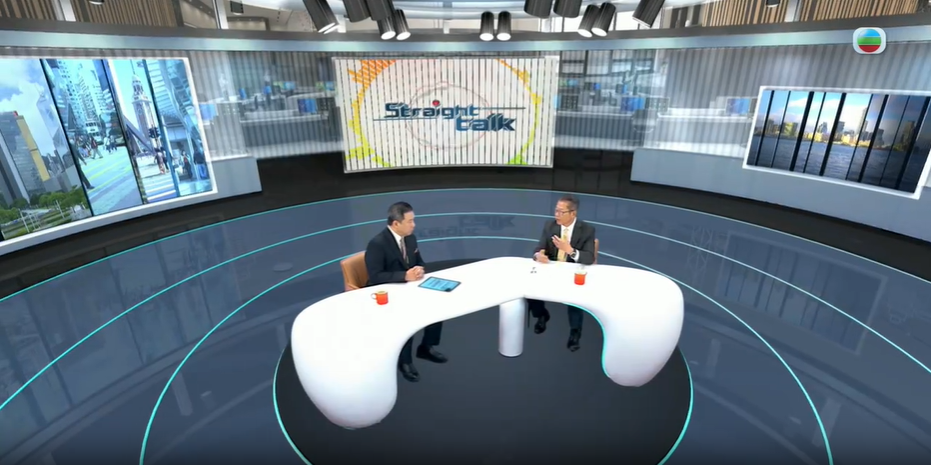
E. Chan: Welcome back. Financial Secretary Paul Chan is in the studio this evening to share with us how Hong Kong can turn its role in the recent APEC Finance Ministerial Meeting here into tangible economic opportunities for our city. So, FS, you have said to us that it was a very good environment, good vibe, that a lot of people see Hong Kong as who we really are …
P. Chan: Yes
E. Chan: ... and be interested to come back to have more investments and more collaborations.
Challenges
E. Chan: One thing that we've been hearing a lot from the community is that the challenge is actually attracting investment that actually creates real economic activity. Do you think, after this APEC, we will attract more overseas investment, and encourage companies actually to expand their operations here? Because I was over in Bangkok for the weekend, and they told me that actually Singapore, for example, has benefited in the last few years in terms of what has happened in Hong Kong and the rest of the world. Do you think now is a turning point for Hong Kong to be back to where we were, or even doing better?
P. Chan: I'm sure we will do even better. In terms of capital flow, in fact there has been net capital inflow, not just from the mainland, but also from established market like the US and Europe. And on the other hand, on this opportunity, we showcase to them, explain to them our development strategy about the Five-Year Plan as well. Given the global situation, they are seeking diversification, seeking investment opportunities. We encourage them to bring business delegation to Hong Kong as well so that we can do some business matching. And in one, few situation, they visited our Science Park. They visited our Northern Metropolis. That gives them the optimism as well, in terms of Hong Kong's future development. We would be shipping, finance, trading, as well as technology and innovation. And on the technology and innovation, there are a lot can be collaborate.
E. Chan: Just now you mentioned digital infrastructure financing, that we can get cheaper funds. Where do you see the biggest opportunities for Hong Kong, because we have things like data centers, AI, fintech, other areas. How can Hong Kong businesses capture this opportunity, do you think?
P. Chan: On one hand, they need to raise financing for their infrastructure. That would be good not just for the finance sector, but also for the professional sector, as well as our contractors. On the other hand, say for example, one of the participant is AIIB, Asia Infrastructure Investment Banks.
E. Chan: Right.
P. Chan: They indicate their interest in participating in our Northern Metropolis development. In other words, in the Northern Metropolis, there would be these development banks coming in as well. What is important is not just them, but they as a catalyst to bring in other long-term capital. So, going forward, the Northern Metropolis development will be a project having a lot of international interest. Many of the participant this time also raise about Northern Metropolis because they have heard about it. They do not have, they do not have enough information, on this huge development. So, this time, through the interactive debate, through visiting the sites, they have a much better idea.
E. Chan: Right. Paul, do you see that the government has a role from now on to help this opportunity turn into actual projects and actually a private sector investment? Because in the past it has been very sort of a stay on the side, not through direct helping, but I think for Hong Kong, I think we need more government direct support. Do you see that happening?
P. Chan: Well, the government plays a catalytic and facilitative role, so when we encourage the officials to organize delegations to Hong Kong, we will connect them with our InvestHK and OASES to give them full range of support.
E. Chan: Okay.
P. Chan: We also mention to them about the possibility of a concessionary package to attract them to settle into Hong Kong, depending on the scale of investment and the level of expertise. So, APEC alone, I think this opportunity is to enable the rest of the world to have a better understanding of the vibrancy and opportunities here. Going forward in the coming few months, as you know, we have a lot of mega events happening.
E. Chan: Yes.
P. Chan: Sporting events, cultural events, financial events. So, a lot more people will come, and this will be also driving our retail sector, the F&B sector. And when I look at the statistics, indeed, in terms of retail, it has been coming back in the past 16 months.
E. Chan: So, FS, another part that I was going to ask you is about Hong Kong's sort of, I would say, backbone. It is SMEs – the small and mediums enterprises. We face a lot of challenges right now, as you know, and especially getting financing or even expand overseas. Is there any government plan in terms of helping them to get more financing. Especially with AI, there's going to be new opportunities, so to speak, and, and to overseas markets?
P. Chan: Well, we help the SMEs through a multi-pronged approach. Number one, as you rightly point out, is liquidity. On that, we have extended our 80 percent guarantee loan scheme previously to fix- to help them to get funding easier. I mentioned about the Project CargoX, which also helped the traders in terms of easier access to come to cheaper finance from the banks.
In terms of digital transformation, we have subsidies, and we have asked the Hong Kong Productivity Council, as well as the Cyberport, to help us equip them, give them training in terms of their digital transformation. And in the BUD fund we in fact subsidize their overseas visits and their visits to the mainland in terms of joining the business delegations, so it is a multi-pronged approach.
E. Chan: Right.
P. Chan: And what is more important, I think, at the same time, is to continue to build our economy. If our economy is vibrant, growing, then the opportunity for SMEs naturally are better.
E. Chan: Right.
P. Chan: When you look at our asset market, for example, the real estate market since the second half of last year has already come back. Last year, the residential property price went up by about 3 percent. This year so far, another 7 percent. Volume-wise, it's almost back to the 2018 level. So, the residential market is on a positive trend. On the office market, also stabilizing. When I look at the rental, particularly in the core area, the rental start to come back.
And for the relatively remote area, of course, still needs some time, but at the same time, we take different methods to help utilize this excessive stock. For example, in suitable locations, allowing them to convert these office properties in student hostels. So, given all these efforts, our assessment is that the asset market in terms of real estate, is stabilizing. In certain sector, slightly on the positive side. The stock market is also stabilizing. With the economy improving, consumption will follow.
E. Chan: Right, FS, I'm sure this is the most important part of interview because most viewers will have assets in different classes, and you have updated us. As we spoke earlier, we know that the finance industry and the technology industry are the one that are really taking the lead at the moment. Do you think this APEC opportunity will create more chances for traditional trade, like professional services, trade and logistics? You mentioned about that we maybe go out with the mainland companies, for example. Do you see the traditional industries being able to pick up the momentum again?
P. Chan: For the traditional industry players, on the one hand, we need to move with times. For example, in terms of using AI to enhance efficiency, digitalization, and at the same time, perhaps, in terms of market, need to assess where are the bright spots ...
E. Chan: Right.
P. Chan: … and realign ourselves accordingly. For example, in terms of merchandise trade, the Southeast Asia, mainland, our largest market. Mainland previously was mainly exporting, but now, they are very keen in terms of importing as well.
E. Chan: Right.
P. Chan: And that offers tremendous opportunities for our traders. So, I think the question is to have a better assessment of the mega trend, under the geopolitical situation, and identify the growing area. Indeed, the government, when I mentioned the various schemes that we have roll out, have already given some indication and hints as to the future development.
E. Chan: Right.
P. Chan: So, I think join us, and if there are policy suggestions from the industry we welcome.
E. Chan: Right, FS, I'm going to ask you the last question, and we all know that with geopolitics and, and all that has happened, Hong Kong has been very tough in terms of facing the international world. You mentioned to me that through APEC meeting, it is a very good opportunity to tell the rest of the world we're as good as we used to be, even better. What other events can we do to continue this momentum?
P. Chan: Well, we need to take a multi-point approach. Business, finance is one, and on the other hand, in the international arena, I think the entire community can help us to share the good story of Hong Kong, the situation here. And at the same time, when these guests come, the moment of truth to them is when they go to restaurants, go to the shops, what are their experiences? So, the quality of service is also very important. We'll continue to host different events, cultural, sports, finance, trade, so that we'll continue to have influx of visitors. High quality visitors as well.
E. Chan: Right.
Conclusion
P. Chan: FS, thank you very much for the good work you have done, and especially sharing your insights with us. APEC has given Hong Kong an important platform to strengthen its international connections that, with the right strategy, could bring more investment, open up new markets, and create lasting benefits to our businesses and people.
Thank you for watching Straight Talk. I'm Eugene Chan, and good night.
