

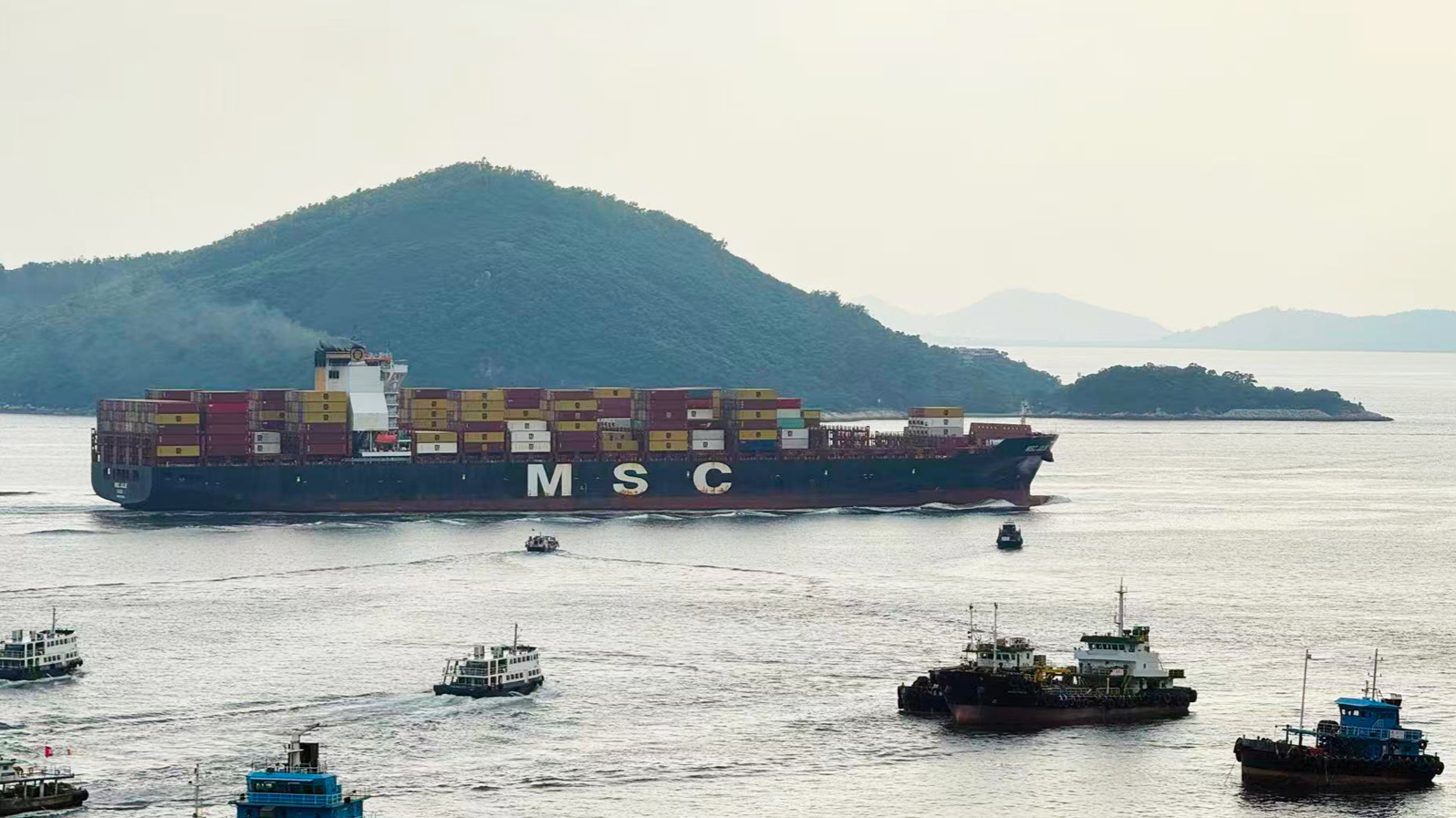
Hong Kong registered a 64.9 percent increase in the value of its exports in September compared with the same month a year ago, thanks to the sustained stellar performance in the exports of artificial intelligence-related electronic products, marking the fastest monthly year-on-year growth in over four decades.
With exports to all major markets increasing notably, the growth in exports also marks the 20th consecutive month of double-digit increases, according to official data.
In September, imports of goods recorded a 57.8 percent rise, external merchandise trade statistics released by the Census and Statistics Department showed on Wednesday.
The value of total exports of goods increased to HK$762.6 billion ($97.2 billion) in September, after a 53 percent year-on-year rise in the previous month. Meanwhile, the value of goods imported rose to HK$808.9 billion in September, after a 60 percent rise in August.
ALSO READ: Hong Kong logs 28.6% y-o-y increase in August exports
Comparing the third quarter of this year with the second quarter on a seasonally adjusted basis, the value of total exports and imports of goods increased by 8.8 percent and 7.9 percent, respectively.
Exports of “office machines and automatic data processing machines” jumped 183.7 percent in September year-on-year, while those of “electrical machinery, apparatus and appliances, and electrical parts thereof” rose 66.2 percent.
Total exports to Asia grew by 67.5 percent. Exports to several major destinations outside the region — notably Mexico and the United States — also increased, where shipments surged 148.1 percent and 133.4 percent, respectively.
Looking ahead, a spokesman for the special administrative region government said the city’s merchandise trade performance will continue to benefit from the prevailing wave of robust AI-related investment and resilient global economic growth.
ALSO READ: HK reaping fruits of tech that simulates human intelligence
The spokesman cautioned that external uncertainties warrant close monitoring, including the Middle East conflict, trade protectionist measures by major economies and risks associated with the rapid expansion of global investment in AI.
Hong Kong’s export growth was broad-based rather than driven by a single market, with shipments to major markets such as Malaysia, Singapore and the US all recording gains, said Ryan Ip Man-ki, vice-president of Our Hong Kong Foundation and executive director of its Public Policy Institute.
He said the figures suggested that strong demand for electronics, active regional supply chains and wider momentum in global trade jointly supported Hong Kong’s trade performance.
But Ip warned that recent concerns about the creditworthiness of CoreWeave, an AI cloud infrastructure provider, have triggered a sell-off in AI and semiconductor stocks, prompting investors to question whether the pace of spending on AI infrastructure can be sustained.
READ MORE: Hong Kong plays a unique strategic role in AI development
“If the AI investment cycle cools, demand for semiconductors, servers and related electronics could weaken, leading to a gradual easing in Hong Kong’s import and export growth after the fourth quarter,” he said. Trade data over the coming months will help determine whether the current upswing is sustainable, Ip added.
Tommy Chung Ki-fung, a Hong Kong lawmaker representing the import-and-export sector, said that beyond global demand for high-tech electronics, the city’s efforts to develop commodity warehousing and delivery services and expand into emerging markets are increasingly bearing fruit.
Imports of nonferrous metals jumped more than 60 percent year-on-year, while those of “petroleum, petroleum products and related materials” rose nearly 70 percent. Chung said the gains reflected the growing role of warehouses authorized by the London Metal Exchange and Chicago Mercantile Exchange, together with Hong Kong’s broader commodities sector, in supporting physical delivery, risk hedging and asset management.
Stocking up ahead of the holiday shopping season also helped boost trade. Chung said businesses in Europe, the US and other overseas markets were building inventories ahead of Christmas and the year-end shopping season, fueling a marked recovery across the consumer electronics supply chain.
