

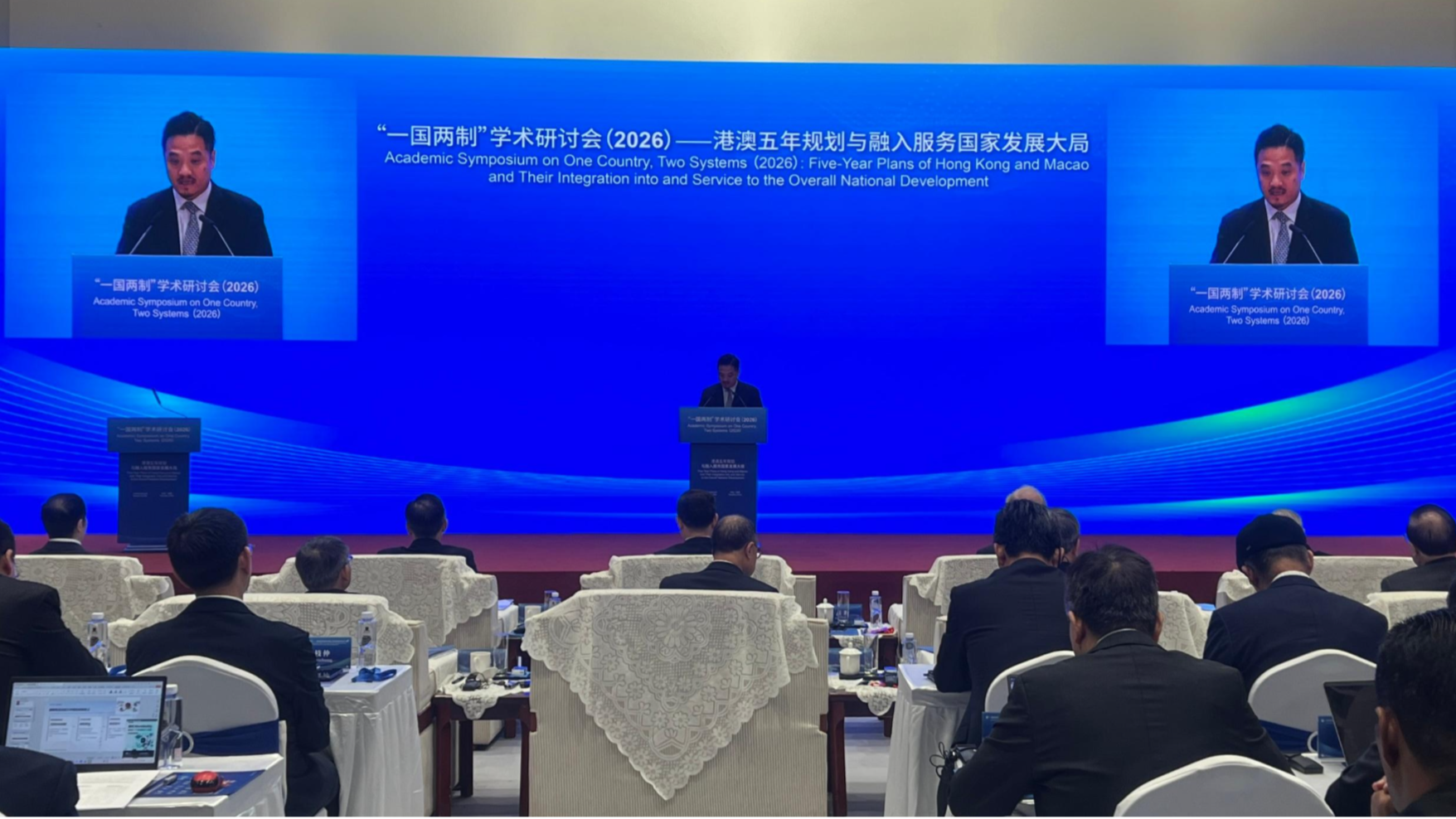
The five-year development plans of the Hong Kong and Macao special administrative regions mark a milestone in implementing the "one country, two systems" principle, providing a framework for the two cities' long-term development through pragmatic goals and deeper integration into national development, officials and experts said at a symposium in Shenzhen on Saturday.
The symposium, themed "Five-Year Plans of Hong Kong and Macao and Their Integration into and Service to the Overall National Development", brought together nearly 100 government officials and scholars from the Chinese mainland, Hong Kong, Macao and overseas.
The Hong Kong SAR unveiled its inaugural Five-Year Plan for Economic and Social Development (2026-30) on Sept 16, with the aim of aligning its development with national blueprints, strengthening its competitive edge and improving people's well-being.
The Macao SAR released its third five-year plan on Aug 18, pledging to better integrate into the nation's overall development, improve governance efficiency and advance appropriate economic diversification.
READ MORE: HK to work closely with GBA cities to boost high-caliber talent flow
Participants reached a broad consensus that the formulation and implementation of the two SARs' five-year plans represented a breakthrough in the practice of "one country, two systems" and were a significant milestone.
Deng Zhonghua, president of the Chinese Association of Hong Kong and Macao Studies, said the plans faithfully implemented the principle of "one country, two systems", each with clear development concepts, well-defined goals and tasks, and effective safeguard mechanisms.
"They're high-quality, tailor-made plans that align with the actual conditions of the two regions," Deng said.
Drawing on the country's successful experience in formulating and implementing five-year plans marks a major shift in the approach to governance by Hong Kong and Macao, Deng said. The shift, Deng added, is from a focus on short-term development and annual administrative arrangements to medium-and long-term overall planning, and from responding passively to challenges to planning proactively for the future.
Gao Xiang, president of the Chinese Academy of Social Sciences, which organized the symposium, said the formulation and implementation of the two SARs' own five-year plans represent institutional alignment under the "one country, two systems" framework.
The plans reflect the two regions' commitment to upholding the foundation of "one country" while proactively aligning with the national governance system, demonstrating their broad-mindedness and awareness of the bigger picture, Gao said. They also represent the exploration of a new governance model that combines an efficient market with an active government.
ALSO READ: From research to opportunity: HK’s role in nation’s global reach
"Alignment (with national strategies) doesn't mean copying a dedicated chapter," said Stephen Wong Yuen-shan, head of the Chief Executive's Policy Unit of the Hong Kong SAR.
The key is to thoroughly understand the full outline of the nation's 15th Five-Year Plan (2026-30) and identify areas where national needs and Hong Kong's advantages converge, while adjusting policies as national strategic priorities evolve, Wong said.
Cheong Chok-man, director of the Policy Research and Regional Development Bureau of the Macao SAR, highlighted the importance of public consultations during the formulation of Macao's third five-year plan.
The draft blueprint included 56,000 Chinese characters, while the final version contained 86,000. The additional 30,000 characters reflected input gathered through consultations with various sectors of society, Cheong said.
Looking ahead, Cheong added, Macao should fully leverage its advantages, including its extensive international connections, to strengthen its role in cultural exchange between China and foreign countries and to better tell stories about China and the Macao SAR to the world.
READ MORE: Greater Bay Area needs a shared problem-solving system
Parallel forums held on Saturday afternoon focused on means to enhance the core competitiveness of the two SARs, developing the Guangdong-Hong Kong-Macao Greater Bay Area, and promote the integration of Hong Kong and Macao into the nation's development.
Henry Ho Kin-chung, founder and chairman of the One Country Two Systems Youth Forum and a member of the expert group of the Chief Executive's Policy Unit of the HKSAR, discussed the significance of the city's five-year plan, particularly in cultivating talent.
Ho stressed that the city should accelerate the development of the Northern Metropolis University Town, a 1,000-hectare innovation and education cluster within the city's ambitious Northern Metropolis project.
The project will play a key role in helping Hong Kong achieve its goal of becoming an international education hub and a base for high-end talent, he said.
Ho said he expected the city's development blueprint to improve governance by bringing together various policy measures under a broader framework and setting clear targets and key performance indicators for government departments.
Contact the writer at atlasshao@chinadailyhk.com
