

Success of Bali’s Monkey Forest Ubud Run 2026 highlights China-Indonesia ties, power of sport

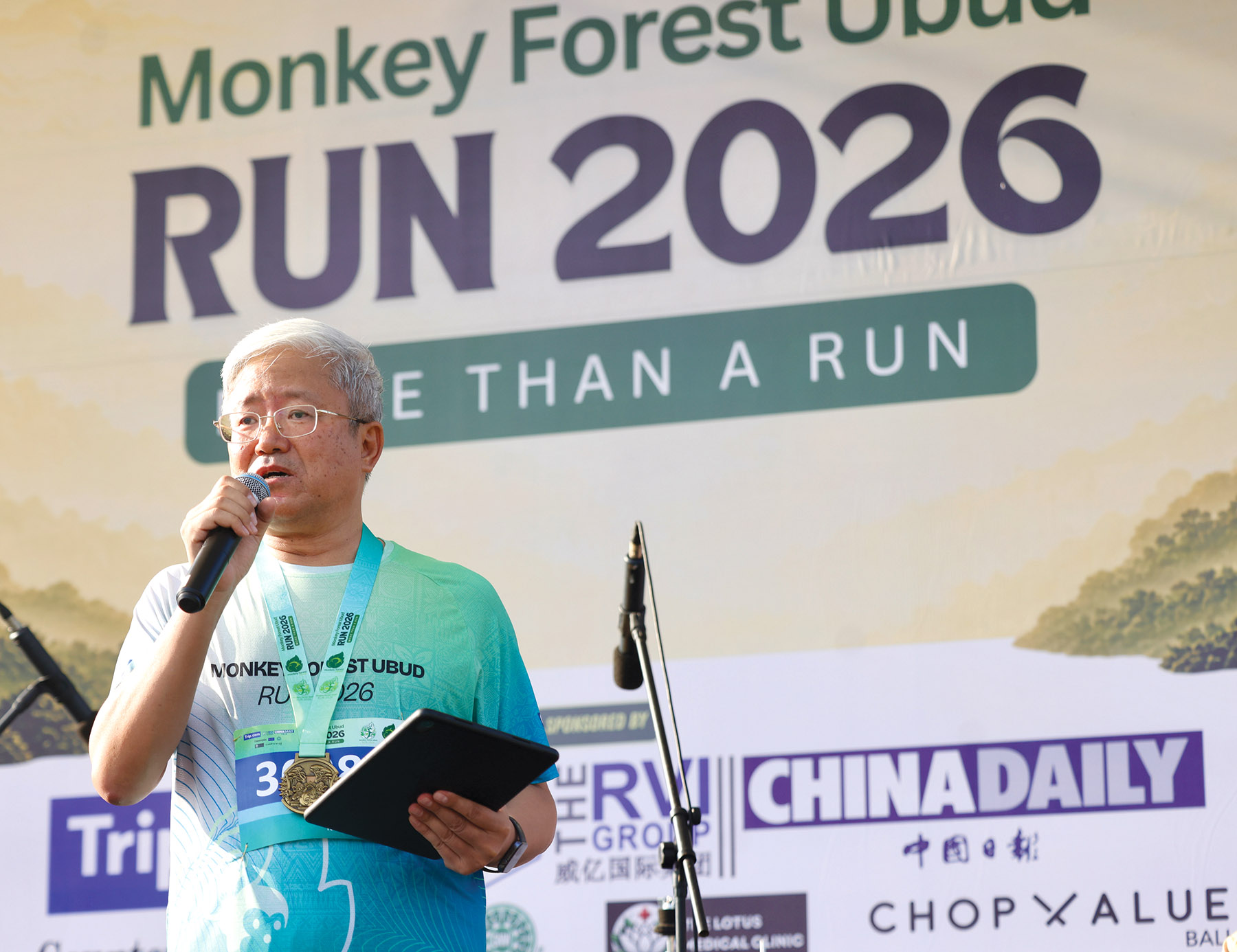
Before dawn on Oct 18, some 1,734 runners set off through Ubud’s streets and greenery in Bali, Indonesia, for the Monkey Forest Ubud Run 2026.
Themed “More Than A Run”, this year’s event featured a 5 km fun run and a 10 km challenge amid the backdrop of Monkey Forest Ubud, a nature reserve and cultural site that is home to more than 1,200 long-tailed macaques and ancient Hindu temples.
Organized by Monkey Forest Ubud alongside China Daily, Trip.com, and the RVi Group — a Singapore-based education investment and management group — the race brought China Daily’s “Run With History” cultural heritage running series to Bali for the second consecutive year.
Launched in 2019, the initiative has brought races to the ancient city of Bagan in Myanmar, Ayutthaya in Thailand, and Luang Prabang in Laos, combining sporting activities with exploring historic and cultural sites.
Zhang Zhisheng, Chinese consul general in Denpasar, the capital of Bali, completed the 5 km course and joined local officials at the awards ceremony. Among the guests was I Wayan Sumarajaya, head of Bali’s provincial tourism office, representing Governor Wayan Koster.
Zhang told China Daily that this year’s higher turnout and the governor’s decision to send a representative for the first time reflected the event’s growing recognition locally.

He described the race as an occasion for locals, overseas visitors, and Chinese nationals to meet through a shared sporting activity.
“Mass-participation sport is the most inclusive and vibrant form of people-to-people diplomacy. It needs no translation to build bridges and connect people from different countries, particularly young people,” he said.
Zhang added that the event went beyond physical exercise and reflected the friendship between China and Indonesia, which marked the 76th anniversary of diplomatic relations this year.
He also noted that Ubud, a center of Balinese arts and traditional culture, offered visitors opportunities to learn about local traditions.
The Monkey Forest Ubud Run 2026 brought together runners from Bali and around the world.
Local runner I Putu Radika, taking part in his first race in Ubud, said the gardens and greenery around Monkey Forest were as memorable as the encouragement he received during the 5 km run. He said spectators cheered tired runners and participants urged one another to keep going.
Nan Phyu Hnin and Eaindray Lin, two 13-year-olds of Chinese heritage from Yangon, Myanmar, joined the race as part of a school-organized learning journey involving 51 students from Singapore International School: RVi Academy Yangon.
They said running with classmates, the distinctive Monkey Forest setting, and an enthusiastic warm-up session made their first visit to the race enjoyable.
For Danis Langlos, a 60-year-old Frenchman who took part in last year’s Monkey Forest Ubud Run, this year’s 5 km race was a chance to run with his 14-year-old daughter.
“We don’t compete for the podium, we compete for the happiness,” said Langlos, who has lived in Bali for 23 years.

He said running had become part of his routine over more than a decade and that he hoped his passion for the sport would encourage younger people around the world, including his daughter, to stay active.
Em Roblin, who placed sixth in the 10 km race, attended with her 10-year-old daughter, Glady Lola Roblinson, who ran the 5 km event.
Now living in Bali, Roblin previously spent more than a decade working in Beijing. She recalled running in Chaoyang Park and watching long-distance running grow more popular over the years.
As she neared the finish line in Ubud, Roblin was beginning to tire. Then she noticed bright pink flowers blooming beside the route, a common sight along Bali’s roads and part of the tropical scenery lining the course.
“I can find joy in the discomfort,” she said, recalling how the flowers lifted her spirits during the final stretch.
I Wayan Sumarajaya, Bali’s provincial tourism chief, said the island’s natural scenery and cultural traditions are important draws for visitors. He welcomed more tourists from China and said the province was working to make travel more convenient.
China was Bali’s second-largest source of foreign visitors in the first eight months of this year, with about 420,000 arrivals from the Chinese mainland, Zhang said.
Bali also featured among the 10 most-booked overseas flight destinations for Chinese travelers during the recent National Day Golden Week holiday, according to Trip.com Group.
Zhang cited the resumption of direct flights between Beijing and Denpasar in July as one example of closer travel links.
The consulate has also worked with local police, immigration, and tourism personnel to provide Chinese-language training and put up multilingual safety notices at tourist attractions, he said.
Sumarajaya also spoke of efforts to make visits more convenient through digital payments. Under a cross-border arrangement launched this year, travelers using Alipay or the UnionPay App can pay at participating merchants through Indonesia’s QRIS digital payment system, according to Bank Indonesia — the country’s central bank — and payment service providers.
Zhang also highlighted recent progress in economic cooperation between China and Indonesia. Bilateral trade reached $101.3 billion in the first half of 2026, up 32.5 percent year on year, while Chinese imports from Indonesia rose 49 percent to $53.5 billion, he said.
Bali began exporting salak (snake fruit) and other fruit to China this year, while cold-chain logistics seafood shipments to China continued to grow, Zhang said.
He also added that China Huadian’s Bali power plant played a key role in maintaining a stable electricity supply on the island.
A consortium led by China’s Zhejiang Weiming Environment Protection Co won a contract for a waste-to-energy project in Bali this year, with construction underway and completion expected in about 18 months, Zhang said.
The project was expected to resolve Bali’s long-standing waste problem and bring Chinese technology and expertise to local environmental management, he added.
This year, Southwest China’s Yunnan province also began the third phase of an ecological agriculture and tourism demonstration project in Bali’s Tabanan Regency, providing improved seeds, agricultural machinery, and technical support to promote organic farming and agricultural tourism, Zhang added.
Looking ahead to the APEC Economic Leaders’ Meeting in Shenzhen in November, Zhang said, “China is willing to strengthen strategic coordination with Indonesia through multilateral platforms such as APEC and advocate a universally beneficial and inclusive economic globalization.”
He said the consulate in Denpasar would continue to facilitate local exchanges between Bali and Chinese provinces.
Contact the writers at effiezhang@chinadailyapac.com
