

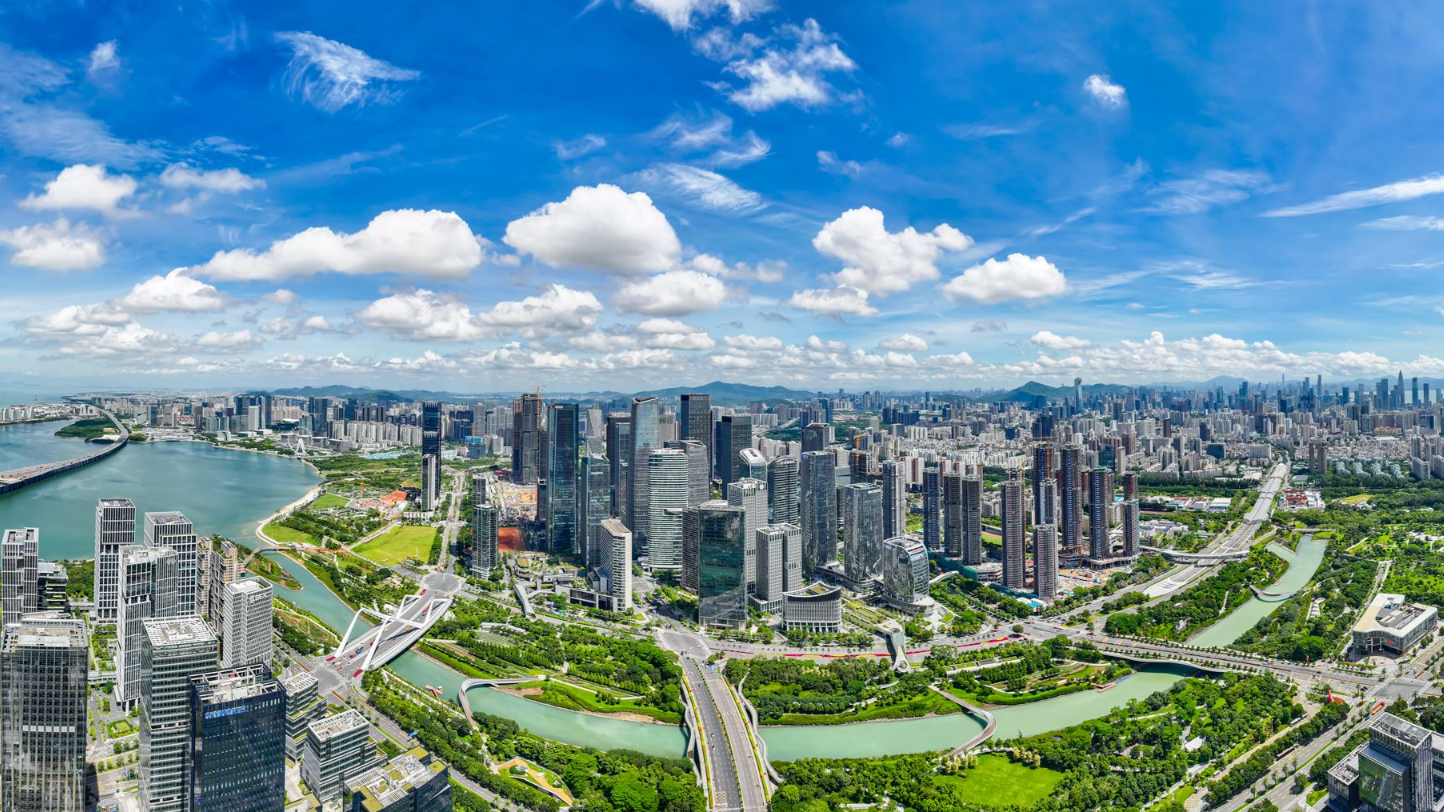
The open fintech system proposed by national authorities will integrate Hong Kong’s financial edges more deeply into tech industry chains in the Guangdong-Hong Kong-Macao Greater Bay Area, supporting the cluster in becoming a world-class industrial and financial center, as well as a global hub for patient capital.
Experts made the remarks after various central government departments jointly issued guidelines on Monday to strengthen financial service support for the construction of international technology innovation centers in the Beijing-Tianjin-Hebei cluster, the Yangtze River Delta, and the Greater Bay Area.
As the authorities aim to develop distinct fintech systems in different centers, the Beijing-Tianjin-Hebei cluster will beef up financial service support for major scientific infrastructure, the Yangtze River Delta will promote a shared fintech ecosystem with broad industry participation, and the 11-city Greater Bay Area will strive to build an open cross-boundary fintech system with high-level collaboration and regulatory alignment.
Leveraging the financial strengths of Hong Kong and the whole Greater Bay Area, the guidelines propose to develop the Shenzhen Stock Exchange into a global asset platform with distinct innovative market features. It also vows to channel great support for the Greater Bay Area to deeply integrate financial resources with the real economy and foster patient capital.
Focusing on the core functions and international positioning of the three innotech centers across the nation, the guidelines propose targeted optimization measures of financial services to foster innovation at its source, boost high-end industries, and gather top-notch talent. By 2030, it is expected to form a more robust financial support system for the entire technology chain, with a significantly increased share of direct financing and deeper regional financial integration.
Fan Kwok-yuen, an assistant professor at Hang Seng University of Hong Kong, said that Hong Kong has much to offer in achieving the document’s proposals on building world-class venture capital centers in major innotech clusters and increasing the proportion of direct financing in the technology sector.
ALSO READ: Hong Kong can turn wealth into impact
By the end of 2025, Hong Kong’s total assets under management (AUM) had risen 20 percent year-over-year to HK$42.2 trillion ($5.4 trillion), reaching a record high. Its net inflows totaled HK$2.1 trillion, surging 193 percent year-over-year.
The innotech sector on the Chinese mainland has long relied on indirect investments such as bank loans. In comparison, Hong Kong’s advantage in equity investment is more conducive for direct investment, Fan added.
In his view, the document further clarifies the requirements for aligning financial cooperation rules in the Greater Bay Area in regulatory tools, credit information, and evaluation standards, indicating more concrete implementation directions for the industry.
For example, it includes measures to promote the alignment of fintech regulatory mechanisms between Hong Kong and the mainland, deepen cross-boundary credit reporting, and innovatively proposes converting companies’ technological innovation capabilities into credit scores to facilitate evaluation by financial institutions.
In addition, he believes that the initiative to facilitate leading tech talent to repatriate overseas assets and use overseas funds to establish tech firms will further enhance the mainland tech industry’s appeal to overseas talent and capital.
READ MORE: Over 160,000 investors join Hong Kong's Cross-boundary WMC 2.0
Yu Lingqu, deputy director of the department of finance industries at the China Development Institute, said that, with the emphasis on cross-boundary coordination, the guidelines aim to tackle challenges in cross-boundary investments of sci-tech innovation entities, cross-regional allocation of innovation capital, and the financial support for early-stage hard-tech projects.
In particular, the document pledges to support enterprises in leveraging the resources of both the domestic and international markets, and encourages Hong Kong-listed companies in the Greater Bay Area to also list in Shenzhen in accordance with regulations.
He predicts that as cross-boundary fintech pilot programs continue to deepen, more patient and long-term capital with international elements will flow into the Greater Bay Area’s hard tech sector, further bolstering its technological self-reliance.
Kenny Shui Chi-wai, vice-president of Our Hong Kong Foundation, noted that funding must align with the pace of scientific research. “When R&D, testing, and production are located in different cities, financial services must also transcend geographical boundaries to provide ongoing support for scientific research findings to move from the laboratory to the market,” he said.
Expressing support for the proposal to establish a cross-regional fintech service alliance, Shui expects that the measures to expand patient capital and strengthen the alignment of financial regulations will further fuel the commercialization of scientific achievements in the Greater Bay Area.
Contact the writer at bingcun@chinadailyhk.com
