

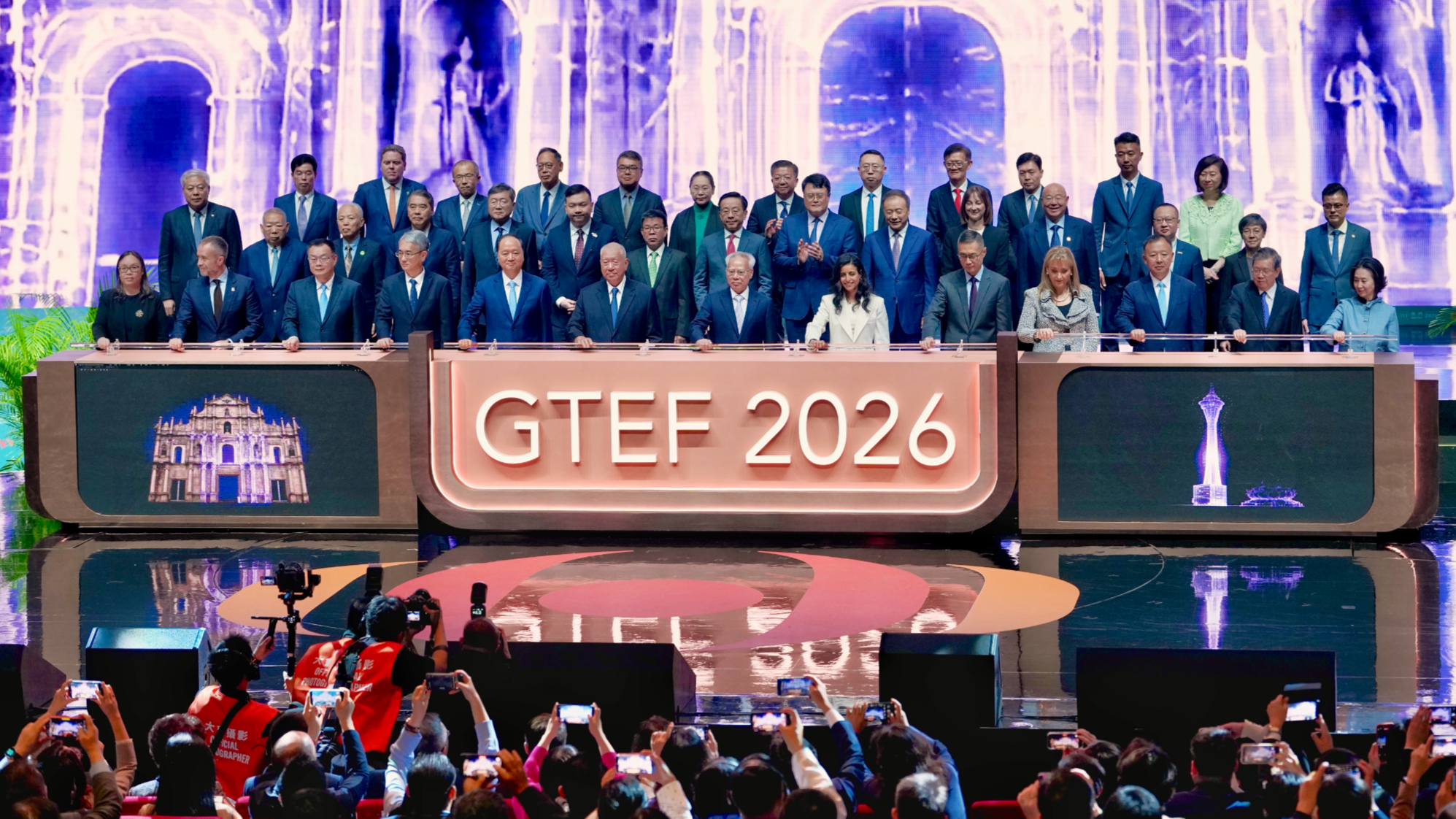
Tourism leaders called for stronger international and public-private cooperation at the opening of the 12th Global Tourism Economy Forum in Macao on Friday, saying the industry can play a greater role in driving sustainable and inclusive growth despite worldwide economic uncertainty.
The three-day forum, held under the theme “Crisis • Resilience • Evolution – Building a Tourism Economy for a Shared Future”, brings together government officials, representatives of international organizations, business leaders and experts to discuss the opportunities and challenges facing global tourism.
Spain is this year’s partner country, while the southern Chinese island of Hainan is the featured province.
Chief Executive of the Macao Special Administrative Region Sam Hou-fai said the forum has grown into an important platform for high-level dialogue and multilateral cooperation in tourism and culture since its founding in 2012.
Global tourism has rebounded strongly from a series of challenges and is undergoing a new phase of transformation, Sam said. Macao’s tourism industry, he added, has continued to strengthen, with visitor arrivals exceeding a record 40 million last year.
He said the city’s efforts to combine tourism with other industries are generating new momentum, while its tourism offerings are becoming more international and diverse. “This is not just growth in numbers, but an improvement in quality,” he said.
ALSO READ: Shaping the future of tourism economy
UN Tourism Secretary-General Shaikha Al Nuwais said international tourist arrivals reached a record last year. A further 690 million arrivals have been recorded so far this year, up three million from the same period a year earlier.
“With the geopolitical situation and with everything happening in the Middle East, this number is very promising,” she said. “And this tells us that the tourism sector has tremendous potential.”
Al Nuwais said China, as a global tourism powerhouse, could make a contribution to the International Year of Sustainable and Resilient Tourism designated by the United Nations General Assembly for 2027.
Delivering a keynote address, Long Yongtu, former vice-minister of Ministry of Foreign Trade and Economic Cooperation of China, echoed the emphasis on inclusion. He said residents of tourist destinations are playing a growing role in the country’s tourism industry, helping change both who travels and how people travel.
Rural residents accounted for 20 percent of China’s tourists last year, Long said, describing the figure as a significant breakthrough that reflected the increasingly inclusive growth of its tourism sector. China’s experience could offer insights for the global industry, he added, particularly amid growing global uncertainty.
Gloria Guevara, president and CEO of the World Travel & Tourism Council, said despite geopolitical challenges, global travel and tourism GDP grew by 4 percent last year, outpacing economic growth of 2.8 percent. The sector accounted for about 10 percent of global GDP, with Asia-Pacific leading regional growth at 8 percent.
Representing global private-sector tourism leaders, Guevara stressed that closer collaboration and effective policymaking are essential to sustaining growth. “Working together, implementing the best policies to move forward,” she said.
Miguel Sanz, director-general of Spain’s national tourism agency Turespana, said “connectivity between China and Spain is expanding rapidly”, noting that air capacity has increased by more than 40 percent in 2026, with flights reaching 87 a week.
Spain welcomed 800,000 Chinese visitors in 2025, generating $2.5 billion in spending, Sanz said. To meet growing demand, Spain has expanded its visa-processing capacity in China, with applications now processed in less than a week.
“Travel demand is growing strongly in both directions,” he said, adding that more Spaniards are visiting China, contributing to a deeper and more balanced tourism relationship.
