

The Hong Kong Special Administrative Region can deepen cooperation with Indonesia in financial and legal services, particularly in areas where the Southeast Asian country needs common-law expertise, a senior Indonesian official said.
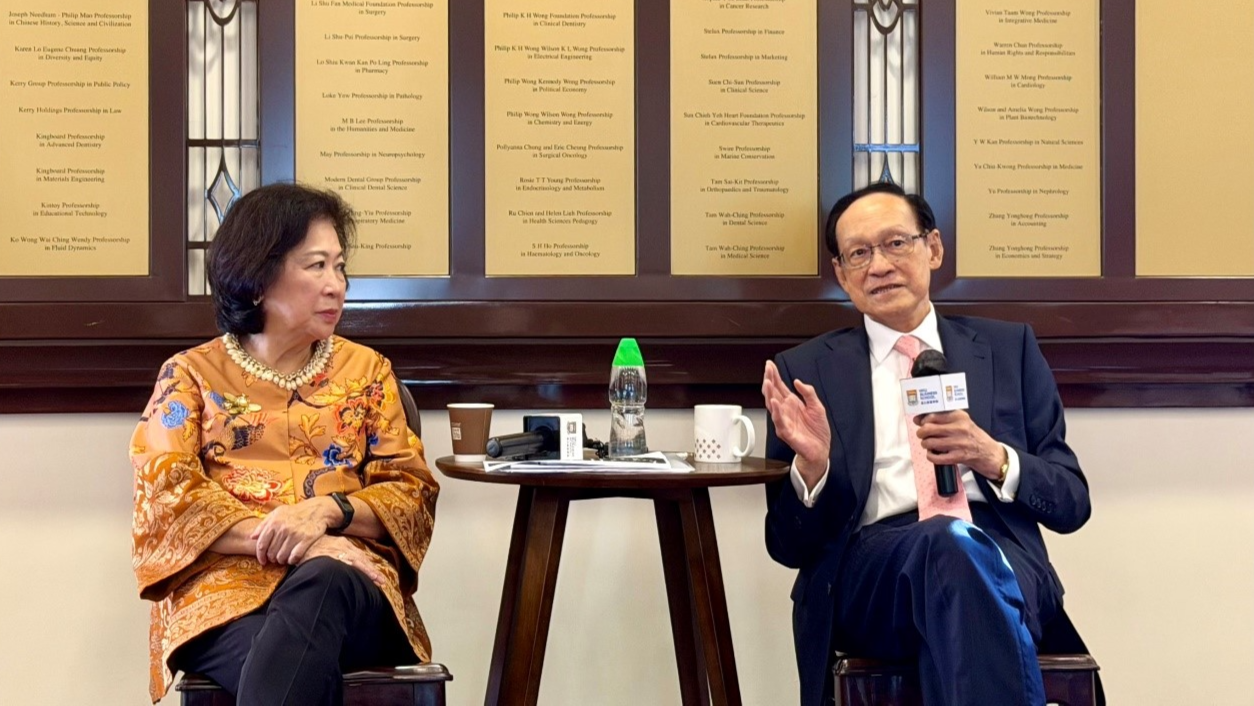
Speaking at a media roundtable hosted by the University of Hong Kong’s Business School on Wednesday, Mari Elka Pangestu, the Indonesian president’s special envoy for international trade and multilateral cooperation and vice-chair of the National Economic Council, said Indonesia is seeking to attract family offices and other investors as part of its efforts to develop a financial center.
“We have been told by investors that what (they) want is common law,” Pangestu said. She noted that many leading international financial centers operate under common-law systems, including Hong Kong, and said this is an area where Indonesia can draw on Hong Kong’s experience.
“I can see that we will probably come and look for legal expertise in Hong Kong, say for those who are very experienced with common law.”
ALSO READ: HK welcomes creation of working group for RCEP accession
Pangestu also pointed to the reputation of Hong Kong’s stock market and its regulatory regime, saying more Indonesian companies could consider listing in the city.
“This should be something that is part of our (relationship), whether it’s in the free trade agreement context, or whether it’s just in our economic partnership, something that should be explored.”
Economic ties between Hong Kong and the Association of Southeast Asian Nations (ASEAN) have continued to expand. In 2025, ASEAN was Hong Kong’s second-largest trading partner, with total merchandise trade reaching HK$1.67 trillion ($214 billion), or more than 15 percent of the city’s global merchandise trade, according to Hong Kong’s Trade and Industry Department.
As of the end of 2024, ASEAN was Hong Kong’s third-largest destination for outward direct investment, with investment stock of HK$671.2 billion.
Pangestu said “the real potential” for Hong Kong-ASEAN cooperation lies in financial connectivity, sustainable finance and infrastructure investment.
“What we need to do is align the green bond standards and taxonomies and mobilize private capital for Southeast Asia’s energy transition,” she said.
READ MORE: Win-win opportunities await stronger HK-M’sia partnership, says Yau
Edward Chen Kwan-yiu, honorary professor at the HKU Business School, echoed Pangestu, saying that Hong Kong can play an important role in developing regional carbon markets.
He said that carbon markets require strong regulation, legal frameworks, monitoring and reporting systems, third-party verification, as well as trading platforms and settlement mechanisms.
“Hong Kong is in a position, as already a top financial center, to fulfill all these requirements for a cross-border carbon market,” he said, adding that such a market could eventually be linked with ASEAN economies.
The Hong Kong SAR government issued about HK$20 billion worth of digital green bonds in four currencies at the end of September, marking the world’s largest digital bond issuance.
Chen also highlighted the SAR’s role as a connector between China and ASEAN, noting that the city handles more than 70 percent of global offshore renminbi settlement.
In June, Bank Indonesia, the Hong Kong Monetary Authority and the People’s Bank of China signed a memorandum of understanding on a framework to support transactions between the Indonesian rupiah and offshore renminbi. The arrangement will allow companies and institutions in Indonesia and the HKSAR to settle cross-border trade and investment directly in the two currencies.
Chen said the framework will provide a more convenient channel for ASEAN companies. Borrowing costs in offshore renminbi are lower than in US dollars, while transaction costs are reduced because companies can exchange the two currencies directly without using a third currency, he said.
Speaking later at the Edward K Y Chen Distinguished Lecture on the same day, Bernard Charnwut Chan, chairman and president of Asia Financial Holdings Ltd, said Hong Kong should deepen its understanding of ASEAN economically, socially and academically.
This will help the city better identify areas where it could “come in and fill the gaps”, Chan said.
Contact the writer at irisli@chinadailyhk.com
