

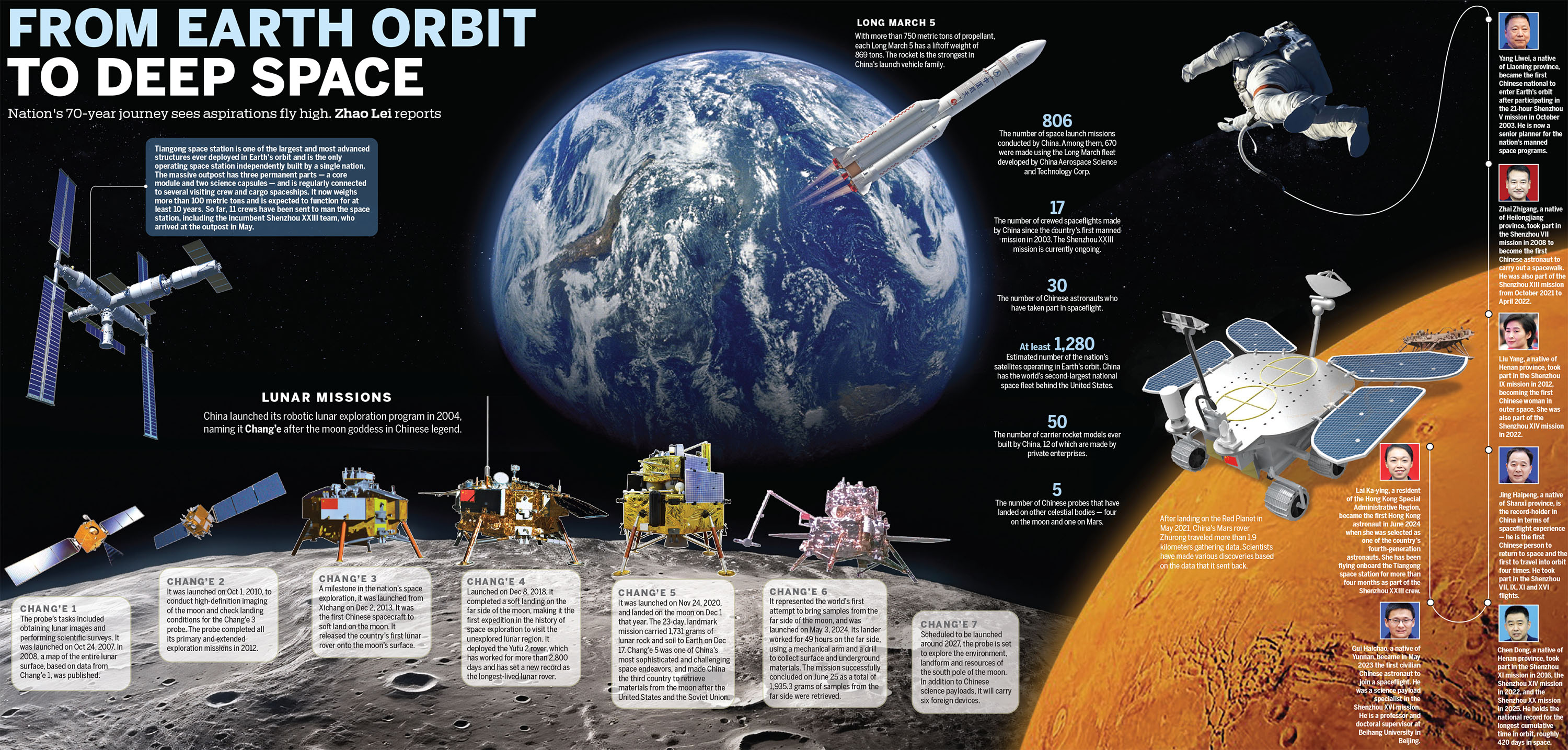
Nation's 70-year journey sees aspirations fly high. Zhao Lei reports
China's push to land astronauts on the moon by 2030 is shifting from a long-term blueprint to tangible reality, with major infrastructure construction and hardware testing being carried out at pace by the nation's space industry.
According to the China Manned Space Agency, preparations are in full swing to push forward the construction of facilities and equipment required for lunar landing missions at the Wenchang Space Launch Center in Hainan province, as well as the building of other ground support systems such as telemetry, tracking, command and communications, as well as preparations for the landing site.
The development of major flight vehicles, including the Long March 10 heavy-lift carrier rocket, the Mengzhou crew spacecraft and the Lanyue lunar lander, is progressing smoothly, the agency said.
READ MORE: China to accelerate lunar mission plans this year
A series of critical tests have been completed in succession, including the pad abort and the maximum dynamic pressure escape flight tests for the Mengzhou, the landing and takeoff tests for the Lanyue, and the static ignition and low-altitude flight tests for the Long March 10, according to the agency.
In addition to hardware preparation, Chinese space authorities have been training astronauts for lunar expeditions, preparing them for the unique environment on the "silver sphere".
On the moon, the astronauts' major tasks will include driving a Tansuo rover to carry out scientific assignments and collecting samples.
Once realized, China's manned lunar program will make the country the second nation to land astronauts on the moon, significantly boosting its global space standing.
The United States carried out six Apollo crewed missions in the 1960s and 1970s, landing 12 American astronauts on the moon's surface.
Zhang Hailian, a senior official at the China Manned Space Agency, said that the moon is the nearest extraterrestrial body that humans can reach based on current technologies, so manned missions to the moon will be a realistic and practical step to start with in order to expand China's exploration endeavors in deep space.
Orbital outpost
The country's confidence and capabilities for a lunar landing are built upon the remarkable strides it has made over the decades in both human spaceflight and robotic lunar exploration programs.
In a low-Earth orbit about 400 kilometers above the ground, the symbol of China's strength in manned space — the Tiangong space station — has been traveling around the mother planet for some five and a half years.
The origin of China's aspirations to operate its own space station can be traced back to the mid-1980s when a group of distinguished space scientists started calling for government support to open manned space programs so that China would not lag behind in the global arena of space exploration.
In September 1992, Chinese scientists formulated an extensive and ambitious plan for crewed spaceflights that was approved by the top leadership, officially opening the nation's manned space program.
Since then, the Chinese space community has made additional plans and taken a systematic approach, advancing patiently from simple, multiday missions to sophisticated, monthlong flights involving several spacecraft.
After nearly 30 years of preparations that had included five unmanned flights and six crewed missions, China launched the first, and central, component of its space station, the Tianhe core module, in April 2021, and began to send astronauts to fly with it to perform trial operations and prepare for the arrival of other parts.
In the second half of 2022, the Wentian and Mengtian science modules were launched to dock with Tianhe, completing the space station's construction.
The Tiangong is one of the largest, heaviest and most advanced structures ever deployed in Earth's orbit and is the only operating space station independently built by a single nation.
Its major role is to serve as the national space-based platform for scientific experiments and technological tests.
By the end of 2025, 265 scientific and technological projects had been arranged or conducted on board the space station, covering life science, microgravity physics and new space technologies, according to the China Manned Space Agency.
So far, 27 Chinese astronauts in 11 crews have been sent to man the space station, including the incumbent Shenzhou XXIII team, who arrived at the outpost in late May.
Deep-space expeditions
Thanks to its long-term efforts, including strong government support and farsighted planning, China's robotic lunar exploration program has expanded rapidly over the past decade, and has methodically completed its three-phase roadmap of orbiting, landing and sample return.
So far, the country has conducted six robotic missions to explore the moon. It deployed two rovers on the lunar surface through the Chang'e 3 and Chang'e 4 missions. It has also retrieved samples from both the near and far sides of the moon via the Chang'e 5 and Chang'e 6, becoming the first and only nation to have achieved such a historic feat.
Next year, China plans to launch a new historic mission — the Chang'e 7 — to explore the environment and resources, especially traces of water, at the south pole of the moon.
Beyond the moon, China has left its mark on another extraterrestrial body in the solar system — Mars — via the Tianwen 1 mission, which was launched in July 2020 as the country's first independent interplanetary expedition.
ALSO READ: China's Tianwen 3 probe to seek proof of past life on Mars
Tianwen 1's landing craft touched down on the Martian surface in May 2021 after traveling more than 470 million kilometers, and going through an extremely challenging landing process. Soon after the landing, it released a rover named Zhurong to perform scientific tasks.
Before Tianwen 1, no country had ever tried to send an orbiter, a lander and a rover in one single flight to Mars.
Zhurong, the sixth rover deployed on the Red Planet, following five predecessors from the US, traveled more than 1,900 meters in its yearlong journey and obtained much data and many images en route to its destination — an ancient coastal area on Utopia Planitia, a vast Martian plain.
In May 2025, China launched the Tianwen 2 robotic probe, which was its first asteroid sampling mission, aiming to explore and retrieve samples from a small, near-Earth sun-orbiting asteroid called 2016 HO3.
The spacecraft traveled along a carefully calculated trajectory toward its destination, and rendezvoused with 2016 HO3 in July.
The probe has been using its 11 scientific instruments to carry out remote-sensing surveys of the celestial body, and will deploy special devices to collect surface substances in due course, according to the China National Space Administration.
In the next step in its deep-space exploration program, China plans to collect Martian samples and bring them back to Earth around 2028 via the Tianwen 3 mission.
The primary scientific goal of this mission is to look for traces of life on Mars, according to Liu Jizhong, chief planner of the Martian soil-return project.
Private sector rising
Alongside State-funded projects, China's private enterprises have become serious players in the country's growing space industry.
So far, five private companies — i-Space, LandSpace, Space Pioneer, Galactic Energy and Orienspace — have used their own rockets to conduct orbital missions, which refer to powered flights that place satellites or other kinds of payloads in orbit in outer space.
ALSO READ: Orienspace sets sea launch records with Gravity 1
Chinese private enterprises have developed and built 12 types of carrier rockets that have been used in 52 flight missions.
In August, LandSpace successfully launched its ZQ 3 Y2 reusable rocket from the Jiuquan Satellite Launch Center in the Gobi Desert, sending the gigantic vehicle into the target orbit. Several minutes after liftoff, the first-stage booster completed a precision vertical landing on a ground pad in Minqin county, Gansu province, marking China's first land recovery of an orbital-class rocket booster.
Orienspace, another private rocket maker, has developed the world's biggest, heaviest and most powerful solid-propellant rocket — Gravity 1 — and has conducted four launches.
Contact the writer at zhaolei@chinadaily.com.cn
