

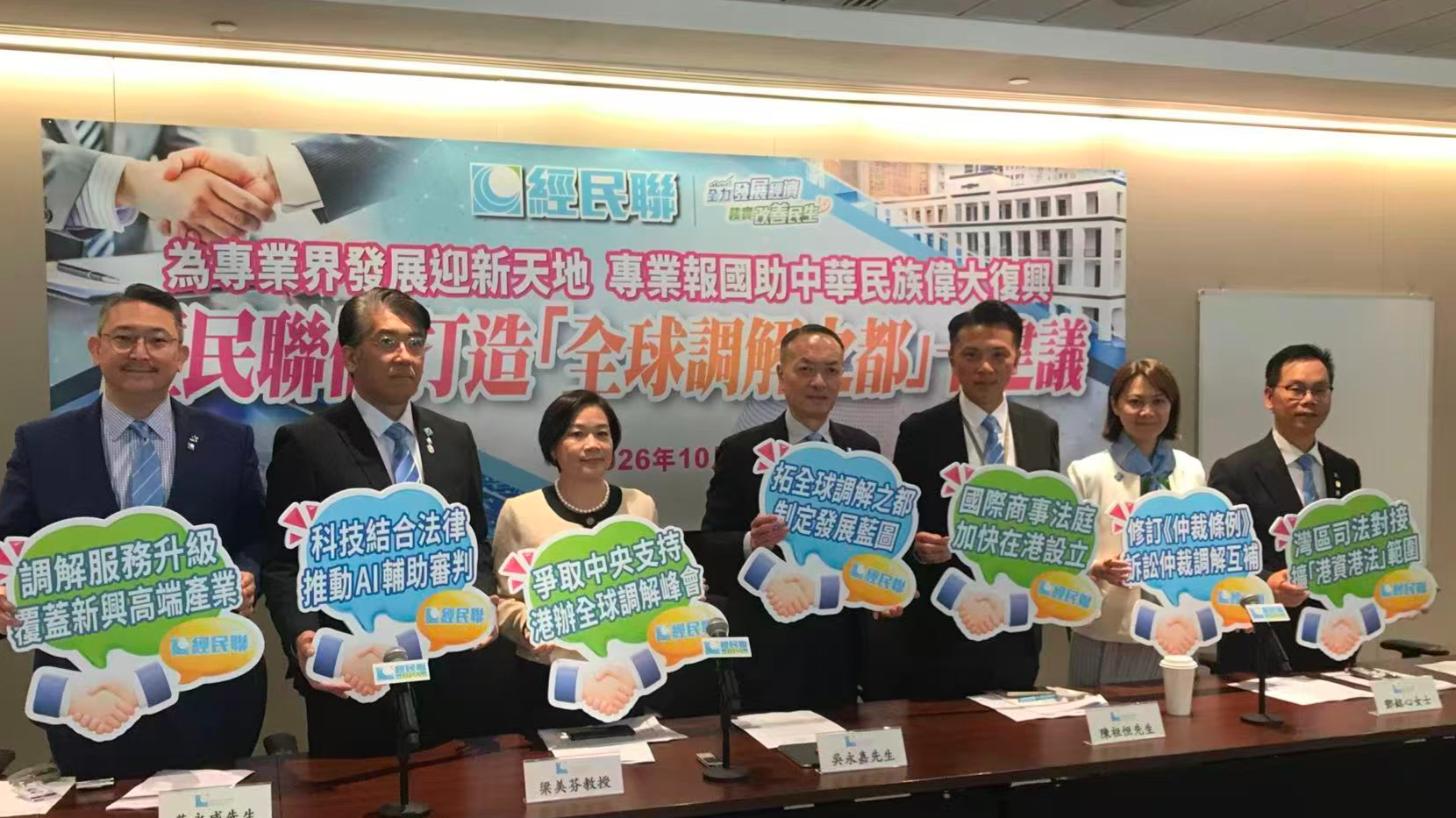
A political party representing the city’s business and professional sectors has proposed 10 measures in a research report aimed at ensuring the city becomes a global mediation hub.
The Business and Professionals Alliance for Hong Kong (BPA) proposed hosting a global mediation summit in the city, accelerating the establishment of the Hong Kong International Commercial Court, and expanding mediation services to cover emerging and high-end industries.
The alliance also recommended inviting authoritative international organizations to set up offices in the city, and striving to host a United Nations branch.
“Upgrading the status of Hong Kong from an arbitration stronghold to a comprehensive international legal hub integrating litigation, arbitration and mediation will attract a large amount of business to Hong Kong,” said Jimmy Ng Wing-ka, the party’s leader and a lawmaker representing the Industrial (Second) functional constituency.
Ng said the planned Hong Kong International Commercial Court is expected to allow overseas lawyers to represent clients in certain commercial proceedings, and actively recruit current or retired judges from common law jurisdictions to participate in adjudication, thereby enhancing the international business community’s confidence in the rule of law in Hong Kong.
The Judiciary announced in May that it planned to establish the Hong Kong International Commercial Court, a specialist division of the High Court, within a year to adjudicate complex, high-value international and cross-boundary commercial disputes. The International Organization for Mediation, inaugurated on Oct 20, 2025, successfully mediated its first international maritime dispute in May.
Priscilla Leung Mei-fun, the BPA’s vice-chairwoman and a lawmaker, said: “Given the complex international trade and investment environment, and the lack of a unified dispute resolution mechanism among economies participating in the Belt and Road Initiative, Hong Kong’s development as a global mediation center will serve as a primary venue for establishing a dispute resolution mechanism for the initiative.”
ALSO READ: Hong Kong retains position as the world's freest economy
This mechanism aims to resolve disputes through equal consultation based on fairness and inclusiveness, promoting win-win cooperation within the Belt and Road Initiative and generating greater demand for Hong Kong’s professional services in legal, trade, finance, and logistics, she added.
Sunny Tan, a BPA vice-chairman and a lawmaker representing the textiles and garment functional constituency, said the government should vigorously expand the special administrative region’s international mediation network, promote pilot projects for cross-border enforcement of commercial settlement agreements in the Guangdong-Hong Kong-Macao Greater Bay Area, and build a sustainable “mediation ecosystem”.
Under the Foreign Judgments (Reciprocal Enforcement) Ordinance, Hong Kong currently has direct registration enforcement arrangements with 15 designated jurisdictions. However, most jurisdictions in Southeast Asia, the Middle East, as well as Japan and South Korea, are not covered.
“The Association of Southeast Asian Nations is Hong Kong’s second-largest trading partner; the Middle East, particularly the six Gulf states, is a key node in the Belt and Road Initiative, and Japan and South Korea are major economies in the region. The lack of enforceability of the judgment will directly weaken the local business community’s willingness to choose Hong Kong as a venue for dispute resolution,” Tan said.
Contact the writers at oswald@chinadailyhk.com
