

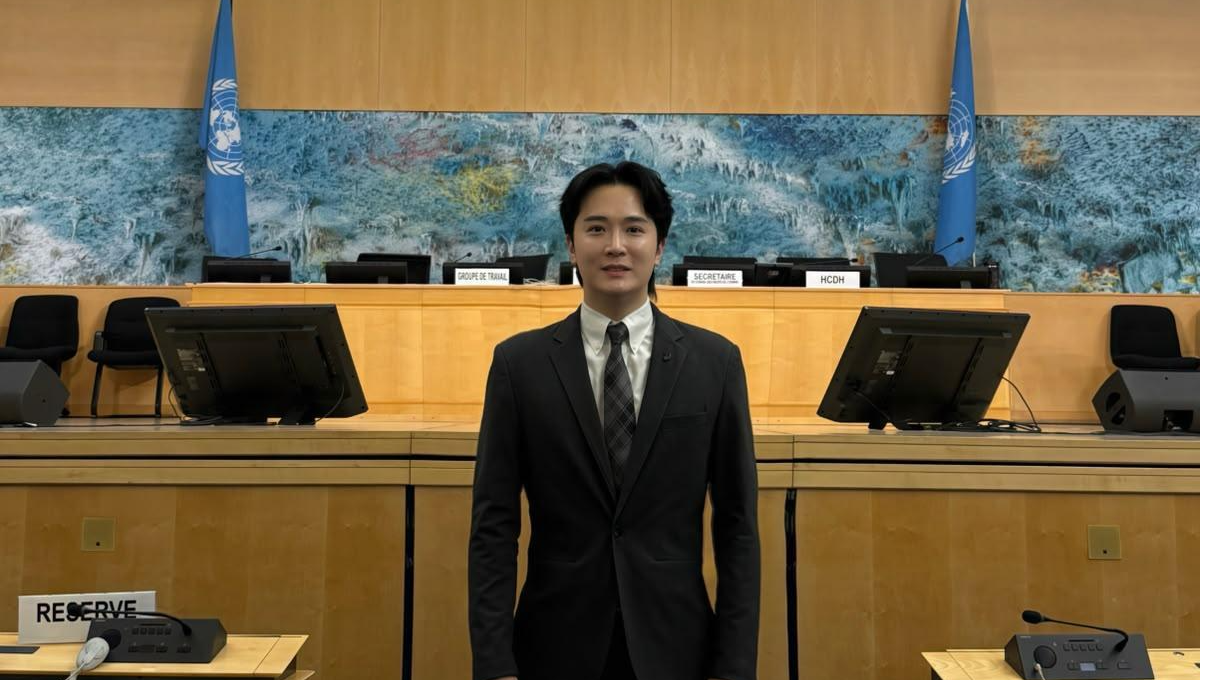
A medical expert from the Hong Kong Special Administrative Region has called for compassionate and equitable deployment of artificial intelligence to address global development disparities.
Kevin Lau Chung-hang, who was awarded the HKSAR government’s Medal of Honor and founder of Trinity Medical Group, told the ongoing 63rd session of the United Nations Human Rights Council in Geneva that technological progress must serve human dignity while highlighting Hong Kong’s role as a bridge for international cooperation.
“AI will read the scan the doctor must still hold the hand,” he said, adding that intelligence without compassion remains mere computation.
ALSO READ: HK-listed firm-developed AI lung drug reverses aging markers in study
Lau, who’s also a practicing radiologist and founding convener of the Hong Kong Youth Professional Global Advocacy, spoke at a side event entitled “AI for a Better Future”, co-hosted by the Permanent Mission of the People’s Republic of China to the UN Office at Geneva and the China NGO Network for International Exchanges.
Drawing from his frontline experience in the HKSAR’s hospitals, Lau noted how AI has been transforming local care, saying the city’s Hospital Authority currently operates 15 AI models across public hospitals, including automated systems that triage 2,000 chest X-rays daily.
However, he highlighted critical global workforce shortages, citing World Health Organization projections of a deficit of 10 million health workers by 2030. In the WHO African Region, the current workforce meets just 43 percent of demand, with nations like Ghana having only three radiologists per million people, he said.
ALSO READ: Hong Kong banking on AI, robotics acumen
Meanwhile, 2.2 billion people remain offline globally, further widening inequalities. To address these gaps, Lau pointed to practical solutions, including portable AI medical-imaging units developed in China and weighing under 25 kg. Deployed in rural Kyrgyzstan, they now deliver rapid tuberculosis screenings for up to 400 patients daily, with each scan completed in just 15 seconds.
To support global capability building, Lau said China’s frontier AI models are “open-weight” that can be downloaded and deployed at a fraction of the cost.
He also noted key international initiatives, including that by the Shanghai-based World AI Cooperation Organization -- the world’s first intergovernmental organization dedicated to AI cooperation.
READ MORE: Global tech talent meets in HK to advance AI applications
Lau emphasized Hong Kong’s role as a bridge for global cooperation, noting that Cyberport’s Artificial Intelligence Supercomputing Center, along with the Shenzhen-Hong Kong-Guangzhou cluster, ranked as the world’s No 1 Global Innovation Cluster for the second consecutive year in the World Intellectual Property Organization’s Global Innovation Index.
“Development is not a favor granted by the strong. No child offline, no patient unseen, no nation left behind,” he said.
