

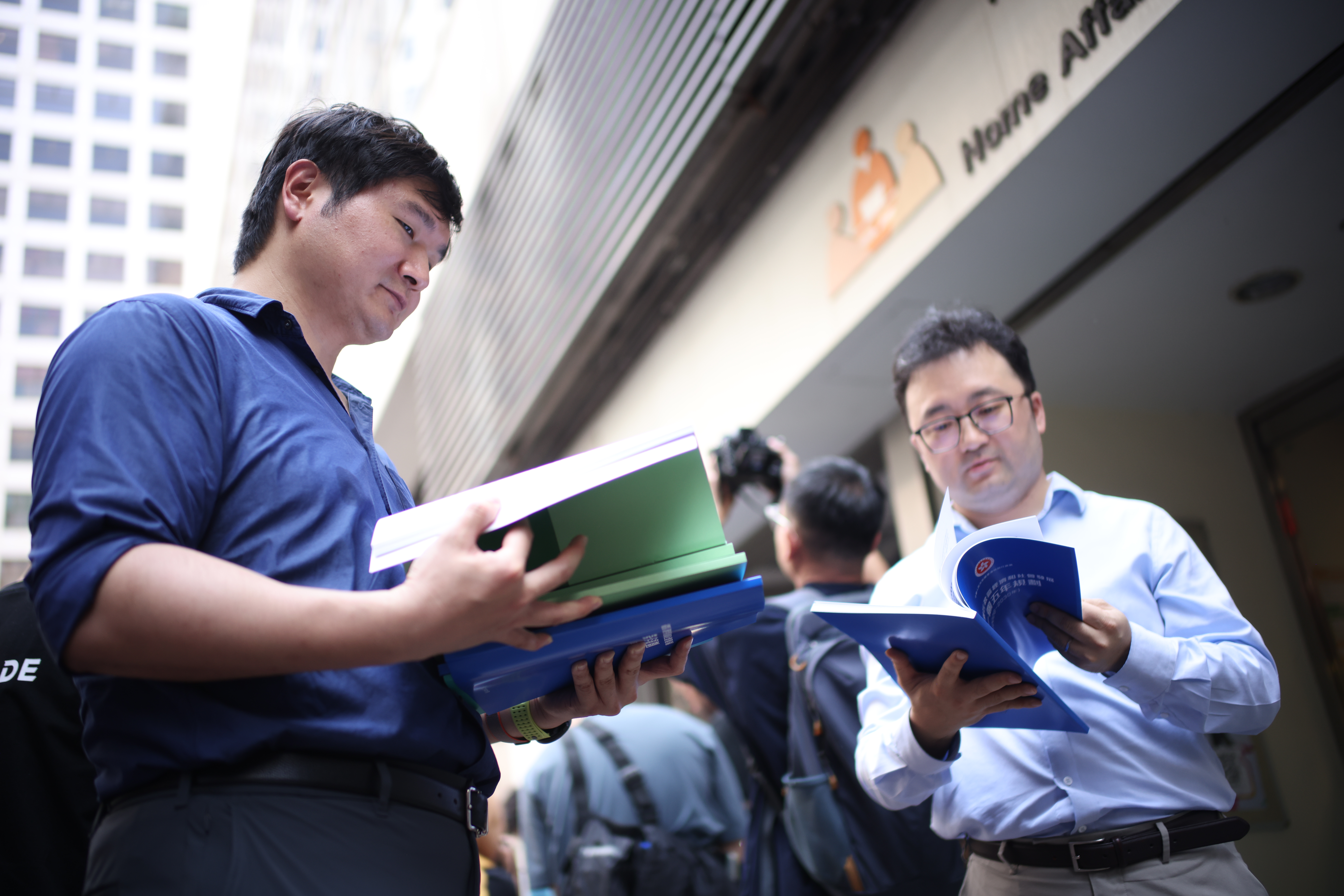
This is a historic moment, both for the governance of the Hong Kong Special Administrative Region and for its bet on a transformative, fledgling industry: the low-altitude economy (LAE).
The SAR has released its first-ever Five-Year Plan for Economic and Social Development (2026-2030), devoting a dedicated section to developing the LAE and elevating the city's ambition to become "an Asia-Pacific hub for innovative low-altitude application. "
Among its provisions, the Plan formally enshrines the LAE as a strategic pillar and, notably, advocates for the establishment of an international LAE cooperation organization with the nation.
ALSO READ: CE: HK residents to enjoy higher income, improved city in 5 yrs
This ambition is rooted in, though not explicitly dictated by, national planning. The National 15th Five-Year Plan (2026-2030), adopted in March, instructs the HKSAR to "consolidate and elevate its status as an international financial, shipping, and trade center and international aviation hub" — reaffirming aviation as the central government's core mandate for the city.
Hong Kong's low-altitude push, a self-initiated extension of that national aviation-hub mandate, casts the city's role in cautious, facilitative terms — leading and bridging the LAE industry across the Asia-Pacific region, both in rule-setting and industrial standards.
"The timing could not be better, especially given current geopolitical considerations," Tan Gangyi, head of the Low-Altitude Economy Institute at Huazhong University of Science and Technology, told China Daily.
"Building an ecosystem is the best way to align with the nation's 15th Five-Year Plan and embrace drones and low-altitude aviation as the next phase of economic transformation," said Tan, who signed a memorandum of understanding with Hong Kong on cross-boundary commercial LAE cooperation last week.
ALSO READ: HK's 5-year plan, policy address aim to improve housing, help grassroots
The Plan's provisions are specific and layered in support of this ecosystem: The city will formulate and implement an Action Plan on Developing the Low-Altitude Economy, which, according to Mable Chan, secretary for Transport and Logistics, will cover legislative amendments, standard-setting, and infrastructure development planning.
Regulatory framework-building and standard-setting, combined with infrastructure build-out, will be the city's focus in developing the LAE, while the manufacturing of drones and electric vertical take-off and landing aircraft is left to mainland players. Advancing research, cultivating talent, and facilitating manufacturers' global expansion assign Hong Kong a threefold role — "leading, bridging, and demonstrating" — according to the Plan.
The Plan also prioritizes cross-boundary low-altitude logistics within the Guangdong-Hong Kong-Macao Greater Bay Area, calling for an integrated, scaled cross-boundary network built on the region's industrial base and geographic proximity, alongside broader efforts to knit Hong Kong International Airport into a multimodal transport web spanning major cities across the Guangdong-Hong Kong-Macao Greater Bay Area.
"This reflects a highly strategic vision," said Su Hui, chair professor in the Department of Civil and Environmental Engineering at the Hong Kong University of Science and Technology. Su, who spent 17 years at NASA, said the LAE will be both an engine of economic growth and a vital backbone of smart city management.
ALSO READ: HK's 5-year plan lists 105 indicators to build ‘open, prosperous’ city
"This is a notably proactive blueprint to serve our nation in the best way we can," said Sunny Tan, chairman of the Hong Kong Productivity Council.
To build "a competitive" LAE ecosystem, the council — as a technical partner of the LAE Regulatory Sandbox — "will actively support technology testing and validation, the development of standards and certification systems, the application of regulatory technology, talent training, and the development of cross-boundary application scenarios," Tan said.
The Northern Metropolis, a focal point of the Plan, will provide application scenarios for the LAE, with its ample space, well-developed institutional framework, and cross-boundary flow of data, technology, and talent, said Kazaf Tam Chun-kwok, legislator for the New Territories North constituency, which covers the Northern Metropolis area.
With its ready-made "cross-boundary synergy," Hong Kong will play a role in shaping international low-altitude economy standards, Tam told China Daily.
READ MORE: HK highlights innovation-industry integration in GBA collaboration
"The Plan is pragmatic in this respect," Su said. Having consolidated the implementation experience from the first batch of LAE Regulatory Sandbox projects, the Plan sets a goal of regularizing "the more mature projects" and formulating relevant standards.
So far, more than 140 sandbox applications have been approved by the Civil Aviation Department, with over 20 projects — ranging from facade cleaning to infrastructure inspection — now operating on a regular basis. The more advanced "Regulatory Sandbox X," launched in November 2025 to test unmanned traffic management systems, non-conventional aircraft and cross-boundary operations, drew more than 100 applications, with pilot batches rolling out through 2026.
Under the Plan, Hong Kong will test more technically complex application scenarios — including cross-boundary routes, low-altitude passenger-carrying aircraft, unmanned aircraft traffic management systems, and multi-user shared platforms — to accelerate cross-boundary low-altitude logistics activities.
This is evidence-based, incremental institution-building — a rational hedge against a sector whose global business models remain unproven. The Plan, in this regard, is banking on "attracting more buyers" by fully leveraging the city's free and open economy.
The top-level design merits credit for its restraint, though academics say it could be "more ambitious" in testing application scenarios.
Still, the Plan faces a hard deadline: legislation. Dedicated rules for non-conventional aircraft remain in the drafting stage, with officials targeting Legislative Council consultation only next year. Legislator Elizabeth Quat, founding president of the Greater Bay Area Low-Altitude Economy Alliance, has pressed for the appointment of a dedicated Low-Altitude Economy Commissioner — and even a statutory Low-Altitude Authority — to end the current fragmentation.
Contact the writer at: jessicachen@chinadailyhk.com
