

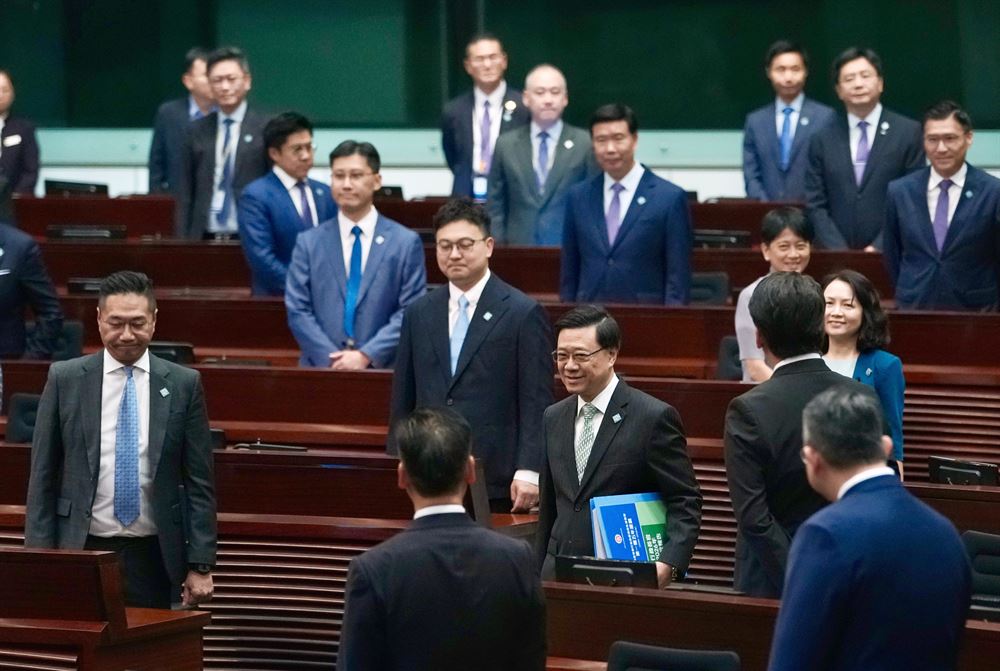
The Hong Kong Special Administrative Region Chief Executive John Lee Ka-chiu said the government will take the lead in actively exploring and promoting the use of renminbi to settle government expenditure under suitable scenarios, noting the administration will further enhance the offshore renminbi market’s capacity to support the real economy, enabling trade, investment, financing and cross-border business dealings to grow.
Delivering the city’s inaugural Five-Year Plan for Economic and Social Development (2026-30) and the fifth Policy Address of his administration on Wednesday, the chief executive said the SAR aims to strengthen its role as a global offshore financial hub in three key areas -- renminbi business, asset-and-wealth management, and risk management activities.
“Hong Kong, as an international financial center, must firmly demonstrate its international positioning by leveraging its open financial markets to attract global capital, talent, and financial enterprises,” he said.
“We will strive to actively consolidate Hong Kong’s status as a hub connecting global financial markets, facilitating international capital to seize the development opportunities available in our country and in Asia, while assisting Chinese mainland enterprises and capital in pursuing high-quality global expansion.”
ALSO READ: LIVE: HK blueprint eyes enhancing livelihood, economic breakthrough
The government, he said, expects commodity trading to be a major scenario of renminbi internationalization in the future.
“We will further enrich the variety of renminbi-denominated and settled commodity futures and options traded in Hong Kong, while encouraging and supporting the use of renminbi for pricing and settlement in spot commodity transactions. We will develop renminbi-denominated commodity trading and pursue differentiated and complementary development with the mainland market, including collaboration with the Qianhai Mercantile Exchange,” Lee said.
Other measures planned to bolster the SAR’s offshore renminbi business include increasing liquidity, expanding product supply, supporting the inclusion of renminbi counters under Southbound Stock Connect trading, and promoting the advantages of the city’s offshore renminbi services to overseas markets.

On asset-and-wealth management, the chief executive said Hong Kong will continue to raise its asset allocation and wealth management functions by enhancing the regulatory and market infrastructure, enriching the professional services ecosystem, diversifying asset management instruments, and boosting tax regimes for funds, single family offices, as well as carried interest.
Diversifying asset management instruments is in the form of equity and bond market enhancements. In the equity market, Hong Kong Exchanges and Clearing, which runs the city’s bourse, and Qianhai Equity Exchange will deepen collaboration and link up more quality mainland enterprises with the international capital market through Hong Kong’s listing platform.
ALSO READ: Hong Kong targets innovation spending at 3% of GDP after 2030
In the bond market segment, the government will encourage more mainland institutions to invest in Hong Kong’s bond market, expand the channels and trading volumes in respect of the Stock Connect, Bond Connect, Wealth Management Connect, and the Private Equity Connect, as well as establish an electronic fixed income and currency trading platform catering to local markets and renminbi internationalization.
For risk management activities, Hong Kong will deepen regulatory cooperation with the mainland and overseas markets, and fully leverage its competitive edges in the global insurance, reinsurance and capital markets to advance the synergized development of traditional insurance and non-traditional risk management tools.
“Thus, we can unleash the synergy effect of multilayered risk transfer and pooling mechanisms through insurance linked securities, captive insurers, and a marine specialty risk pool, consolidating our strategic role as a regional and global catastrophe and specialty risk management hub,” Lee said.
