

Frederik Anseel aims to cultivate future biz leaders at HKUST, leveraging the city’s strategic position in tech development
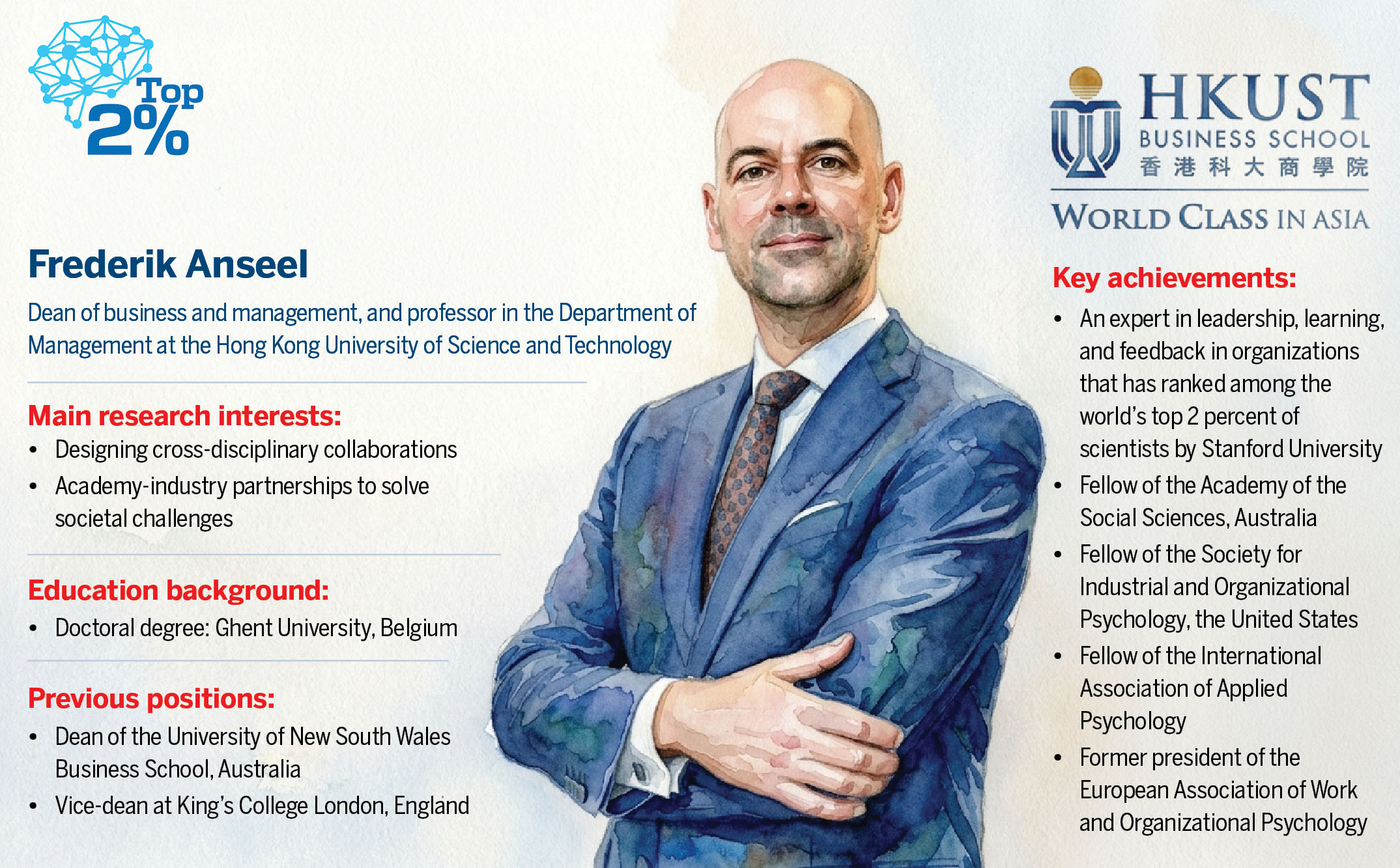
Editor’s note: What draws the world's leading scientific minds to Hong Kong? In this series, China Daily speaks with locally based researchers ranked among the global top 2 percent of scientists, exploring the frontiers of their current research and uncovering why they chose to make Hong Kong their home.
It didn’t take long for Belgian-born scholar Frederik Anseel to decide to relocate to the Hong Kong Special Administrative Region, after working on several continents at top universities, as he wants to be part of two things — China and its booming artificial intelligence development.
Anseel took the helm of the Business School at the Hong Kong University of Science and Technology (HKUST) in February. In a recent exclusive interview, he told China Daily that he was drawn by Hong Kong’s forefront standing in the AI wave, backed by the Chinese mainland’s innovation and technology ecosystems, and the city’s pragmatic culture and bridge role connecting the mainland.
A well-acclaimed scholar in organizational leadership, Anseel was ranked by Stanford University among the “World’s Top 2% Scientists” last year. Reflecting on his days in Europe and Australia, he observed a pervasive curiosity about China’s rapid emergence as an economic and innovation superpower, which he described as “probably today only matched by the United States”. Many such discussions in the past five years boiled down to two key words: China and AI, he said.
READ MORE: Wanna be part of what’s happening in China and booming AI
“But if you are far away from everything, you want to be part of it. … You want to be part of the place where AI is really booming,” Anseel said of his transcontinental relocation.
In his view, the opportunity to join HKUST, which excels in technology and AI development, allows him to remain relevant and tap into the mainland’s thriving technology and innovation ecosystems.
Since moving to the city, Anseel has experienced some pleasant surprises — Hong Kong’s deep cultural reverence for universities, learning, and research, as well as its pragmatic, results-oriented attitude.
“In other places, there is a lot of talk first about grand strategies,” he said. “Here, people don’t strategize a lot, but do things. There is a culture of underpromising and overdelivering.”
Despite a turbulent global trade landscape, Anseel remains optimistic about Hong Kong’s geopolitical importance.
“Even if we live in a world that becomes more multipolar, people will still need places where they can meet and do business,” he said. “The Hong Kong SAR is part of China, but it’s also international. So it provides a place for international business.”
The city’s common law system, linguistic diversity, open markets, and direct access to mainland technological innovation continue to underpin its appeal to global enterprises, he said.
While acknowledging that Hong Kong’s role has evolved over the past decade, he said that it has only become more critical as a gateway — both for foreign investors entering into Chinese markets, and Chinese enterprises expanding abroad.
“I think Hong Kong should embrace these distinct advantages,” he said.
To strengthen ties with the mainland, Anseel visited Shanghai and Xiong’an New Area in Hebei province in the past few months to connect with local industry, education and business partners. “The plan for the coming months for me is to visit as much as possible to connect with people and learn and see how we can do that best,” Anseel said.
Before joining HKUST, Anseel served as dean of the University of New South Wales Business School, leading the school to become one of the most successful business schools in Australia. His career also included tenures as vice-dean at King’s College London in England, and as head of department and talent management adviser to the rector at Ghent University in Belgium.
Tech-savvy future
Anseel is set to maximize Hong Kong’s bridge roles and its technological strengths to cultivate a new generation of business students equipped with crucial skills for a technology-centric era.
Anseel said business schools globally are grappling with the growing role of technology in the business world. “Now, business is technology,” he said. “So business students now need to be very good in technology and then business.”
He said that while students still require foundational training in traditional disciplines, they must increasingly pursue dual expertise in engineering or technology.
In 2003-04, HKUST became the first higher education institution in Hong Kong to launch an undergraduate dual-degree program integrating technology and business knowledge, the Dual Degree Program in Technology and Management, and Anseel hopes to expand such initiatives to the master’s level.
“What we (the Business School) want to create is more projects that students can do, for instance, together with engineering,” he said.
For instance, Master of Business Administration students could form teams with engineering students to strategize marketing, initial investment, and capital funding for tech startups.
ALSO READ: HKUST-developed AI model 'able to forecast storms 4 hrs ahead'
A key project in his business education vision is HKUST’s upcoming medical school, approved in November by Chief Executive John Lee Ka-chiu, as part of broader endeavors to develop Hong Kong into an international hub for medical training, research and innovation.
Anseel said the medical school, slated to enroll students by 2027, can serve as a testing ground for the business-plus-technology approach.
“In medical school, we (faculty of the Business School) could provide unique expertise in teaching, like healthcare management. How do you manage a hospital? How do you manage information systems?” he said.
Future curricula could encompass hospital financing, healthcare policy, and health economics.
He said the school can also integrate its research in consumer behavior to help develop policies that encourage healthier lifestyles among the population.
Contact the writers at williamxu@chinadailyhk.com
