

Parallels between industries create strong argument for investment
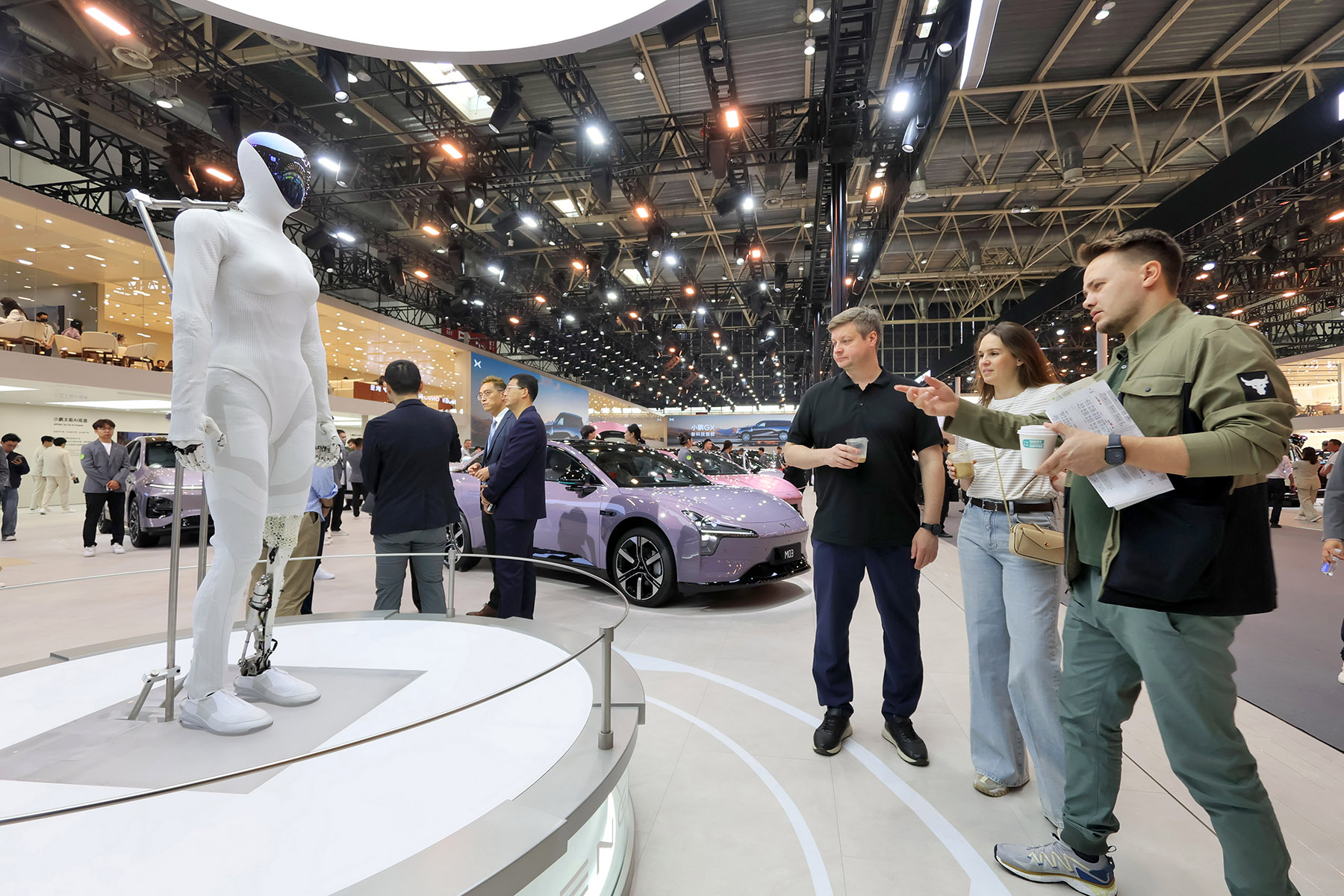
From BYD to Chery, XPeng to Leapmotor, around 20 automakers have invested in the humanoid robot sector. It highlights an industrywide strategic shift toward embodied intelligence — driven by deep synergies between the automotive and robotics industries in technologies, supply chains and manufacturing systems that enable seamless capability migration.
XPeng secured more than $900 million in the first round of financing for its robotics business last week, pushing the unit's post-money valuation above $6.3 billion. The deal marks the largest single private equity fundraising round in China's embodied intelligence sector to date, underscoring investor confidence in automakers' push into next-generation robotics.
As a pillar of XPeng's physical AI strategy, the Iron humanoid robot is built on full-stack in-house hardware and software development. The company plans to start mass production by the end of 2026 and begin official deliveries across China and overseas markets in 2027.
READ MORE: Robot on the line
He Xiaopeng, CEO of XPeng, projected that the full life-cycle revenue and gross margin per Iron robot will surpass those of the company's passenger vehicles. Since June, He has also served as CEO of the robotics business.
Li Tengfei, vice-president of Leapmotor, noted that NEV companies — particularly those with full in-house R&D capabilities — are among the best-positioned to develop robots. Leapmotor confirmed last week that it has formulated plans in the robotics field. The company also expanded its strategic cooperation with FAW to include embodied intelligent robots.
Meanwhile, Nio announced that its autonomous driving chief Ren Shaoqing has founded an embodied intelligence startup, with Nio set to make a strategic investment.
The primary driver behind automakers' enthusiasm for humanoid robots lies in inherent industrial synergies. Core NEV components, including motors, electric controls, sensors and chips, as well as precision manufacturing expertise, are highly transferable to robot development.
BYD's first commercial humanoid robot, Xiaodi, made its global debut earlier in August. An insider close to BYD revealed that Xiaodi heavily reflects the company's automotive roots, with over 80 percent of its technologies developed in-house and largely repurposed from BYD's electric vehicle systems and intelligent driving technologies.
Beyond technical overlap, automakers boast mature supply chain management, rigorous vehicle-grade quality standards and large-scale mass production experience — systematic engineering strengths that most pure-play robotics startups lack.
Zhang Guibing, executive vice-president of Chery Automobile, pointed out that the auto and robotics industries share roughly 70 percent synergistic potential, particularly in supply chain and manufacturing management. While automobiles focus on intelligent mobility, humanoid robots extend capabilities to physical execution, and the technological boundary between the two is blurring amid advancing automotive intelligence.
"More than 85 percent of the entire robot supply chain overlaps with XPeng's automotive supply chain. Therefore, we are very confident that XPeng's robots will achieve industry-leading cost competitiveness," He said.
Vehicle assembly workshops — known for high labor intensity — serve as ideal real-world test beds for humanoid robots, enabling automakers to build a closed loop of in-house scenario deployment, iteration and validation.
Tesla's Optimus robots are operating in its factories worldwide. Its Shanghai Gigafactory has deployed 50 Gen 3 robots since the second quarter of 2026 for tasks such as seat installation and quality inspection, building practical experience to support global robot deployment.
Dongfeng Motor's humanoid robots have also been deployed on the front lines of auto production, handling production line material sorting and smart park inspections — tasks that require high-intensity, repetitive labor.
Cross-industry expansion also comes as intense domestic price competition squeezes auto profit margins, and maturing autonomous driving technology may limit future vehicle sales growth. To diversify revenue streams and foster new growth curves, automakers are accelerating investments in emerging tracks such as robotics.
Chery's robotics arm, Aimoga Robotics, is preparing for an IPO to raise funds for sustained technological R&D, Zhang said earlier in August.
Zhang compared today's robotics sector to the early-stage NEV industry — characterized by a surge of startup entries and intensifying competition. He predicted ongoing industry consolidation and cost competition, saying that automakers' vast engineering and software talent reserves give them inherent advantages in robotics iteration.
However, He noted that the technical challenges and innovation difficulties of advanced humanoid robots are at least 20 times greater than those of smart cars. Robots require three types of models operating at different thinking speeds — ultrafast, medium and slow — with autonomous driving corresponding to the medium-speed model.
The distinction lies in the operating environment: autonomous driving navigates structured environments with clear rules, whereas humanoid robots must operate in the unstructured physical world, making task composition and motion control far more complex.
ALSO READ: Robotics boom fueling nation's tech ambitions
Robots also need to develop models for whole-body motion control, data privacy, fall prevention and low-battery protection — capabilities that have no parallel in the automotive field, He said.
Shi Shuai, a partner in the automotive team at Roland Berger China, said humanoid robotics remains in its early commercial stage. Most global deployments are still confined to tests and prototype validation, with large-scale mass adoption likely years away. Still, rising labor demand and falling industry costs have unlocked a substantial long-term upside.
The consulting firm predicted that the global humanoid robot market will reach $300 billion by 2035 under baseline scenarios and $750 billion in optimistic cases. The sector could exceed $4 trillion by 2050 — rivaling the current scale of the global automotive industry — if technological iteration, supply chain maturity and application expansion maintain their current momentum.
Contact the writers at caoyingying@chinadaily.com.cn
