

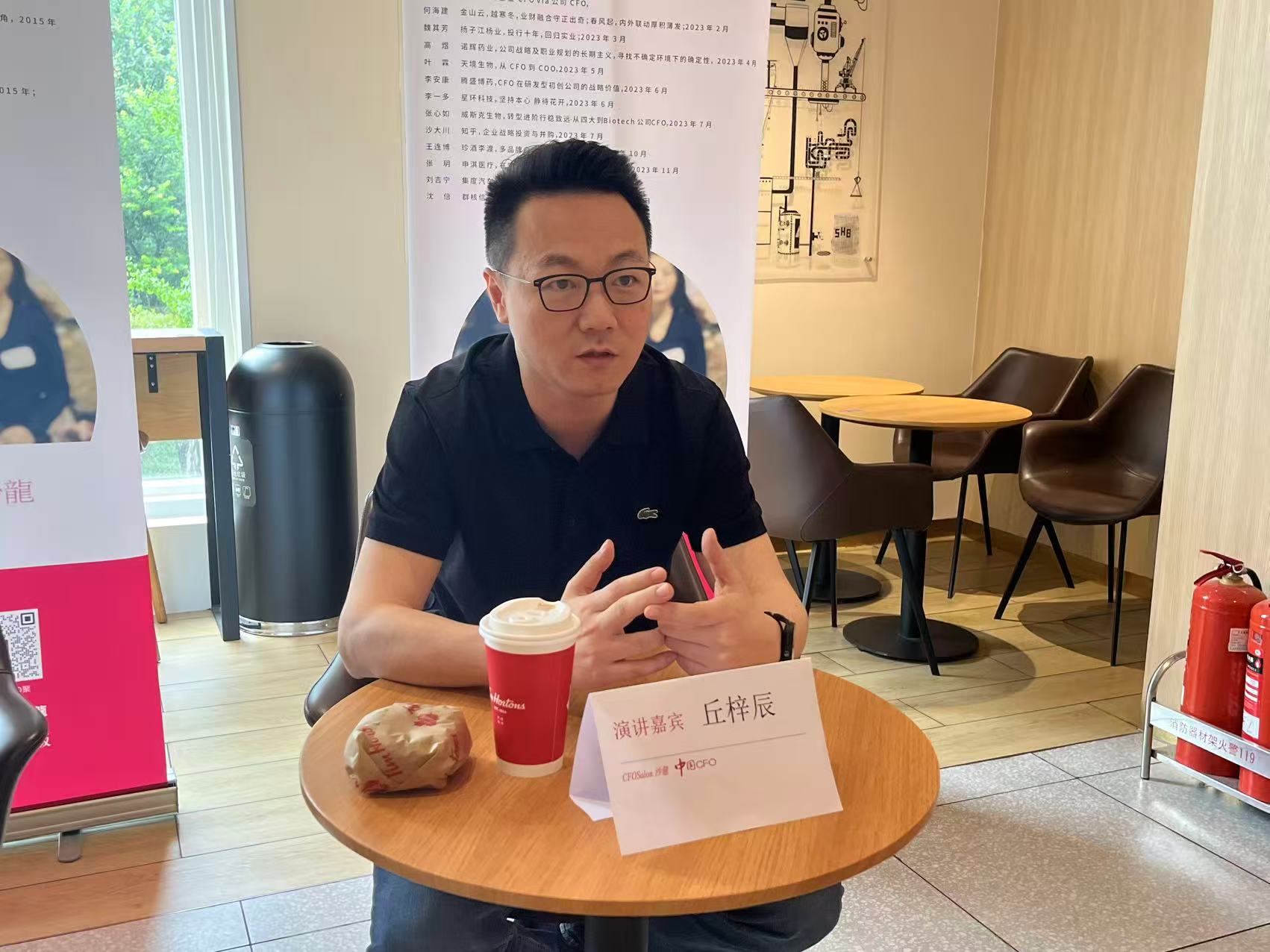
Zichen Qiu, co-founder and chief financial officer of 0602, discussed the economics of AI hardware and the evolving role of CFOs in early-stage startups during a recent CFO Salon session in Beijing.
Delivering his keynote at the Tims Coffee store on Golden Tree Street on July 4, he drew on his extensive frontline experience spanning multinational corporations, internet platforms, venture capital, and AI hardware startups and outlined the company's strategy for combining artificial intelligence with original intellectual property.
From finance to AI entrepreneurship
Sharing his career trajectory, Qiu said he started at a Big Four accounting firm and later joined GE as a Financial Management Program (FMP) trainee. He eventually became CFO of Meituan Longzhu Capital before co-founding the AI hardware startup 0602 Digital Technology.
Over the course of his career, he has worked across Fortune 500 companies, major internet companies, consumer investment firms, and tech startups. He summarized his career transition as a threefold shift: "From heavy to light (industry shift), large to small (company type shift), and from an internal to an external focus (finance function shift)." At the core of this journey has been a willingness to embrace industry trends and reposition his capabilities as circumstances change.
At 0602, Qiu is working on Wander Puffs, an original IP developed as the centerpiece of an AI-powered companion ecosystem for families. The company is seeking to build more than a plush toy connected to a large language model, he said.
By integrating anthropomorphic characters, long-term memory technology and a defined fictional world, the product is designed to evolve from "accompanying you" to "understanding you" and ultimately "empowering you", positioning it to tap into a family-companionship market estimated at 100 billion yuan.
MORE CFO SALON ARTICLES
- Navigating market cycles, breakthrough growth for service industry going global
- China biopharma sector entering new phase of global expansion, CFO Salon hears
- Jessie Zhu stresses long-term layout in general electronic testing industry
- ‘Embrace the trend, accompany with resilience’
- Exploring the path of fitness technology
0602 embeds a voice-interaction module in plush toys and uses post-training and fine-tuning to adapt a general-purpose model. It incorporates psychological frameworks and dialogue mechanisms to make conversations less like mechanical question-and-answer exchanges.
The intended users include children, women aged 18 to 30 and mothers seeking emotional support, said the CFO. The key competitive barrier for AI companions lies not in "being able to speak," but in "knowing how to relate to you" and creating a safe space where users feel heard, understood, and accompanied.
Differentiation built on IP, agent systems, recurring revenue
Kevin Kelly once predicted that much of today’s AI is built for calculation and task execution – mere utilities. But the next great technological shift will be emotional agents – AI capable of mirroring and understanding human feeling. Synthetic emotional intelligence will become the most valuable layer of all technology, far more irreplaceable than raw computational power.
Qiu broke down his company's product strategy into three layers: "what everyone has," "what we do better", and "what no one else has." These refer, respectively, to capabilities available to most market participants, capabilities that 0602 aims to deliver more effectively and assets it considers distinctive.
The first layer, "what everyone has," is the basic "hardware plus software-as-a-service (SaaS)" model used across much of the AI hardware sector. Hardware is generally sold once, while model calls, voice interactions and AI token usage create ongoing costs, he said. A one-off sale therefore cannot sustain the business model on its own, said Qiu, adding that long-term viability depends on recurring revenue from subscriptions, top-ups, or value-added services that can cover ongoing service costs.
“What we do better", the second layer, is the psychology-based agent system. A general-purpose large language model can provide standardized information, but a companion product must also sustain a dialogue and ask questions that encourage self-expression rather than merely supply answers, he said. To support this approach, 0602 has built an agent system on top of a large language model, integrating a psychology-focused knowledge base, dialogue datasets, and the Wander Puffs story world. Repeated interactions are intended to help the system develop long-term memory and build a more personalized relationship with the user.
The third layer, "what no one else has", is the original IP, explained Qiu. He categorized IP development into content-driven approaches, such as Disney, and image-driven approaches, such as Sanrio. While the former builds emotional connections through stories, characters, and worldviews, the latter relies on recognizable visual symbols to build awareness. 0602 has opted for the more challenging content-driven route, hoping users will love not just the character's appearance, but also the worldview and emotional connections behind it.
While discussing the relationship between AI and consumer goods, Qiu distinguished between "AI+" and "+AI." The former refers to AI-native products that would cease to exist without AI; the latter adds AI capabilities to existing consumer goods, IP, or use cases to enhance emotional value and interactivity and deepen relationships with users, he added.
For 0602, AI is not merely a feature added to a toy, but the core capability that transforms original IP from a static ornament into a source of sustained dialogue and long-term companionship.
Screenless devices, growth flywheel of AI hardware
Explaining 0602's growth flywheel, its CFO defined value creation as new supply minus existing supply and switching costs. Based on this logic, the company’s new supply includes original IP, the agent system, user co-creation, accumulated dialogue data, emotional feedback, and medium- to long-term memory. Only through the continued accumulation of these "new supply" elements can a product drive deeper user engagement beyond a one-time purchase, thereby opening new distribution channels, he said.
Pointing out that smartphones remain the dominant devices in the era of the attention economy, Qiu said the common challenge facing new devices such as AI toys, smart glasses and smart bracelets is how to redirect a portion of users' daily attention from screens to screenless AI devices.
For AI hardware, the focus should not merely be on the potential size of a specific toy category, but on how new devices can capture attention and drive frequent LLM interactions and token usage, he added.
From a longer-term perspective, emotional companionship should not be limited to static ornaments or single functions; it should evolve toward dynamic companion products for families. This value comes not just from physical utility. It also stems from users' emotional attachment to the IP, their connection to its worldview, and the familiarity built through long-term memory, he said, adding that in this sense, competition in AI hardware extends beyond technology to use cases, content, companionship, and business models.
Q&A session
Question 1: How can an original IP truly resonate with users and generate emotional value?
Zichen Qiu: Visual appeal drives the initial purchase, but many successful IPs resonate because they evoke childhood memories or allow users to project their emotions onto the characters. For AI toys, appearance is just the start. The key question is what makes users turn them on and in what situations. We want the product to be a safe space when users feel down or need to vent. Appearance gets the product into the home; dialogue and companionship keep it in use.
Question 2: AI dialogue incurs ongoing token costs. How is the payment model designed?
Zichen Qiu: One-time hardware sales cannot cover long-term token costs, so recurring revenue is essential. We have our own app for top-ups, with a six-month free trial to encourage regular use. In China, a flat monthly SaaS subscription is not always practical, so we charge for value-added features such as additional character voices and voice cloning. For example, children can hear stories told in their mother's voice. These features provide a clearer reason to pay than a standard monthly subscription fee.
Question 3: The AI hardware market is highly competitive. How do you improve retention through use-case selection?
Zichen Qiu: AI hardware has a complex value chain, and margins can be thin after distribution, marketing, and overhead costs. We initially targeted women aged 18 to 30, but activation and retention declined after three months. We later saw greater use in child-focused scenarios, where the product could engage children and give parents more time. After this adjustment, retention improved and average usage time rose from 15 minutes to about one hour. The lesson is that product-market fit must be demonstrated through specific use cases and measurable behavior, not broad concepts.
Question 4: How has your role changed in the transition from CFO to co-founder?
Zichen Qiu: In a startup still moving from zero to one, the CFO's responsibilities extend beyond conventional financial reporting and fundraising. I work with the product and technology teams, act as a product manager, and bring investor feedback from roadshows into management discussions with the product team and CTO. Early-stage entrepreneurship requires wearing multiple hats and getting involved beyond one's professional domain. Co-founders need complementary skills and must balance different perspectives. It is not just a change in title; it requires continually deciding when to accelerate and when to slow down while balancing resources, product priorities, team needs, and risks. This places greater demands on a CFO's capabilities.
