

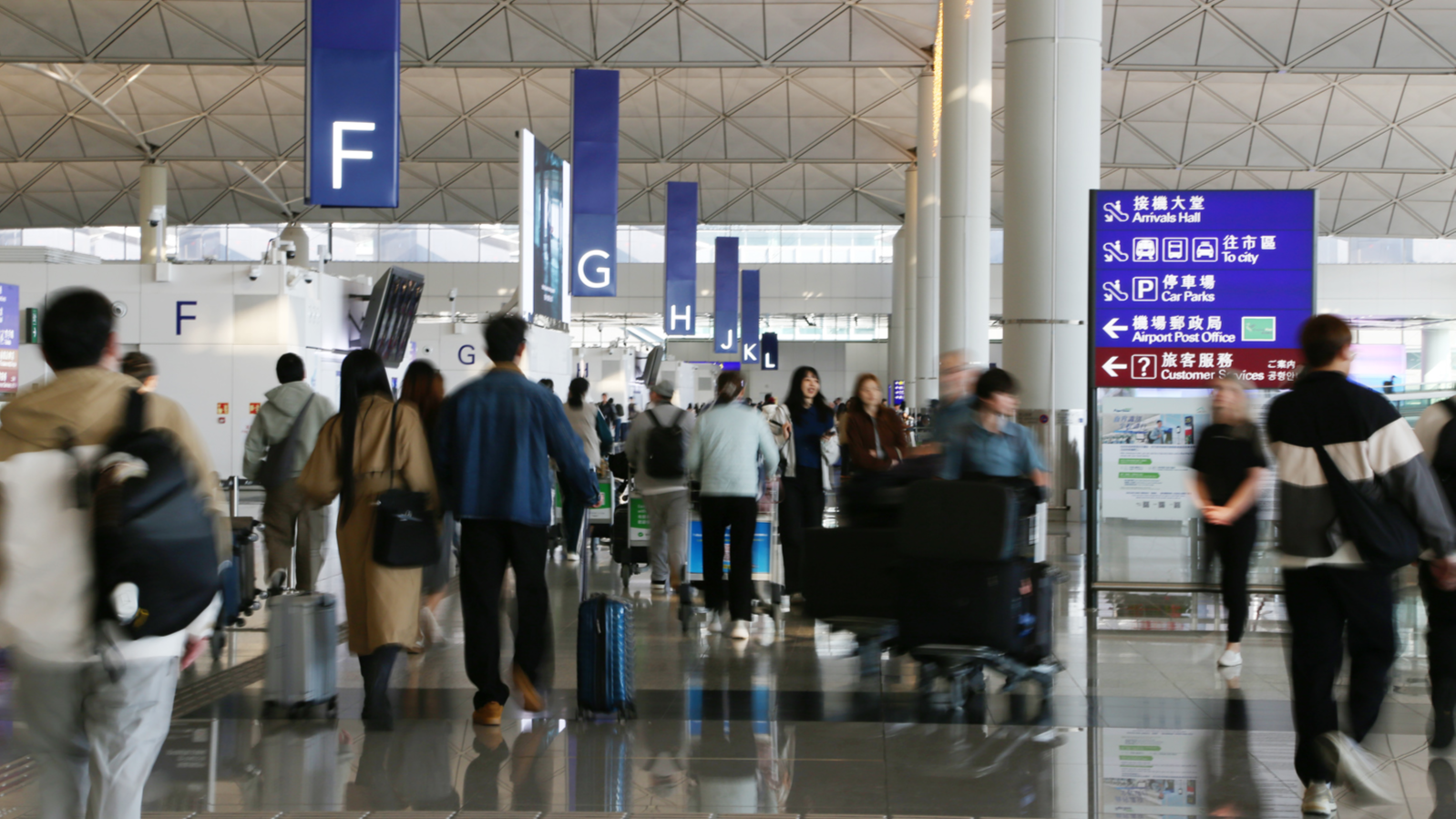
The Hong Kong International Airport recorded 5.62 million passenger trips in July, up 8.4 percent from the same period last year, according to the Airport Authority Hong Kong.
The AAHK said in a statement that flight movements rose 1.7 percent year-on-year to 34,230 last month as a double-digit increase in transfer/transit passengers drove overall passenger growth. Most markets expanded while the decline in the Middle East continued to narrow.
Over the first seven months of the year, passenger volume saw an 11.2 percent year-on-year growth to 38.4 million, while flight movements increased by 4.0 percent to 234,905, the AAHK said.
On a 12-month rolling basis, passenger volume rose by 12.6 percent year-on-year to 64.8 million, while flight movements went up by 5.3 percent to 403,670, it added.
ALSO READ: HK visitor arrivals rise 12% as aviation hub role strengthens
On cargo front, the AAHK said cargo volume declined 1.9 percent year-on-year to 422,000 tonnes last month.
Transshipments and imports recorded 14.5 percent and 2.9 percent growth, respectively, while exports declined by 8.4 percent year-on-year, the AAHK said.
By region, Southeast Asia and the Chinese mainland remained resilient, helping to offset softer traffic from Europe and North America amid shifting global trade patterns, it added.
From January to July this year, cargo traffic grew 14 percent in Southeast Asia and 11 percent in Europe, offsetting the declines in North America and the Middle East, and driving up total cargo throughput over the seven-month period by 3.2 percent year-on-year to 2.92 million tonnes.
READ MORE: HKIA sees 14.7% rise in passengers, HK$2.04b in profit in FY2025/26
The AAHK added that, over the past 12 months, total cargo throughput grew 3.2 percent year-on -year to 5.16 million tonnes.
“The global air cargo market continues to navigate a complex operating environment shaped by changing trade landscape,” Chapman Fong, AAHK director for hub development, was quoted as saying in the statement.
“Despite these challenges, HKIA’s extensive air network and exceptional efficiency enabled air cargo operators to adapt to the changing circumstances by making rapid cargo rerouting and logistics arrangements.”
He added that the growth in markets like Southeast Asia and the mainland underscores the resilience of the Hong Kong Special Administrative Region's role as a leading international cargo hub.
